Whenever I come across new or prospective vegans online who express concern over not knowing what to prepare to eat for themselves, or who worry about lacking variety in what they do prepare, I'm glad that I always have dozens of links on hand to share. I had a discussion with someone a few days ago who'd expressed to me what a shame he feels it is that there are "so very many vegan food blogs" but "not enough vegan education blogs". The truth is that these many vegan food blogs do provide heaps of education about how to prepare delicious vegan meals. Many of them also touch upon nutrition or discuss vegan products which aren't food-related. They communicate to their readers that going vegan leaves you with so many wonderful options to explore when it comes to healthy (as well as absolutely decadent) eating -- and they do it with so much enthusiasm! Here's a collection of links to recipes that some of my favourite food bloggers have featured during the past few weeks:
Pineapple!
Just in time for what seems to be an abundance of cheap fresh pineapple at my local grocery store, Claire from Chez Cayenne has posted a simple recipe for Pineapple Salsa. She also posted a yummy-sounding and easy to make Grilled Pineapple recipe a few weeks ago (see photo from her blog at right) that I look forward to trying out this weekend. Just yesterday,  Joel Luks recommended to me on Twitter that I add frozen cubes of pineapple to smoothies, which sounds really delicious. Add to this that Allyson at Manifest Vegan shared a recipe for gluten-free Pineapple Walnut Muffins just a few days ago, so the list of things to make just grows and grows. It's funny, but just a month ago, I'd never purchased and eaten an actual pineapple. I'd always had it canned and pre-cut and today I've got four sitting on my kitchen counter -- yum! (If I've missed really good pineapple-related posts on any other vegan food blogs, please do let me know.)
Oh My!
I love scanning through the latest updates on the blogs I follow and stumbling upon posts that leave me a little wide-eyed. It usually happens when someone shares a recipe that stands out in some way or another -- either because it sounds wickedly indulgent, terribly delicious or just  plain old different. The Vegan Fried Pickles Meg posted about at The Snarky Chickpea definitely caught my eye (see photo from her blog at right). Last week's Deep Fried Strawberries by Lee over at The Vegan Version are definitely something I'd whip up as a decadent dessert for the right guest. So would the Choclava Mini-Tarts posted by Robin Robertson on her blog Vegan Planet -- after all, who can resist chocolate and baklava? Kelly Garbato's Creamy Vegan Mac & Cheese Pizza at The Perfect Pizza Press looks like a veritable carb-on-carb feast worthy of a movie night with friends. She shares her own recipe for it, but states that you can just take your favourite vegan mac & cheese recipe, heap it on pizza dough and then bake it until it's done.
Traveling Vegans
Laura Jill has been documenting her recent trip to China with stories and with scrumptious food photos. Take a look at her recent posts at LJ's Veganlicious Life to get an eyeful.
New (To Me) Websites
Speaking of gluten-free recipes, I recently discovered a new site which offers up plenty of them while also featuring baking and dining out tips, tutorials, product reviews and more. It's called xgfx and is run by the aforementioned Manifest Vegan's Allyson Kramer, happyveganface blogger Jessy Farrell and Cake Maker to the Stars blogger Kittee Berns. It's definitely worth exploring and bookmarking, whether you're avoiding gluten or not so go have a look.
Back in March, Leinana Two Moons (of Vegan Good Things) started up a blog called Vegan Sandwiches, asking readers to submit photos of their... favourite vegan sandwiches (or wraps and so forth). There hasn't been an update in a few weeks and I hope that it's still going. Why not pop over and submit a pic this week to see if it will help to keep it going?
Bring 'Em Back!
I do so very much wish that one of my favourite recipe blogs, Vegan for the People, was still updated regularly; it's been inactive for almost a year now. It's a great archive of interesting  recipe ideas -- often just things thrown together quickly that worked out beautifully, entertaining stories, gorgeous photos and product reviews -- but I want more! His posts covered everything from what he'd concocted with simple leftovers to recipes for things like Stuffed Zucchini Squash Blossoms and Somali Sambusas. I can't help but wonder if Mike K. is doing any other recipe writing elsewhere? Anyone know?
I've also been missing Melissa's posts over at The Papaya Chronicles. I love making (and devouring) her Leftover Potpie and her Three Sisters Stew. Melissa? Are you coming back to blog some more?
What are some of your favourite vegan food blogs? Please share them with everyone below!
Monday, May 30, 2011
What's Cooking?

Saturday, May 28, 2011
What This Vegan Eats
Neither chef, nor photographer, I'm nonetheless sharing a few more photos of things I've slapped together over this past week: Here's an easy-to-tweak favourite: Kitchen sink tofu scramble with organic tofu, red bell peppers, onions, heirloom rainbow carrots, potatoes and kale. I seasoned it with crushed garlic, nutritional yeast, turmeric, parsley, soy "bacon bits", black salt and freshly-ground pepper.
 A simple breakfast: Organic wheat squares with raspberries and unsweetened vanilla almond milk with mandarin oranges and sliced banana on the side.
 Here's some vegetable-lentil soup made with diced tomatoes, purple cabbage, red lentils, carrots, potatoes, green pepper, onions, garlic and smoked paprika. I added a little bit of salt to taste, and it was so delicious.
 Red potatoes mashed with nutritional yeast and topped with a mixture of legumes simmered in fire-roasted tomato salsa with crushed garlic added to it. A side of kale and heirloom rainbow carrots tossed with a sweet onion dressing complemented it nicely.
 Broccoli stir-fried with onions and a bit of tofu with a five-spice sauce, spooned over some garlic-sesame udon noodles.
 Finally... Who says that salads are all about lettuce? Here's some purple cabbage, carrots, radishes, scallions and cherry tomatoes over some chickpeas, all of it tossed with a creamy roasted garlic dressing.
Cheap and simple vegan eats, no?
Friday, May 27, 2011
Reading Between the Lines in Restaurant Reviews

Part One
In a recent piece on a media website in Pennsylvania called Upper Moreland-Willow Grove Patch, "classically trained chef" and self-described "avid carnivore" Heather Greenleaf provides readers with a review of a restaurant in Huntingdon Valley, PA called Wild Ginger. It's not really the critique of the dishes served up at this "restaurant specializing in vegetarian and vegan cuisine" that is problematic -- it was actually mostly positive; what left me rolling my eyes was mostly the context she provided for the review.
For instance, Greenleaf presents processed meat substitutes as being some sort of necessity for those who don't consume animal flesh. She then describes her own negative experiences with a few of them as having left her opting not to play masochist with her taste buds and as having cemented her decision to continue eating non-human animals :
In recent years, I have tasted various garden burgers, imitation bacon products and tofurkies. In each instance their displeasing taste and texture have confirmed that I simply don’t have the commitment needed to adhere to this diet.I've served up substitutes to any number of non-vegans over the years and have more often than not witnessed positive reactions. Regardless of this, though, who needs heavily processed meat substitutes to not eat animals? Has she been reading too much of Mark Bittman's gibberish?
Perpetuating the idea that vegan food is generally yucky to set the tone for a review of a vegan-friendly restaurant is bad enough; it's when she contextualizes further and goes on to spell out what she describes as "levels" of vegetarianism, however, that she really fumbles quite badly.
[Her many friends] eat at various vegetarian levels – some eat fish but not red meat, some eat beef but not pork, and some have chosen to be vegan, giving up all animal proteins including dairy and eggs. [...] Each of their diets has many restrictions, and I imagine that it is hard for them to find something on a menu when eating out.Of course, eating one species of animal but not another is not "vegetarian", and I hardly think that choosing not to eat cows would in any way leave anyone struggling to find something to eat on a menu. Also, veganism is most certainly not just a variation or "level" of vegetarianism (nor is it merely a "diet" for that matter). It's evident that Greenleaf is horribly confused about terminology and even basic biology, though, when she writes that she and her dining partner were "committed to eating like we were vegetarians" and that they proceeded to order octopus: "I’m not sure whether cephalopods count as meat, or if they are technically fish, but the dish was wonderful."
The rest of Greenleaf's review involves discussing and praising actual vegan dishes, although again dwelling on how "realistic" the meat substitutes in one were. Even though she does go on to praise the food she and her friend consumed, her positive review still remains swaddled in misunderstandings of both vegetarianism and veganism -- and she leaves her readers no doubt that she is convinced that the vegan food she did actually try at Wild Ginger was more an exception than the rule.
Part Two
A second review I read this morning was featured on Houston's CultureMap media site. In "Where's the cheese? A meat eater takes on the new Heights Ashbury coffeehouse's vegan offerings", writer Sarah Rufca begins by making it clear that the idea of not using animals for food is unthinkable to her, and that sending her to review vegan dishes was a mistake: "Cheese is my favorite food, and my second favorite food is all meats. It's just not going to work."
As if to present herself as earnestly wanting to try to find something positive to write, she insists that the decor at the coffeehouse was swell. The bulk of her food review, on the other hand, was mighty unfavorable. What's worse is that she twice mentions grading dishes "on a vegan curve", as if it's to be expected that the taste and quality of the food should be lesser without animal products. She also ends up assessing dishes based upon how accurately they mimic non-vegan dishes which ordinarily rely heavily upon animal products:
I ordered the macaroni and cheese dish, which I'll admit upfront was a mistake. At the moment, I was working under the impression the food was merely vegetarian, and I was not remotely ready for the introduction of a cheese sauce imposter. As far as cheese substitutes go, this one wasn't terrible [and i]f I was grading on a vegan curve I would call it not bad, but compared to the real deal it just doesn't hold up.She comments positively on the Niçoise salad she orders, but then assesses it in terms of its lacking "the signature fishy taste" which usually comes from the tuna and anchovies in its traditional non-vegan form. At this point, I had to wonder if it had occurred to her to try a dish that wasn't attempting to offer itself up as a plant-based replica of one which ordinarily relies on some sort of animal product. So many non-vegans -- and sometimes vegans, too-- have a hard time thinking outside of the omni-box when it comes to meals; they readily assume that vegans need fake _____ on their plates for a dish to be satisfying and delicious. The coffeehouse's website lists no menu, so it's hard to speculate whether or not she had some options made available to her which weren't simply trying to emulate ordinarily animal-product heavy dishes.
She spends the rest of the review finding something to criticize about each subsequent dish she samples -- the only item that's praised is a glass of lemonade! The truth is that Rufca walked into the place with her mind already made up about vegan food. She sums up her visit by bringing up the "vegan curve" again, making it clear that expectations concerning vegan food should somehow be lower: "If it wasn't vegan food, it'd be terrible. But for what it is, maybe it's OK." To be fair, it's possible that the food at the coffeehouse Rufca reviewed actually wasn't great. Whether or not it was, though, it never really stood a chance of being assessed for what it was, instead of being assessed for what it was lacking. Even if it had been tasty, I've no doubt that Rufca, too, would ultimately have left her readers thinking that it was just a fluke in the otherwise gustatory wasteland which she believes vegans inhabit.
Monday, May 16, 2011
The Roles We Assign
But first he has a mini publicity tour ahead of him. Several national television networks have expressed interest in featuring Smoke, so Folsom was planning to drive into Manhattan on Monday morning, 20-foot horse trailer in tow, so his celebrity donkey could make the interview rounds. Once you peel apart the layers of animal use in the article, Smoke's rescue reeks more of a public relations event than of an action taken with the goal of providing a non-human animal with a decent life. Rather than permit the donkey to live out the rest of his life peacefully, it seems that he'll continue to exist on whatever terms set out for him by the humans who call him "property". Horses A Huffington Post blurb I read this morning involved what's apparently become a scandal concerning the television show "Top Chef Canada". The show, a non-vegan cooking competition of sorts, involves the use of any number of animal products on any given episode. Tonight's episode, however, will feature one of the show's contestants using horse meat, and this seems to have outraged people around the world. Bloggers have been a-blogging about it like mad and a "Boycott Top Chef -- Protect the Horses" page has even been set up on Facebook. Why are people so outraged? Here's some insight from the comments left in response to the Huffington Post article:
Two articles I stumbled across this morning had nothing to do with veganism, but everything to do with our moral confusion when it comes to how we perceive and use non-human animals:
About a Donkey
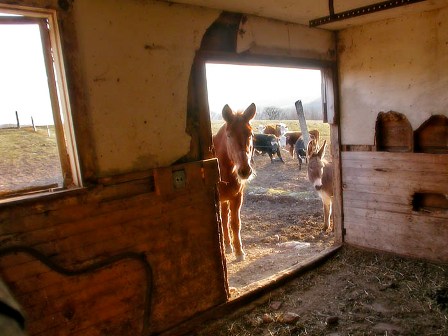
The first article ("Iraqi donkey finally in U.S.") is about a donkey, adopted as a mascot and named "Smoke" by retired Col. John Folsom's Marine unit stationed at a base in Iraq in 2008. When his unit left, the remaining Marines at the base continued to care for the donkey; once those Marines left, the Army soldiers at the base handed the donkey off to a local sheik who proceeded to neglect the former mascot. Folsom and some others found out anda massive effort spanning continents and featuring the help of military officers, government officials, foreign journalists and many others [ensured, with t]he Society for the Prevention of Cruelty to Animals International rais[ing] money to cover the thousands of dollars it cost to transport Smoke to the United States.
And how did Folsom, his friends and family and "members of the local horse set" celebrate Smoke's arrival in the U.S.? Folsom'sfriends Debbie and Alan Nash hosted the welcome-to-America party on their polo horse farm"[where t]hick New York strip steaks and pork ribs sizzled on the grill.
Folsom's efforts were not lost on assembled guests, who expressed their admiration of his beautiful gesture: “'It's wonderful they rescued this donkey,' said Carl Cox, who goes fox hunting with Debbie Nash and came to see the donkey".
After the rough life Smoke's had and what was surely the somewhat traumatic event of being transported halfway around the world, one would think that the rest of his days would involve some peace and quiet, but Folsom has other plans for the donkey:He'll soon start his new job, providing comfort to veterans at Take Flight Farms. The Omaha nonprofit uses horses to provide equine therapy to military veterans struggling with post-traumatic stress disorder.
"That's a fine animal which can benefit humans in so much better ways, Why don't people get that?" -- Jaeshik
"I do not believe in eating companion animals or recreation animals, but that notwithstanding much if not most US horsemeat is simply not safe for human consumption." -- Marybeth Kuznick
So on the one hand, some see horses as having a different "purpose"or as having a multitude of better uses for humans than that of being served up on a plate: They deserve to be a different kind of property. On the other hand, those who seem to view any non-human's flesh as fair game are mostly concerned with what they see as the danger of consuming an animal not raised from the ground up to end up on said plate. Many of the Huffington Post comments (and other comments I've seen online) in response to the story describe the inability to ascertain the types and amounts of medications administered to the horse throughout his life. This of course perpetuates the myth that the flesh of animals raised from "cradle to grave" for human consumption is free from potentially dangerous chemicals.
"These horses aren't purpose bred for meat, there is no traceability in place and no regulations as to the mediciation they are given. These are lesson horses, dressage, jumpers, ropers, trail riding, backyard, racing, carriage, used up mennonite, police, rodeo, RECREATIONAL HORSES. I will never purposely eat horsemeat, but if they were actually raised like beef from the time a foal hits the ground, including ear tags, production records, traceability, etc and handled in a more humane way to slaughter then it would be more palatable. What RIGHT does the pleasure horse industry have to suddenly turn their horse into human food when they're done with them? What RIGHT do they have to be able to sell their horses as meat for human consumpion on an honour system?" -- LJ60
Unfortunately, the few who do seem to point out (and rightly so) that eating the flesh of a horse is no morally different than eating the flesh of a pig or cow seem to be the "expand your palate" types, suggesting that people loosen up and try it, along with other bits and secretions from any number of other non-human animals not usually viewed as "food" in the West.
(Me? I'm just waiting for a PETA press release proclaiming that horse consumption is somehow more markedly "inhumane" than other forms of animal consumption this week .)
Want to spread some more clarity and consistency in how we view non-human animals and how we choose whether or not to use them? If you're not vegan, go vegan; if you are, talk to others about going vegan today!
Saturday, May 14, 2011
Vegan Black Metal Chef -- Episode 1: Pad Thai
I'm guessing that most of you have seen this already. I'm posting it there for those who may not have done so. I dunno how long Vegan Black Metal Chef Brian Manowitz will be able to pull this off, but I'm already really looking forward to Episode 2! Check out his new website, Veganblackmetalchef.com.
Friday, May 13, 2011
What This Vegan Eats
I went on a huge fruit and kale kick this past week. Here are a some photos of a few things I ended up devouring: My fruit basket overflowed a few days ago. Some of what I nabbed and ate (raw or cooked)? Cantaloupe, bananas, tomatoes, sweet potato, tangelos, avocado, mangoes, mandarin oranges, lemon and limes.
 Kale, tomatoes and shredded carrots tossed with a balsamic vinaigrette, piled around quinoa (prepared with a pinch of turmeric) and topped with avocado wedges.
 A tofu wrap: Tofu marinaded in a bit of soy with powdered chipotle, pan-fried with Spanish onions, mushrooms, green peppers and some salsa. Avocados and cherry tomatoes and a smear of Vegenaise.
 Pinto bean soup with potatoes, carrots and zucchini. Seasoned with powdered chipotle (the stuff is marvelous!) and crushed garlic.
 Raw kale tossed with cherry tomatoes, mushrooms and scallions. Tossed with a drizzle of olive oil and balsamic vinegar flavoured with a bit of Dijon mustard.
 The kale salad went well with carrots and potatoes mashed with crushed garlic, nutritional yeast and a bit of Vegenaise.
 Oven-roasted red potatoes, carrots and zucchini (drizzled with olive oil and lemon juice).
 Those were just some of the things I prepared. Breakfast sometimes involved things like fruit smoothies with a spoonful of nut butter and some flax, old-fashioned or steel cut oats with almond milk and fresh, dried or frozen fruit -- or even sometimes just soup. Lunch invariably consisted of a huge salad comprised of an endless assortment of vegetables and legumes, or of leftovers on hand. The bottom line is that it doesn't take a whole lot of work to slap together delicious and nutritious food and it's easy to do so without involving the consumption of non-human animals or their products in the process.
Tuesday, May 10, 2011
On Rejecting Animal Use

I also pointed out that regardless of how supposedly comfortably these chickens are raised, the bottom line is that they're bred into wretched lives of being treated like food-producing machines. I asked her if this was what she really thought of non-human animals -- that they're things existing solely for our pleasure and convenience. I hoped not. She didn't answer, but I got a "tsk" or two from a few welfarists who suggested I'd had no business passing judgment on her choices, insisting to me that "every little bit counts" and that she was somehow "vegan-minded" and "on the right path". Why did I not praise her, they asked, since she was at least sourcing her eggs from someone purportedly treating their chickens a bit more kindly? Who was I to judge her for the best possible choices she was making for herself?
How is comforting oneself over one's continued use of animals either "vegan-minded" or on the "right path", though?
"If They're Happy and I 'Know' it, Clap Your Hands!"
I shared this, primarily, to re-emphasize that foregoing animal flesh while otherwise consuming animal products is still engaging in animal exploitation. We're kidding ourselves if we think that there is a difference between chomping down on a chicken leg or having a couple of scrambled eggs (or a bowl of dairy ice cream, and so on). And for those who try to lull themselves into thinking otherwise while they claim to support animal rights, or they express concern with not directly contributing to just plain old harming other animals, the truth is that there's no getting around the fact that using animals means perpetuating what is essentially for them a life of enslavement involving various forms of torture. Furthermore, regardless of how horrible that world is for them, respecting their rights and interests involves not thinking of them as things which exist for us to use in the first place. These are just the facts, though, as uncomfortable as it may be for some to weigh them.
I Ain't Clapping
As a vegan and as an abolitionist animal rights advocate, I avoid participating in animal exploitation. I don't condone others' doing so and I sure as hell don't applaud it or encourage it. If you tell me that you take the interests of non-human animals seriously but feel that you're doing "enough" by avoiding meat and sourcing your eggs from birds at the happy chicken farm down the street, I will tell you that consuming animal products other than meat is still animal exploitation, and that veganism should be the moral baseline for all who do claim to really take the interests of non-human animals seriously. I will say to you that you should go vegan, or at least take steps toward doing so. To hurt or shame you? No. To provide you with the facts so that you realize what your choices involve? Absolutely. After all, why should I lie when billions are dying every single year when they needn't?
If I refuse to acknowledge this or that form of animal exploitation as being more commendable than another, I am merely refusing to condone it and refusing to nod politely at any justifications given for it. I think we owe non-human animals -- as well as non-vegan animal advocates -- at least that much. Don't you?
--------------------------------------------------
To find out more about why vegetarianism falls short of offering justice to non-human animals and denies them their personhood, please read the following essays:
- My ramble from March 2010: "Why I Will Not Advocate Vegetarianism"
- Bob Torres' "Why Vegetarianism Isn't Enough"
- Dan Cudahy's "What Is Wrong With Vegetarianism"
Also, have a listen to this podcast by Gary L. Francione:
- "Commentary #6: Aspects of the Vegetarian/Vegan Debate"
For some advice on how to proceed when talking to others about what we owe nonhuman animals, read this blog post by Vincent Guihan: "They believe harm is wrong, but how do we get them to act on that?"
Sunday, May 08, 2011
What This Vegan Eats
Some of the things I've been eating this past week: Tofu scramble with green peppers, zucchini, mushrooms and garlic. Seasoned with a wee splash of tamari, a pinch of black salt, a fair amount of nooch, lots of crushed garlic, turmeric, dried parsley and freshly-ground black pepper.
 Fruit soup: Cantaloupe, blueberries, raspberries, lime juice, a dollop of organic peanut butter, flax, some wheat germ and a drizzle of maple syrup.
 Cabbage & diced tomatoes tossed w/sesame oil & rice wine vinegar. Breaded Gardein strips, pickle, hot banana peppers and Vegenaise on a kamut roll. Radishes!
 Spinach cooked with diced tomatoes and Indian seasonings, oven-baked Gardein patty and cantaloupe. A quick and tasty dinner!
 Kale salad! Shredded kale w/mandarin orange segments & avocado. I mixed a bit of really good Dijon & a drizzle of extra virgin olive oil into some balsamic vinegar for the dressing. It was so good!
Thursday, May 05, 2011
"Seagans"? Really?
 The SFGate has a new blog as of today; it's called "Veganize It!" and it's written by Sabrina Modelle who proposes to spend her time veganizing recipes for readers. Modelle describes herself as having recently completed a 28-day vegan cleanse, in which she also omitted alcohol, caffeine and refined sugar.
By the beginning of March, I knew my eating habits would change drastically forever. Since I am a food writer, I adopted a six-day-a-week vegan/seagan diet with one day for research, cooking, recipe development for clients and dining at the latest and greatest. It works perfectly for me, and it feels like a nice balance for my health and the health of the planet.Basically, instead of attempting to compartmentalize veganism according to different meals (à la Mark Bittman), Modelle does so according to different days of the week. Unsurprisingly, she also restricts her consideration of the term "vegan" to food and describes her reasons for doing whatever-it-is-that-she-is-doing as being based in concern for her own "health and the health of the planet". Somehow, non-human animals get lost in the discussion.
A so-called six-day-a-week vegan diet would be confusing enough to The SFGate's readers, since it conveys that one can be somehow logically and accurately qualify oneself as being any sort of vegan when one continues to eat -- or otherwise use -- animal products. However, Modelle's use of the word "seagan" piqued my interest (albeit in a sort of all-too-familiar stomach-churning way). A quick Google search confirmed the obvious, that "seagan" is supposed to be some sort of variation of "vegan" which includes the consumption of fishes and other sea creatures.
Before my Google search, however, I left a short comment in response to her article asking what exactly she means in describing herself as "vegan/seagan", just to get the straight dope. Her response? It confirmed my suspicions and contained an attempt, perhaps simply based on a lack of nutritional information, to justify her not even following a so-called vegan diet for those six days out of seven:
Hi Mylene,Indeed, labels get awfully complicated. They particularly get complicated when someone attempts to co-opt one which denotes a lifestyle avoiding all animal consumption and tries to fragment it around part-time animal consumption, or the consumption of only certain animal species.
Until recently, I was eating a six day a week vegan diet, but it became apparent that soy products were triggering my migraines. I also eat beans and seitan for protein, but many beans trigger my migraines as well. About two weeks ago, I added fish to my diet. The result being, I eat a vegan diet with some sustainable seafood for added protein a couple of times a week. Seagan is just a made up name that I’ve heard tossed around over the years during my bouts of vegetrarianism/veganism/pescatarianism/ethical omni life. I like six day a week seagan because I’m not pescatarian since I don’t eat eggs or dairy (except on my one day a week). Labels are so complicated, right?
In good faith, I responded to her with the following explanation and suggestion:
I was curious, since you wrote "vegan/seagan" and vegans (by definition) avoid all forms of animal use or exploitation (i.e. food, clothing, entertainment, et al). Limiting the use of the word to food alone is problematic, but using the word "vegan" to describe a diet that involves the habitual consumption of one (or several) type(s) of animal species is certainly an incorrect use of the term. BTW, if the sole reason that you're consuming fishes and and other sea creatures is that you fear you're not getting enough protein (since you state that soy and some other legumes give you migraines), you should consider exploring other really good plant-based sources of protein like seitan, nuts/seeds (and their butters), quinoa, amaranth, oats and various other whole grain products.Hopefully she'll consider those options instead of thinking that she needs to continue consuming animal flesh to obtain adequate dietary levels of protein. At the very least, however, I hope she'll agree that it makes sense for her to cease using the word "vegan" to describe any facet of her own personal consumption as it stands now, diet or otherwise. As any vegan who's interacted with friends, family, coworkers, food service workers (and so on) already knows, there's already more than enough confusion out there over whether vegans consume this or that animal product. Let's hope that Modelle opts to clarify things rather than muddle them further for the general public. And let's hope that she gives some serious thought to actually going vegan.
Monday, May 02, 2011
Either / Or?
As so many of these articles start out, Brown falls all over herself to try to establish her credibility as a warm-hearted lover of fluffy non-humans. She posts "cute animal videos on Facebook", she tells us, and she has a soft spot for her cat. If that doesn't convey her earnestness, Brown delivers a KO by waxing nostalgic over her more innocent days:
My favorite childhood journey was to the Catskill Game farm, where you fed little bottles of milk to the baby lambs, pigs and deer. The pigs and I both squealed with delight.Of course, it's easy enough to love the animals we call "pets" or "companions" and who doesn't love a cute animal video to tug at our old heartstrings and entertain us? And of Brown's warm fuzzies over her squealing bottle-feeding visits, she fails to elaborate that the Catskill Game Farm was a zoo filled with exotic animals and that when the zoo closed down because of financial problems, just under a thousand animals ended up auctioned off in single day to the highest bidders -- many of them sold off to organizers of canned hunts. "Clearly, I am an animal nut," says Brown. Indeed...
So with her solid lover-of-cute-fuzzy-animals cred established, Brown slips into semi-confessional mode to display her inconsistency and absolute moral confusion to all by talking about her own set of limits and loves when it comes time to choosing which animals she will or won't use:
My love for animals led me stop eating meat and poultry 15 years ago, but I've never been able to make the leap to veganism, and I constantly feel guilty about it. Am I weak, cruel, vain? Perhaps. I love ice-cream, omelets, and salmon; shoes, belts and bags. I draw the line at buying leather coats, which is really just to save face -- I don't want what I'm wearing to scream "dead animal carcass." Leather shoes are smaller and less conspicuous.One is left to wonder what sort of bandwagon she's on, since it seems clear that she almost seems proud or flippant in describing how she occasionally self-flagellates over her "love" and continued consumption of dairy, eggs, fish, leather.
Brown goes on to weave her "friend" Kathy Freston's Oprah-hyped purported vegan cred into her article, mentioning how Freston recommends moving towards a "vegan diet" in increments to "improve your health, the environment, and of course, lessen animal suffering". Brown admits that that in 15 years of her supposedly -- and she adopts Kathy Freston's catch-word here -- "leaning in" towards veganism, she's mostly engaged in self-deception to excuse away her use of animals:
For years I blindly (and somewhat intentionally) operated under the incorrect assumption that in buying leather products I was simply utilizing the by-products of meat eaters. I now know that's not true. And while I do seek out 100% man-made shoes [...] if really taken by a pair of leather boots, I will buy them. For the most part, I buy non-leather handbags [...] and belts if they're decent looking. But again, if I fall in love with something leather, I seem unable to keep myself from buying it.She admits that her possible impulse control disorder is all about vanity. She asserts that she's just plain ol' powerless to resist, regardless of the fact that she claims, herself, that most of the animals used to satisfy her leather fetish come "from nations where animals are notoriously badly treated" (a distinction here being akin to pointing out that someone was tortured on a plank rather than being tortured on a badly-inflated air mattress). Even making this meaningless distinction in her head, though, leaves her claiming that she just can't help herself. For Brown, the lure of a cute purse trumps the torture of a sentient creature -- however "notorious" she qualifies said torture to be.
Her confusion becomes even more apparent when she starts justifying her eating fish. She draws the line at boiling lobsters alive (who are not fish, but I digress) and at eating farmed fish (for health reasons, because of the "murky, chemical laden water" in which they're raised). The rest are on the menu for her since they're "harder to relate to than [cute] furry mammals, our brethren". (Obviously, Brown's brethren don't include animals whose skin is used to make her shoes and purses.) She then once again focuses on the treatment of animals typically raised for food by asserting that unlike farmed mammals, fish lead good lives -- up until they don't. Yet even then, she admits that she is aware that the manner in which those fish have their lives taken is heinous and she asserts that even knowing this is not enough to keep her from continuing to consume them.
Perhaps a day on a fishing boat watching nets full of fish squirm and jump and gasp for life might cure me of my fish habit, or seeing the unfortunate sea turtles, dolphins and other lovely aquatic creatures that get caught in the nets.She basically discusses animals in terms of the degrees she perceives in their treatment, then admits that treatment is actually mostly irrelevant to her. She writes of her awareness of the meaninglessness of the expression "free range" in the egg and dairy industries. She describes how chicks are habitually ground alive and the conditions under which chickens are kept. She writes of the repeated impregnation of dairy cows, who live, in her own words "miserable lives" and whose offspring fare no better to keep up with the human consumer's demand for dairy.
So what's Brown's solution? Although she seems to have bought into and understood the arguments that groups like HSUS and PETA use when targeting areas in animal agriculture in need of so-called brand spanking new and improved regulations, or when they single out specific forms of animal use as worse than others, Brown merely muses about a less "cruel" manner in which to continue raising them for her use.
Maybe we're meant to use some animal by-products -- eggs and milk and wool [...] -- but to do it without cruelty could perhaps only be accomplished on a small farm. The size and needs of our society make it difficult to meet demand. But still, there are many ways it could be done more humanely, even with mass production, though the agriculture lobby is strong and resistant.Brown herself asserts that when it comes to going vegan, she "stop[s] short". All of this talk of the cruel treatment of animals has merely left her admitting to repeated self-deception or in portraying herself as being otherwise too helpless to resist. It's left her musing about a world where "cruelty" could (purportedly) be taken out of the equation so that she could continue to buy her leather purses without feeling "guilty". This is what all of the information she's absorbed about the treatment of animals has left her wanting -- guiltless use. And it doesn't happen, she'll still continue using some animals and compartmentalizing her justifications as she goes along. For Brown, it's about her -- not about non-human animals. Referring to herself as too selfish and as just not having had that epiphany that would leave her considering going vegan, she calls out to (Kathy-vegan-catch-word) "veganists" and attempts to bond by getting them to share their stories and then asking them for absolution until she is able to "surrender [her own] selfishness", pleading: "[I]s half a vegan better than none?"
In Brown's world, either you use animals a little or a lot and they're either treated badly or treated "humanely". Hopefully she can let go of her self-cajoling long enough to realize that the real either/or involves the decision to either continue using them, or in weighing the rights and interests of all non-humans seriously enough to choose not to use them at all. And this is why when we talk to Val Browns, we really need to deliver a clear and unequivocal vegan message.
Saturday, April 30, 2011
What This Vegan Eats
I'm wandering away from the soup photos this week... Open-faced seitan sandwich with cheddar Daiya on pumpernickel toast, topped w/gravy made from leftover seitan basting liquid. Peas and sauerkraut. Comfort food extraordinaire!
 Steamed broccoli w/oven-baked Gardein chunks and plum tomatoes.
 Oven-baked sweet potato wedges (seasoned with chipotle powder) and Gardein strips.
 Yes, sometimes vegans eat simple salads. This one had romaine lettuce, cucumbers, tomatoes, radishes and scallions and ended up topped off with ground flax and Italian dressing.
Wednesday, April 27, 2011
How Do You Protect a 'Thing'?
 I wonder sometimes how many hours of my life I could give up just addressing some of the more problematic information and opinions Mark Bittman releases into the ether. His Opinionator blog post from late yesterday ("Who Protects the Animals?") is certainly no exception to much of the confusion he spreads about what we do or don't owe non-human animals. He has rejected veganism publicly and periodically asserts that veganism is a bad idea because it's supposedly all about eating processed fake meat. And regardless of this, he's co-opted the word "vegan" to describe a diet by which someone only eats animal flesh for dinner.
In his recent piece, Bittman writes about E6 Cattle Company in Texas which recently came under fire when undercover video taken by animal advocacy group Mercy for Animals revealed incidents of cruel behaviour by employees, including but not limited to bashing in the heads of live cows with pickaxes. Bittman goes on to describe other widely-reported cases involving animals raised for human consumption and describes as "horror stories". He expresses what seems to be indignation over the fact that "federal laws governing animal cruelty apply [only] to slaughterhouses" where animals spend their last few moments alive before they're "dispatched". On the actual farms or premises where animals are enslaved and raised, they are only "protected" by state laws, he criticizes. He calls this, along with lack of enforcement of any laws at all in place the "root of the problem".
Bittman asserts that this videotaping is necessary to ensure that animals raised and slaughtered for human consumption are treated "humanely". Furthermore, he writes that polls have shown that "almost everyone believes that even if it costs more, farm animals should be treated humanely". Bittman's concern is over the law that's being considered in Minnesota, Iowa and Florida, by which it would become illegal to engage in undercover videotaping on factory farms. Bittman insists that because of this, welfarist groups like HSUS and Mercy for Animals must not be hindered legally from "documenting the kind of behavior most of us abhor".
At this point, I would have been ready to jump in to add that the heinous video footage that gets passed around from time to time is not the exception to the rule and that the lives of all animals enslaved to be slaughtered for our consumption are horrible lives. But Bittman himself jumps in to admit as much, stating that the video footage we end up seeing merely serves to remind us of what goes on. Of course, he specifies that this is standard on factory farms, but it's not. The same things -- the branding, the dehorning, the forced impregnation and subsequent removal of offspring from their mothers so that they may be sent off to slaughter (or otherwise enslaved themselves for human use and eventual slaughter), et al. -- they occur wherever and whenever non-human animals are treated as future food for human consumption. It's not limited to factory farms. Bittman says that "some abuse is pretty much guaranteed" when the truth is that there is no way in which you can enslave an animal -- treat her like a thing with no interest in a life of her own -- then kill her, and not call it abuse.
Instead of calling for welfarist organisations to be allowed to engage in covert videotaping operations to spot-check for the worst forms of torture imposed on these animals we call "food", why is it so difficult for Bittman to consider suggesting that we don't, in fact, need to use them in the first place? Why is it so difficult for Bittman to consider that since "some abuse is pretty much guaranteed" that all of it could be prevented by educating people that it's wrong to treat sentient non-human animals as if they were things? Bittman inadvertently provides the answer to my questions by saying that "[t]here is, of course, the argument that domesticating animals in order to kill them is essentially immoral; those of us who eat meat choose not to believe this". He argues that allowing welfarist groups to continue videotaping animal agriculture operations would ensure that existing regulations concerning the levels of torture inflicted upon non-human animals would be better observed, while on the other hand, Mercy for Animals' Nathan Runkle elaborates that allowing them to continue videotaping "would allow the public to trust these operations rather than fear them".
And thus lies the absolute moral confusion inherent in speciesism. On the one hand, you have "almost everyone believ[ing] that even if it costs more, farm animals should be treated humanely". Yet the undeniable facts are that all animals raised for food suffer wretchedly on some level or another and that regardless of where they're enslaved or of how they're slaughtered, these animals are treated like things and deprived of being able to live out their own lives on their own terms. And while Bittman himself is willing to admit that the standard practice involved in raising and slaughtering almost 10 billion animals a year in the US alone undeniably involves tremendous suffering, he's not willing to view their enslavement and slaughter as "immoral". And rather than focus on educating the public about not using animals, welfarist organizations like Mercy for Animals work towards facilitating the public's ability to "trust these operations"-- to feel better about continuing to use non-human animals. So, indeed, who does protect the animals? Not Mark Bittman. Certainly not Mercy for Animals.
Please consider going vegan. If you're already vegan, talk to others about doing so. That's the only way to protect non-human animals. At the very, very least, we owe them that much.
Saturday, April 23, 2011
What This Vegan Eats
A few delicious things I've made and devoured over the past week: Dill tabbouleh on quinoa. It was my first time using dill to make tabbouleh and it ended up being a very interesting twist on an old favourite.
 This concoction is a tomato-rice soup w/spinach, onions, mixed legumes, turnip, carrots & corn. I seasoned it with smoked paprika & tarragon, which left it with a rich, earthy taste, punctuated just right with a subtle tang.
 I've been having fresh fruit with my meals a lot lately. This bowl of cantaloupe and wild blueberries accompanied a leafy salad and a piece of pumpernickel toast.
 Sweet potato and red lentil soup, with various Indian seasonings (including fresh curry leaves) and topped with cilantro.
 More fruit! I bought a whole pineapple for the first time in my life today. (No, really.) I've had it canned before, but had never gone at one myself. I've since learned that around half of pineapple's Vitamin C is destroyed in the canning process, along with almost all of its bromelain.
Tuesday, April 19, 2011
Vegan Pregnancies: The Portman Debacle
 Since last week the internet has been buzzing with the news that actress and vegan shoe line owner Natalie Portman has admitted in a recent radio interview that she's resumed consuming animal products. I wrote about it not particularly caring which celebrity goes or stops being vegan this or that week. There's a constant churning, it seems, and the interpretations of "veganism" presented by the celebrities vary enough that any message that could get out to the public about what we really owe non-human animals almost always either gets mangled or lost.
The worst part is that each time a Natalie Portman decides to do an ethical about-face and cites lame or misinformed reasons to justify having done so, it actually sends a strong negative message out to the public about veganism -- or at the very least, it sends out an awfully confused one. And it's what it ends up triggering in its ensuing discussion that leaves me groaning a little. In Portman's case, for instance, every half-wit with access to a keyboard and an internet connection who is either antagonistic towards or dreadfully misinformed about veganism has been been rubbing his hands together in glee since the story broke (and I say "broke" although it wasn't exactly news, but just the first time Portman had gone in as much detail about her change in ethical stance).
Veganism Is teh Evil
The OC Register (which I was told is published in one of the more nutso right wing areas of California) jumped on the opportunity to write a piece that not only questioned the safety of veganism for pregnant women, but its safety for anyone and everyone ("Is veganism right for pregnant women?"). The article starts by mentioning Portman's decision to stop being vegan because of cravings, as well as a vague reference she'd made in her radio interview to pregnant women needing to watch their iron and B12 levels. The article then proceeds to twist those comments into a given that veganism is unhealthy for pregnant women and extends that assumption further: "If shunning animal products is bad for pregnant women and unborn children, is it good for any of us?" The article's writer then talks to an OB/GYN "who knows a lot about prenatal nutrition" and who is "definitely against the vegan diet". And what did token expert Dr. Felice Gersh have to say?
"What is necessary when a women is pregnant to develop her baby or when she’s nursing, is really a good clue for what she needs her whole lifetime," she said. "Some vegans live to be 100, but in general it’s not a good idea to be a vegan."The reasons for this, according to Gersh, are that vegans don't get enough omega-3 fatty acids through their food and are "notoriously deficient" in B12 and zinc ("because they eat so many grains"). To his credit, the article's writer does point out that omega-3 supplements are readily available, although he doesn't address her comment concerning B12 or zinc (nor their purportedly notorious deficiency for vegans) except to add that vegans claim that they can get everything they need from food itself. Basically, the article started with the assumption that veganism is unhealthy for pregnant women and then tried to carry it further (albeit in a really sloppy and open-ended manner) to extrapolate that it's unhealthy for everyone, perhaps planting a seed in the minds of its readers. This is the sort of thing that celebrities announcing their renunciation of veganism and then mumbling a few sentences about health concerns can trigger.
(No Really... Veganism Is teh Evil)
Another anti-vegan opportunist to take off running with Portman's radio interview was Wesley J. Smith, a lawyer and ethicist (of sorts) whose focus is on "human exceptionalism". Gary L. Francione debated Smith around a year ago on the Michael Medved radio show. Smith sees humans are more morally important than non-humans and periodically takes issue with the abolitionist approach to animal rights on his blog. In response to the whole Portman affair ( "Natalie Portman Puts Unborn Baby First by Abandoning Veganism"), Smith had this to say:
Vegans like to say that it is a perfectly healthy diet–more healthy than the biologically natural omnivorous human diet. While it can certainly be indulged healthily–if carefully managed with supplements, etc.–unlike our natural diet, it is potentially hazardous for pregnant women.He then lapses into fear mongering by referring to the recent case in France where two flaky parents decided to ignore the recommendation of their doctor to seek further medical and nutritional counsel concerning their baby, opting to rely on things like cabbage poultices instead. As UWM Post writer Sarah Hanneken pointed out in a recent article ("Vegan parents in the media"), bad parenting is bad parenting and it's unfortunate that sensationalism-seeking mainstream media would rather jump on the word 'veganism' and vilify vegans to more easily sell a story than to actually present all of the facts. It's no surprise that someone as antagonistic to animal rights as Smith, then, would try to link a story such as this one to Portman's announcement, as if it could lend credence to his suggestion that veganism may be hazardous to pregnant women:
Good for her. She listened to what her body needed during gestation. Her baby matters more than “the animals.” Parents should not put their children at physical risk over ideology or belief.So on the one hand, we have something like Natalie Portman's renunciation of veganism leading to the anti-vegans' spewing of more anti-vegan misinformation. Because of course, a celebrity's half-hearted reference to a vague possibility of nutritional deficiencies for pregnant vegan women who don't stay on top of how they're fuelling their bodies, combined with a story about a couple of flaky neglectful parents -- who happened to be vegan -- whose neglect led to the death of their child pretty much cement it that vegans opting to stay vegan through a pregnancy and to raise vegan babies (like Kenya, Anna and Woz and many more women I know) are putting "their [future] children at physical risk over ideology or belief". Riiiiiight.
On Not Really Ditching Veganism
Then there's the problem with "not-really-vegan" vegans hooking on to the news story to absolve themselves of deciding to become less than "not-really-vegan". For instance, on some baby blog today, a pregnant woman called Elisabeth Lambert who self-identified as vegan latched on to the news about Portman's having ditched veganism ("I'm pregnant, vegan, and all I want is a Junior Burger"):
So when Natalie Portman announced last week that her vegan diet had given way to the cravings she was experiencing as a result of her pregnancy, I breathed a sigh of relief. If Ms. Portman, Oscar-winning actress with millions in her bank account to spend on chefs, dieticians, nutritionists and health professionals, couldn’t keep up a vegan diet during pregnancy, then how was a mere mortal like myself expected to? And really, as long as your pregnancy is progressing well, and both you and your baby are healthy, that’s all that matters.So you've got a pregnant woman who calls herself vegan attempting to absolve herself of having given in to a craving to eat a hamburger because the oh-so-famous Natalie Portman ditched veganism during her own pregnancy? (Why do I hear my mother's voice in my head asking me if I'd jump off a bridge if all of my friends did so?) Thankfully, before she reaches this conclusion, Lambert makes it crystal clear that her "veganism" was restricted to the consumption of food and that her "reasons for adopting a vegan diet were health-related, and not due to any ethical or moral stances". So when she writes:
The saltiness, the texture, the bun, the sauce…and the meat. Oh the glorious meatiness of the meat. That meat pattie [sic] was the best thing I’d eaten in forever, so much so, I let myself go into a burger stupor, knocking back burger after burger.I'm a little less inclined to be shocked. Here was a woman who had merely avoided eating animal products up until that point, and very explicitly for her own personal health reasons. Rather than being some sort of ethical vegan confessional, she merely attempts to hop on the Portman story's bandwagon by admitting that instead of perhaps using animal products on her hair or to clean her counter, or to entertain herself, that she put some in her belly. "Meh," I think to myself. "Just another example of a non-vegan's seeking attention by co-opting the term 'vegan' and grabbing a headline to get her five minutes. The true disappointment with this article, however, comes at the end when Lambert asserts that there is a lack of information concerning veganism and pregnancies, which is just plain wrong. There is information to be had in everything from books on vegan nutrition to fact-sheets and guidelines by experts on various vegan websites, as well as on mainstream medical websites. Someone obviously forgot to use teh Google.
When the Vegans Who Think Unequivocally Promoting Veganism Is teh Evil Get Involved
Perhaps one of the worst things that ends up happening when some celebrity in the public eye gravitates from supporting veganism to reverting to using animals is when some animal advocates end up shaming other animal advocates for taking issue with it on any level, presenting what's too often valid criticism as making veganism seem too hard. Sara Best (self-described "mom to two little omnivores and married to one dedicated carnivore") over at This Dish is Veg, for instance, wrote a piece ("Let's all take a breath and give Natalie Portman a break") in which she refers to vegans who'd engaged in discussing Portman's public about-face as having "erupted in a cacophony of chirping" and as "howling in response". With the same derision, Best denounces the criticism raised by vegans of pseudo-vegan Kathy Freston's attempts to water down veganism with her catch-word "veganish" and of vegans' clarifying that Bill Clinton's eating fish meant that he wasn't the vegan mainstream media was widely reporting him to be.
All this judgment flying around the purity of someone’s food choices scares regular people. [...] That soccer mom or that truck driver who heard about the benefits of a plant-based diet and thought about maybe trying it out, might just stick with the KFC if they think they might be attacked should they announce their intention to be vegan but be unable to stick to it a hundred per cent of the time. [...] It’s easier to just not try.I don't even know where to start with this statement. First of all, the word "purity" almost only ever seems to get hauled out when someone is attempting to undermine anybody's holding veganism as a moral baseline when it comes to animal advocacy. It's used to shame those who refuse to condone "some" animal use as praiseworthy. But when Best emphasizes "food choices" and uses "plant-based diet" interchangeably with "vegan", it becomes clear that her interpretation of veganism does indeed allow for "some" animal use (i.e. that of animals not used for food), so it's no surprise that she would begin on this note.
Best goes on to tell advocates to keep their eye on the big picture, which she says is to reduce suffering for the non-human animals, animal industry workers and the very planet itself. (Funny that I thought that this big picture for most vegans actually involves an end to all non-human animal use -- not just a reduction in the suffering of some.) She points out that Portman didn't tell people to "load the kids into the minivan and hit McDonald’s for dinner" but that she's just admitted that she, herself, has gone back to consuming this or that animal part -- to treating animals as things that exist to satisfy her celebrity cravings. Best applauds Portman by saying that she's "still a vegetarian" and that "she still promotes conscious eating". But how the hell do either of these things matter? Whether you're eating animal flesh or eggs or dairy products, it's all the same to the animals enslaved for our use in the end. And as for this promoting "conscious eating" garbage, how on earth is it more ethical to use animals if you are actually aware -- "conscious" -- of what such use entails? One should hope that awareness would actually lead one to cease using animals and to not condone their use, rather than attempting to absolve oneself by claiming "I know where my food comes from".
Best claims that "what you choose to eat speaks volumes about what kinds of actions and policies you support and encourage". Well, Sara Best, what Portman chooses to eat speaks volumes about what kinds of actions and policies she supports and encourages. And your defending her and accusing vegans who've expressed concern over this and seems to speak volumes about what This Dish Is Veg supports and encourages -- and that doesn't seem to include not using animals or treating them like things. Instead of trying to silence valid criticism by conflating it with "attacking" and instead of accusing vegans of expecting those in the public eye who renounce veganism of expecting those celebrities to be "perfect vegans", how about recognizing that those vegans in question are actually worried about the fallout? How about recognizing that pregnant vegans aren't looking forward to having friends, family and even medical caregivers take off running with the ensuing media stories painting veganism as dangerous or portraying pregnant vegans as jeopardizing their future offspring? How about recognizing that shirking off the question of whether or not it's right to treat another sentient creature as a thing shouldn't be excused because of something as ludicrous as a food craving? Instead of accusing vegans discussing their concerns as "attacking" Portman, why not look at what really constitutes the big picture? How about not letting mainstream media -- as well as other animal advocates -- present veganism as involving any degree of deliberate unnecessary animal use?
The whole Portman debacle merely serves to drill home that as animal advocates and activists engaged in vegan education, we shouldn't focus on celebrities hopping on bandwagons. That being said, we really realistically need to make ourselves aware of the problems and additional work which may ensue when they hop off.

