But first he has a mini publicity tour ahead of him. Several national television networks have expressed interest in featuring Smoke, so Folsom was planning to drive into Manhattan on Monday morning, 20-foot horse trailer in tow, so his celebrity donkey could make the interview rounds. Once you peel apart the layers of animal use in the article, Smoke's rescue reeks more of a public relations event than of an action taken with the goal of providing a non-human animal with a decent life. Rather than permit the donkey to live out the rest of his life peacefully, it seems that he'll continue to exist on whatever terms set out for him by the humans who call him "property". Horses A Huffington Post blurb I read this morning involved what's apparently become a scandal concerning the television show "Top Chef Canada". The show, a non-vegan cooking competition of sorts, involves the use of any number of animal products on any given episode. Tonight's episode, however, will feature one of the show's contestants using horse meat, and this seems to have outraged people around the world. Bloggers have been a-blogging about it like mad and a "Boycott Top Chef -- Protect the Horses" page has even been set up on Facebook. Why are people so outraged? Here's some insight from the comments left in response to the Huffington Post article:
Two articles I stumbled across this morning had nothing to do with veganism, but everything to do with our moral confusion when it comes to how we perceive and use non-human animals:
About a Donkey
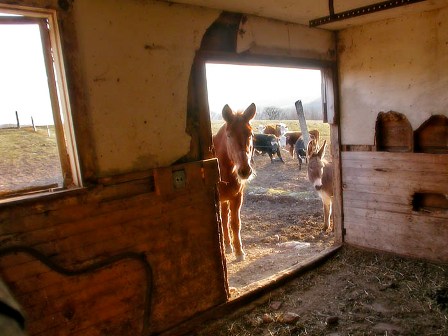
The first article ("Iraqi donkey finally in U.S.") is about a donkey, adopted as a mascot and named "Smoke" by retired Col. John Folsom's Marine unit stationed at a base in Iraq in 2008. When his unit left, the remaining Marines at the base continued to care for the donkey; once those Marines left, the Army soldiers at the base handed the donkey off to a local sheik who proceeded to neglect the former mascot. Folsom and some others found out anda massive effort spanning continents and featuring the help of military officers, government officials, foreign journalists and many others [ensured, with t]he Society for the Prevention of Cruelty to Animals International rais[ing] money to cover the thousands of dollars it cost to transport Smoke to the United States.
And how did Folsom, his friends and family and "members of the local horse set" celebrate Smoke's arrival in the U.S.? Folsom'sfriends Debbie and Alan Nash hosted the welcome-to-America party on their polo horse farm"[where t]hick New York strip steaks and pork ribs sizzled on the grill.
Folsom's efforts were not lost on assembled guests, who expressed their admiration of his beautiful gesture: “'It's wonderful they rescued this donkey,' said Carl Cox, who goes fox hunting with Debbie Nash and came to see the donkey".
After the rough life Smoke's had and what was surely the somewhat traumatic event of being transported halfway around the world, one would think that the rest of his days would involve some peace and quiet, but Folsom has other plans for the donkey:He'll soon start his new job, providing comfort to veterans at Take Flight Farms. The Omaha nonprofit uses horses to provide equine therapy to military veterans struggling with post-traumatic stress disorder.
"That's a fine animal which can benefit humans in so much better ways, Why don't people get that?" -- Jaeshik
"I do not believe in eating companion animals or recreation animals, but that notwithstanding much if not most US horsemeat is simply not safe for human consumption." -- Marybeth Kuznick
So on the one hand, some see horses as having a different "purpose"or as having a multitude of better uses for humans than that of being served up on a plate: They deserve to be a different kind of property. On the other hand, those who seem to view any non-human's flesh as fair game are mostly concerned with what they see as the danger of consuming an animal not raised from the ground up to end up on said plate. Many of the Huffington Post comments (and other comments I've seen online) in response to the story describe the inability to ascertain the types and amounts of medications administered to the horse throughout his life. This of course perpetuates the myth that the flesh of animals raised from "cradle to grave" for human consumption is free from potentially dangerous chemicals.
"These horses aren't purpose bred for meat, there is no traceability in place and no regulations as to the mediciation they are given. These are lesson horses, dressage, jumpers, ropers, trail riding, backyard, racing, carriage, used up mennonite, police, rodeo, RECREATIONAL HORSES. I will never purposely eat horsemeat, but if they were actually raised like beef from the time a foal hits the ground, including ear tags, production records, traceability, etc and handled in a more humane way to slaughter then it would be more palatable. What RIGHT does the pleasure horse industry have to suddenly turn their horse into human food when they're done with them? What RIGHT do they have to be able to sell their horses as meat for human consumpion on an honour system?" -- LJ60
Unfortunately, the few who do seem to point out (and rightly so) that eating the flesh of a horse is no morally different than eating the flesh of a pig or cow seem to be the "expand your palate" types, suggesting that people loosen up and try it, along with other bits and secretions from any number of other non-human animals not usually viewed as "food" in the West.
(Me? I'm just waiting for a PETA press release proclaiming that horse consumption is somehow more markedly "inhumane" than other forms of animal consumption this week .)
Want to spread some more clarity and consistency in how we view non-human animals and how we choose whether or not to use them? If you're not vegan, go vegan; if you are, talk to others about going vegan today!
Monday, May 16, 2011
The Roles We Assign

Saturday, March 27, 2010
Vegan Eats?
Back in September, I traveled to a town around an hour or so outside of Philadelphia to visit with a certain floppy-haired boy. The trip involved a lot of firsts for me. Aside from the fact that I hadn't ventured out of the country in well over seven years, it was my first time traveling through the US on a bus and setting foot in the states of New York, New Jersey and Pennsylvania. It was the first time I've ever fallen asleep listening to a loud chorus of cicadas. I also met a couple of vegans for the first time since going vegan, myself, when we got to share a meal in a fantastic and unassuming little vegan restaurant. The trip also provided me with rare (for me) opportunities to explore a wide variety of other vegan options. Online vegan friends and acquaintances from the Philadelphia area had recommended Govinda's Gourmet Vegetarian to me. More specifically, they'd recommended the fast-food / takeout part of the restaurant called Govinda's To Go. Although it had been described to me as a vegan
  establishment, I soon discovered that it wasn't. When the floppy-haired one and I arrived, I noticed that the menu posted on their wall stated that they offered (dairy) mozzarella cheese as an option for their sandwiches and other dishes. Having had their cheese steak sandwiches recommended by one of the vegan friends who'd suggested the place, the floppy-haired one ordered their Chicken Cheese Steak and I ordered their Pepper Steak Sandwich, both of us making sure to confirm that we wanted dairy-free cheese on them.
After a short wait, our food was ready and we carried it outside to eat, due to limited seating inside. I then noticed that we'd each been prepared Chicken Cheese Steak sandwiches, and after my sweetie and I  discussed our disappointment with the amount of filling in them, I took a bite. We'd spent part of the ride into Philly laughing over his stories of the notoriously sky-high-piled classic Philly cheese steak sandwiches he and his family had enjoyed when he was a kid; these sandwiches had a modest amount of "chicken" in them, with some grilled peppers and just enough of a very, very tasty gravy to moisten them. The bread was whole grain, hearty and delicious and to make my sandwich a little less "dry", I eventually took some of the small bit of plain mesclun mix on the side and tucked it into the bread. Don't get me wrong--it was good. In fact, it was good enough that I took yet another bite before remembering to either stuff in the mesclun mix or take a photo.
When we got home, I took a look at the takeout menu I'd grabbed as a "souvenir" and noticed how the words "vegan" and "vegetarian" were both used as descriptors in it, but that although the front of the menu had the words "fresh", "healthy", "vegan" and "fast" written on it, the back of the menu stated that all items on the menu were either "vegetarian or vegan". I decided to visit the Govinda's website to see what it had to say and found the following general disclaimer:
All of our Selections are Either Vegan or Vegetarian - No Meat, Poultry, Fish or Egg products are used in the preparation of our dishes although for familiarity we utilize the names of meat products. We are committed to the protection of animals.I then noticed that the menu on their site also mentions that "Authentic Mozzarella Cow Cheese" or casein-free soy cheese are both offered as options for their sandwiches. What was really disappointing, however, was reading that the meat substitute used in their version of the classic Philly cheese steak--the Philly Pepper Steak Sandwich I'd initially ordered and (thankfully) not been given--is not vegan. Curious, I did some searching using Google and brought up a few ads for the restaurant where they described their menu as "90% dairy-free".
I live in a small city where vegan options in restaurants or other eating establishments are limited to a small handful of decent ethnic places or the local pita place. I rarely eat out aside from the occasional workplace-related lunch (and even then, I often opt out). The bottom line is that the very few times a year I do eat out, it's at the few places in my city where I know the menu and know the staff and am sure that there's little chance of cross-contamination. I know that many vegans feel that eating at non-vegan establishments is wrong since it entails supporting businesses that also profit off the exploitation of non-humans or that some vegans make exceptions for "vegetarian" non-vegan restaurants. There are no "vegetarian" restaurants here in my city, and even if there were, I wouldn't view them any differently than I would ordinary restaurants (i.e. where animal products including flesh are served) and wouldn't feel compelled to support them any more than I would ordinary restaurants. I have mixed feelings about consuming animal-free products at establishments that otherwise profit off the sale and use of animal products, hence my generally refraining from eating out here, since although I can't avoid buying groceries, I can avoid restaurants. For years, I felt that it was important to provide a demand for vegan options at ordinary establishments, but I'm no longer sure of how (or even whether) this is effective.
I'd been excited about Govinda's, as I'd been excited getting to eat at SuTao Cafe earlier in my visit, where for the first time since going vegan, every single thing on a restaurant's menu was up for grabs. I'd been excited and my disappointment with the place ended up being twofold: First, given how the overwhelming majority of their menu offerings are vegan, I don't understand why on earth they couldn't go the extra step to eliminate the rest of their animal-based options. Secondly, I felt that for a place that half-markets itself as vegan, they should really be more forthright about the animal products contained in their dishes. The fact that the meat sub in their Philly Pepper Steak Sandwich is described as being "not vegan" on their website, while no mention of this is made on their posted or paper menus is disconcerting and--whether deliberately so or not--misleading to vegans. I should have done it months ago, but I do intend to contact them about this over the next few days to get clarification and to express my disappointment.

Tuesday, March 02, 2010
Dealing with Invitations, Family Reunions, Meals, etc.
Pao (aka porolita22) talks about the ins and outs of dealing with social gatherings with friends and family where food is being served.
Tuesday, February 02, 2010
Meals and Such
With morning coffee comes lackadaisical googling. This morning's web-meandering led to some interesting finds, including the following:
It's apparently Meat Week, according to a CBS News article ("Carnivores, Delight: It's Meat Week") about the goings on concerning it in NYC. "We know it is stupid," the NYC event's organizer admitted.
Meat Week was conceived by two bored coworkers in Tallahassee, Fla. Back in 2005, Erni Walker and Chris Cantey were using a word generator on Cantey's Web site that came up with the "holy combination" of "meat" and "week." [...] Now the gospel of meat overindulgence has spread across the country as 16 cities have organized chapters venturing to barbecue restaurants from Jan. 31 to Feb. 7. -- with some locations drawing as many as 70 meat eaters a night.OK, the eye rolling was a given with this one, but what actually caught my attention in the CBC article was when they continued by saying that
[i]n fact, many participants at Meat Week are vegetarians. The draw for many is the communal, family-style environment that is the hallmark of many Southern-style barbecue restaurants.I find it difficult to wrap my head around a reality where people who eschew animal products and who would purportedly be "appalled" by an event completely devoted to eating as much animal flesh as one can stuff into one's stomach would be drawn to its "communal, family-style environment". Could I be wrong or should I assume that the event's founder was being facetious?
"That's why a lot of vegetarians come out, even though they are appalled by what's going on around them," Walker said.
I'm wondering how other vegans feel about (and deal with) food-related gatherings (involving family, work or friends) where animal products are part of the feast. Is it a non-issue for you? Do you grin and bear it, but try to minimize the number of occasions that come up? Do you sit silently, or do you take the opportunity to educate others about animal exploitation? Do you Do you defer questions that may be asked until after the meal? Do you altogether avoid participating in meals where animals or animal products are consumed?
I'm looking forward to hearing about your different experiences!

