But first he has a mini publicity tour ahead of him. Several national television networks have expressed interest in featuring Smoke, so Folsom was planning to drive into Manhattan on Monday morning, 20-foot horse trailer in tow, so his celebrity donkey could make the interview rounds. Once you peel apart the layers of animal use in the article, Smoke's rescue reeks more of a public relations event than of an action taken with the goal of providing a non-human animal with a decent life. Rather than permit the donkey to live out the rest of his life peacefully, it seems that he'll continue to exist on whatever terms set out for him by the humans who call him "property". Horses A Huffington Post blurb I read this morning involved what's apparently become a scandal concerning the television show "Top Chef Canada". The show, a non-vegan cooking competition of sorts, involves the use of any number of animal products on any given episode. Tonight's episode, however, will feature one of the show's contestants using horse meat, and this seems to have outraged people around the world. Bloggers have been a-blogging about it like mad and a "Boycott Top Chef -- Protect the Horses" page has even been set up on Facebook. Why are people so outraged? Here's some insight from the comments left in response to the Huffington Post article:
Two articles I stumbled across this morning had nothing to do with veganism, but everything to do with our moral confusion when it comes to how we perceive and use non-human animals:
About a Donkey
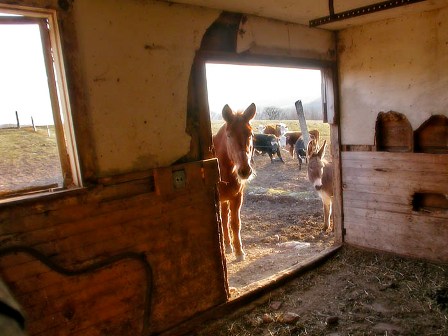
The first article ("Iraqi donkey finally in U.S.") is about a donkey, adopted as a mascot and named "Smoke" by retired Col. John Folsom's Marine unit stationed at a base in Iraq in 2008. When his unit left, the remaining Marines at the base continued to care for the donkey; once those Marines left, the Army soldiers at the base handed the donkey off to a local sheik who proceeded to neglect the former mascot. Folsom and some others found out anda massive effort spanning continents and featuring the help of military officers, government officials, foreign journalists and many others [ensured, with t]he Society for the Prevention of Cruelty to Animals International rais[ing] money to cover the thousands of dollars it cost to transport Smoke to the United States.
And how did Folsom, his friends and family and "members of the local horse set" celebrate Smoke's arrival in the U.S.? Folsom'sfriends Debbie and Alan Nash hosted the welcome-to-America party on their polo horse farm"[where t]hick New York strip steaks and pork ribs sizzled on the grill.
Folsom's efforts were not lost on assembled guests, who expressed their admiration of his beautiful gesture: “'It's wonderful they rescued this donkey,' said Carl Cox, who goes fox hunting with Debbie Nash and came to see the donkey".
After the rough life Smoke's had and what was surely the somewhat traumatic event of being transported halfway around the world, one would think that the rest of his days would involve some peace and quiet, but Folsom has other plans for the donkey:He'll soon start his new job, providing comfort to veterans at Take Flight Farms. The Omaha nonprofit uses horses to provide equine therapy to military veterans struggling with post-traumatic stress disorder.
"That's a fine animal which can benefit humans in so much better ways, Why don't people get that?" -- Jaeshik
"I do not believe in eating companion animals or recreation animals, but that notwithstanding much if not most US horsemeat is simply not safe for human consumption." -- Marybeth Kuznick
So on the one hand, some see horses as having a different "purpose"or as having a multitude of better uses for humans than that of being served up on a plate: They deserve to be a different kind of property. On the other hand, those who seem to view any non-human's flesh as fair game are mostly concerned with what they see as the danger of consuming an animal not raised from the ground up to end up on said plate. Many of the Huffington Post comments (and other comments I've seen online) in response to the story describe the inability to ascertain the types and amounts of medications administered to the horse throughout his life. This of course perpetuates the myth that the flesh of animals raised from "cradle to grave" for human consumption is free from potentially dangerous chemicals.
"These horses aren't purpose bred for meat, there is no traceability in place and no regulations as to the mediciation they are given. These are lesson horses, dressage, jumpers, ropers, trail riding, backyard, racing, carriage, used up mennonite, police, rodeo, RECREATIONAL HORSES. I will never purposely eat horsemeat, but if they were actually raised like beef from the time a foal hits the ground, including ear tags, production records, traceability, etc and handled in a more humane way to slaughter then it would be more palatable. What RIGHT does the pleasure horse industry have to suddenly turn their horse into human food when they're done with them? What RIGHT do they have to be able to sell their horses as meat for human consumpion on an honour system?" -- LJ60
Unfortunately, the few who do seem to point out (and rightly so) that eating the flesh of a horse is no morally different than eating the flesh of a pig or cow seem to be the "expand your palate" types, suggesting that people loosen up and try it, along with other bits and secretions from any number of other non-human animals not usually viewed as "food" in the West.
(Me? I'm just waiting for a PETA press release proclaiming that horse consumption is somehow more markedly "inhumane" than other forms of animal consumption this week .)
Want to spread some more clarity and consistency in how we view non-human animals and how we choose whether or not to use them? If you're not vegan, go vegan; if you are, talk to others about going vegan today!
Monday, May 16, 2011
The Roles We Assign

Wednesday, October 27, 2010
No Such Thing as a Vegan?
A friend of mine who likes to play devil's advocate occasionally sends me articles or other materials he stumbles across online that appear to challenge veganism. Last week he sent me a graphic from the Gizmodo website with the headline "There Is No Escape from Cows" and with the smug sentence "There's no such thing as a vegan" running across its bottom (see below). 
As most vegans already know, animal-free alternatives to many of the items listed off can be found quite easily (e.g. shampoo, vitamins, cosmetics, deodorant, detergents, candles, candy, fertilizer, pasta, cake mixes, et al.) and many are just altogether easily avoidable (e.g. anti-aging cream, matches, et al.). It may not always make life convenient to look for alternatives or to refrain from using certain products, but veganism isn't about doing what's convenient for us. Veganism is about not using non-human animals as things that exist for our convenience.
In cases where animal-free versions of certain products cannot be found and where the use of such products is unavoidable and necessary (e.g. certain medicines), then we all do what we need to do to stay healthy and alive. It's important to remember that with certain medications contain animal products used as fillers or inactive ingredients (e.g. gelatin capsules) that it is entirely possible to seek out and find versions that do not contain any by simply sourcing the medication from a compounding pharmacy. This should always be explored and chosen if it's an option. On the other hand, there are cases where a medication's active ingredients are animal-derived and where the use of this medication is required. In those cases, such use may not feel "right", but it can certainly be excusable (and even justifiable). I have as much interest in continuing my life as any other human or non-human animal, no?
That this is so by no means entails that "some use" of non-human animals can always be excused or justified, of course. Context is everything. Is it possible in this overwhelmingly speciesist world to live a life that is 100% free of the use of animal products? Of course not. Does this mean that it's OK to sneak in the occasional chicken wing for kicks and still call yourself a vegan? Again, of course not. But veganism is a lifestyle that's the hands-on application of an ethical framework where every single day you need to inform yourself so that you can assess situations and make the proper choices. Some of those choices we make as vegans when it comes to our own self-preservation end up being very personal ones, but those decisions we take and those choices we make need to be taken and made in good faith.
To learn more about going vegan and about the abolitionist approach to animal rights, check out the Animal Rights: The Abolitionist Approach website and stop by its brand new discussion forum.
(Note: Edited to clarify a few potentially confusing points.)
Monday, June 21, 2010
On Speciesism and Commodification
"Speciesism is wrong because, like racism, sexism, and homophobia, it excludes sentient beings from full membership in the moral community based on an irrelevant characteristic. Race, sex, sexual orientation, and species are all irrelevant to the capacity to be harmed.
But the rejection of speciesism on this ground implies the rejection of discrimination based on race, sex, or sexual orientation. It is unacceptable to perpetuate the commodification of one group for the benefit of another. Commodification involves treating the other—whether a woman, person of color, gay or lesbian, or nonhuman—as an object, as something rather than as someone."
-- Prof. Gary L. Francione, "The State of the Movement" (2007-01-24)
Friday, June 18, 2010
Bad Reputations
 Rock icon Joan Jett has been a celebrity mouthpiece for PETA for years. She's also often misrepresented in the media and by animal advocacy groups as being vegan, even though she consistently shows up at public events wearing her trademark leather pants and other leather clothing. She set the record straight about her non-veganism recently in an article in the New York Observer:
"If not wearing leather would stop animals from getting eaten, then I'd stop wearing leather tomorrow," said Ms. Jett, who recently released a greatest-hits album and a new book and is played by Kristen Stewart in a new movie, The Runaways. "At least I can sit there and thank the dead cow for letting me wear its skin."The non-human animal enslaved and slaughtered and whose skin Jett continues to wear to maintain her rock 'n' roll image doesn't care whether his or her parts ended up in her body or on her body (or "its" parts, as Jett might prefer to say). It's not how we use non-humans that is significant; what's wrong is that we use them at all.
Add to all of this that PETA described her as handing out "vegetarian/vegan starter kits" for it in NYC a few months back. Whether PETA was using the terms 'vegetarian' and 'vegan' interchangeably (which is problematic in itself, albeit not surprising from PETA) or unapologetically non-vegan Joan Jett hit the pavement to promote that which she herself opts not to embrace, my head could very well implode trying to peel away the layers of muddled contradictions and moral confusion.
If Jett's inability to "get it" with regards to animal use isn't apparent in the previous quote, how about this one from PETA's GoVeg.com website, where she responds to a question concerning how she feels about people who wear fur?
I believe they are callous and self-involved. With such good-quality imitation fur available for making clothes, etc., there is no reason to torture animals. It’s the “out of sight, out of mind” syndrome. Put fur lovers’ legs in a steel trap for a few days, or whack ’em on the head with a club, and maybe they’ll get it.So eating animals is wrong and wearing their skin with the fur still left on it is worthy of having your leg put "in a steel trap", but wearing that skin is perfectly alright as long as you unhair it first? From Jett's first comment, I am guessing that she assumes that all leather comes from cows raised for human consumption and thus attempts to justify her use of it in that she figures that the cows are dead anyway. This is far from being a given, though.
What's somewhat ironic is that PETA, itself, has a blurb about leather on its site where it states the commonly known fact that leather can come from the skin of a wide variety of non-humans (e.g. cats, alligators, kangaroos, ostriches, and more -- some of them raised specifically for the human use of their skin). PETA points out that since leather is generally not labeled, there's often no way to tell whose skin you're wearing (as if it should matter whose skin it is, honestly). PETA also states on its site that the leather industry is the most economically important by-product of the meat industry, helping to prop it up financially. What PETA doesn't mention is that the skin of calves helps prop up the dairy industry even more so -- whether taken after they are slaughtered to become "veal", or taken from the fetal calves of spent pregnant dairy cows at the time of slaughter. Providing demand for a cow's skin ensures the continued profitability of the beef and dairy industries -- dots which Jett, unfortunately, fails to connect. What's most important to remember, though, is that condoning the occasional use of some parts of some non-human animals for human pleasure merely perpetuates the status quo -- that animals are things for us to use. Is that really the best way to advocate for them?
----------------------------------
For more information about PETA and the many dots it miserably fails to connect, itself...
Please check out Dan Cudahy's Unpopular Vegan Essays blog here.
Visit Animal Rights: The Abolitionist Approach to read Prof. Gary L. Francione's articles on how PETA kills animals and has been killing animals for a while, and on Ingrid Newkirk's defense of PETA's speciesist and sexist campaigns (and check out a few examples of the sexist campaigns here and here). Also read about how PETA gives awards to animal exploiters like KFC and works with them to make people feel better about continuing to consume animals.
Have a look at previous My Face Is on Fire posts to read about how some of my fellow abolitionists and I got fed up and wrote a letter rejecting those sexist tactics used by groups like PETA in the animal advocacy movement. Also read an example of how PETA profits from animal exploitation, how it misrepresents veganism while promoting the consumption of animal products and finally, how PETA's Bruce Friedrich has shamed vegans for asking waiters about ingredients on restaurant menus.
Friday, May 07, 2010
Got Milk?
 Every year around Mother's Day, I notice more vegans and animal rights advocates posting reminders in online message forums, via social networking and on blogs about the forgotten mothers in the dairy industry. I stumbled upon a piece by someone called Jocelyn Hoppa when nosing around online this morning that I initially figured would sound a lot like the other articles in circulation ("On This Mother's Day, Take a Moment and Think of the Plight of Mother Cows"). She writes:
 Generally, once the mother cow gives birth, her baby is taken away from her. Can you imagine? Apparently mother cows bellow for days looking for their babies. Then, the mothers are hooked up and milked, which is cold and painful—a very different experience from that if she were nurturing her young. Then, after enduring this for years, they get turned into cheap hamburger.
And then she even offers up health-related concerns about consuming dairy products:
If a story like this does inspire you to give up dairy, you should know that humans do not necessarily need to consume dairy for health. Calcium is found in plenty of plant foods, like leafy greens, sesame seeds (again, who knew?), fortified juices and cereals. A lot of people make the case that dairy products actually make us less healthy, because the saturated fat clogs our arteries and also its protein has an acidic nature that aggravates osteoporosis. Which certainly contradicts the notion of drinking milk for calcium for stronger bones.She spends most of the article communicating that she thinks that cows are mistreated and that dairy is unhealthy, yet also throws in the following:
I'm not vegan or anything, but this is a horrifying depiction of a process that, up until reading this note, I knew very little about. Why I ever thought cows just produced such large quantities of milk without having a ton of babies is beyond me.So, never minding the part where she's managed to overcome her previous understanding of how mammals spontaneously produce milk out of thin air, after all of this: "I'm not vegan or anything"? At the very least, you'd half-expect her to express an intention to go vegan, but it doesn't happen. Obviously, presenting someone with welfarist arguments (involving what she, herself, calls "horrifying" facts about the treatment of nonhumans) and information concerning the unhealthiness of consuming their flesh or secretions don't quite do the trick. Adding further weight to my hunch is the first comment left in response to her article, in which someone recommends Jonathan Safran Foer's beautifully written piece of garbage, Eating Animals, to supposedly learn more about how the treatment of non-humans in "factory farming" is actually "much worse". It's no real surprise that the commentator adds to this that dairy (the discussion of which is pretty much omitted in non-vegan Foer's book) is the "least of [her] worries".
So how best, then, to educate others about veganism? Talk to them about the right all sentient animals have to not be used as things; focus on how their sentience leaves them with an interest in living out their own lives as individuals -- not as our property. It's important to know all of the ancillary reasons that consuming the flesh or secretions of other animals is wrong, but it's crucial to know and understand the most important reason. Start at the root by educating yourself about animal rights by reading Gary L. Francione's Introduction to Animal Rights: Your Child or Your Dog.
For more information on abolitionist animal rights, please visit the Animal Rights: The Abolitionist Approach website.
Thursday, April 01, 2010
On Goodall and Hummus (i.e. More Things Overheard)
In a Huffington Post interview with Marianne Schnall today, Dr. Jane Goodall displayed a disappointing and marked lack of consistency in her view of whether nonhuman animals exist solely for human use and pleasure. To defend her own choice to use nonhuman animals, Dr. Goodall fell back on that old familiar excuse that veganism is "just too hard". When asked about the hypocrisy of calling one species 'pet', while calling another 'pest' (in this case, with reference to hamsters kept in cages vs. mice killed in traps), she responded:

And you get the white coated scientist who has a dog at home who's part of the family who understands ever word I say - but then he goes and puts on his white coat and does unspeakable things to dogs in the name of science. There's a real schizophrenia. Yes, we are very peculiar [laughs].Then, after describing the health benefits she experienced when she chose to stop eating meat, she was asked about going vegan and responded:
Well, I can't go vegan because travelling like I do, I really, really don't think I could. You know, it's really difficult. And I stay with people - we had a vegan staying us one time, and it's very difficult. Three hundred days on the road - you go to North Korea - it's jolly hard to be vegetarian much less a vegan [laughs]. But I do my best. And if people would think about intensive farming - if they would think of the damage to the environment of growing all this corn or raising all these cattle. If they would think about the torture of the animals on the intensive farms. And then if they would realize about the antibiotics getting out into the environment, the bacteria building up resistance and the superbugs that we are breeding, more people would become vegetarians.So she has no difficulty promoting vegetarianism for the environment, for one's health and because of "the torture of the animals on the intensive farms" -- but veganism (i.e. refraining from using animals and their products altogether) is off her radar because it's "very difficult". Considering that as recently as 2007, Goodall was asserting that some cases of vivisection could be justifiable, and that vegetarianism is "not necessarily an option that everyone has to adopt" ("Goodall on Vivisection and Vegetarianism", from Animal Rights: The Abolitionist Approach), her own schizophrenia today isn't all that surprising. There were bits in the rest of her interview that I also found disconcerting. For instance, a) she presented what she called "good zoos" as perhaps being a better place for primates to be than in the wild where they still experience "fear" and "pain", yet b) states later that chimpanzees or the "voice of the natural world" would, if given the opportunity, tell us to bug off and stop interfering and then c) asserts that humans need to get involved--that we "have to go in and manage very often". The one thing that is clear from the interview is that Dr. Jane Goodall thinks that some animals are ours to use--just not the specific ones that she doesn't want us to use.
------------------------------------------------
I found an interesting looking recipe for hummus this morning that uses ginger and heaps of fresh mint to flavour it. The filler in the article that leads up to the recipe, however, left me with a (yep--here I go) bad taste in my mouth.
Because they don’t eat dairy products or meat, vegans can have difficulty getting enough protein in their diet. Combining grains and legumes can be a good source of protein. This hummous can be made with a whole grain to ensure for maximum protein intake.Vegans do not have difficulty getting enough protein in their diet and the whole protein combining theory has been discredited. Why, oh why do people not take 10-15 minutes to do a little bit of background research before perpetuating misinformation? The folks at the University of Victoria's independent paper The Martlet should know better!
Saturday, March 13, 2010
No Emily, Veganism Isn't Just About You or Me
A self-described vegan called Emily Weingarten wrote a fairly negative review of Bob and Jenna Torres' Vegan Freak: Being Vegan in a Non-Vegan World for the AnnArbour.com website yesterday ("We're vegans, not freaks"). I admit (with a small amount of embarrassment) that I have not yet read the book. It's been on my "must read" list since I first stumbled across their Vegan Freak Radio podcast a few years back. The podcast was where I first learned about abolitionist animal rights and Bob and Jenna were the first two vegans I'd ever heard discussing veganism as anything other than a "personal choice". I had spent years wandering about in various online vegetarian communities where vegans were often labeled "extremists" and where vegans having the audacity to talk about veganism were often chided for hurting others' feelings by suggesting (or even rudely asserting) that consuming dairy or eggs or using any other animal product was wrong. Hearing Bob and Jenna's podcast was a relief; Bob and Jenna's were the first two voices I'd ever heard presenting veganism as the absolute least we can do if we're serious about the rights and interests of nonhuman animals, and they did so in this matter-of-fact way that made veganism sound normal and the consumption and use of nonhuman animals sound extremist.
Their podcast also led me to the serious and earnest study of Prof. Gary Francione's writings and of his abolitionist approach to animal rights, which has the sort of clarity that left me sorry I hadn't had it pointed out to me sooner, so that I wouldn't have wasted years fooling myself into thinking I was doing enough for animals. (It's kind of funny and completely coincidental, actually, that with the exception of a brief mention of my interest in Prof. Francione's work a few months beforehand, my first actual post discussing it in any way was almost exactly two years ago.)
So why am I writing about a review of a book by a couple whose advocacy literally changed my life, when I haven't in fact read it? It's not so much what Weingarten said about the book itself that I want to address, as much as what she makes obvious feeds into what she's said. Before she dives into that, Weingarten says of the Torres' book that
Vegan Freak is a sort of vegan manifesto in which the authors [...] attempt to instill vigor and commitment into already-vegans and inspire non-vegans to take on the lifestyle. There isn’t anything wrong with this. Sometimes the only way for vegans to get respect is to be able to eloquently state their reasons for being vegan and to be consistent in their diet and lifestyle.After what to many might sound a fair and reasonable statement, Weingarten continues, throwing in the "however" which is the raison d'être for her entire piece: "Inspiring others to be vegan is OK, so long as it doesn’t go too far." What could she mean by "too far"? She provides one example of it in pretty explicit detail when she states that it's not her intention to focus on that particular example of it:
I don’t want to write a blog entry criticizing Vegan Freak because the authors spend so much time criticizing anyone who is not vegan and using a variety of other negative tones such as cursing profusely and making bad sexual jokes.Now, I don't want to write a blog post criticizing Weingarten for criticizing Vegan Freak's authors for engaging in what she views as their unacceptable behaviour or delivery, partially because she cites no specific examples of it (and I haven't read the book). Most importantly, though, since I haven't read the book and since humour and tone are such subjective things I could get lost in trying to deconstruct what she means by "criticizing anyone who is not vegan" and discussing the thousands of increments between words like "tasteful" and "prudish" that would come up in discussing language use and sexual references. Instead, I want to focus on the remainder of Weingarten's review, which isn't so much a review of the book, as it is a lecture on appropriate behaviour for vegans--her own "manifesto" of sorts.
Weingarten writes, first, that "[a]ny reasons for being vegan are great, so long as they are motivated by a desire to create some sort of positive change." I sort of agree with that. I mean, environmental and health factors are certainly valid motivators to go vegan, for a variety of complex reasons. She writes this, however, as if wanting to criticize the Torres' focus on what is ultimately the most important reason anyone should have to stop using nonhuman animals--the basic immorality of using them at all. It's a tiny shaming, really, that could be overlooked if not for the fact that it becomes a recurring theme in her piece. She goes on to emphasize the "green" factor further in a second point by making the mistake of creating a false dichotomy, asserting that "[e]nvironmental vegans are just as valuable as ethical vegans". As seen in a recent essay on the Animal Rights: The Abolitionist Approach website, it's not an either/or situation ("Veganism: Morality, Health, and the Environment"). For further reading on veganism, animal rights and environmentalism, do check out Vincent Guihan's essay from last August on his We Other Animals blog ("I would throw 1000 ancient redwoods out of the lifeboat to save one kitten! It's not because I'm bad; it's because plants aren't sentient").
Weingarten really goes downhill from there. Her third point is "Veganism is about you", and in it--never mind the wrongheaded title of the point itself--she makes two errors. The first is that she more or less contradicts a statement made in her first point, where she asserted that one's reasons to go vegan should not be selfish ones--that they should not be "vain". In explaining her third point, she writes about veganism being about making yourself feel better and reassures her readers that "[i]t’s OK to be proud of yourself for making these personal choices". So... it both should and shouldn't be about patting yourself on the back. Her second error involves trying to redefine "veganism" to include the option of deliberately choosing to use animal products; if you have any doubt of how "personal" she feels these "choices" are, note this particularly confusing statement:
Being vegan might also make you consider how the clothes you wear make you feel, and you might stop wearing leather, wool, and silk.I'd like to think that Weingarten slipped and actually knows that "being vegan" means that you don't wear leather, wool and silk--not just that "you might stop wearing" them. Maybe her slip-up was due to the fact that those words were mostly filler leading up to the bona fide punch of her point (i.e. another otherwise easily overlooked tiny shaming of the Torres' or of other vocal vegans that just adds to the small pile that is her recurring finger-wagging theme) where Weingarten reminds vegans to act with "modesty and humility around non-vegans". (Disapointingly, though, Weingarten does indeed go on to further illustrate her confusion about what is meant by "veganism" a bit later in the piece.)
Weingarten's issues with vocal vegans who choose to educate others about veganism become even more apparent as she goes on to explain that since the "whole world isn't going to stop eating meat" and we "cannot expect our entire society to adopt a vegan lifestyle when meat and dairy are central components of most Americans’ diets", we apparently need to 1) manage our expectations of others' behaviour and (hey, since everybody else is doing it anyway, and we don't want to look like unreasonable extremist "freaks" or anything) 2) change our own behaviour to better adapt to the expectations of others that we be more like them when it comes either consuming or not consuming animal products. Weingarten's opinion of vegan advocacy is summed up when she says:
What we can do is support the people who are interested in learning more about vegan lifestyle and possibly becoming vegan without alienating ourselves by projecting our vegan philosophies on others who may not be interested at all.Let me translate: Go be vegan in the world and if someone happens to notice and to express curiosity about it, great, but otherwise, shut your pie-hole about it, because telling people that using animals is wrong is preachy and rude. Have any doubts about Weingarten's opinion being that avoiding being rude to your fellow humans trumps the rights and interests of animals? Read on:
Yes, the dairy industry can be just as cruel and unethical as the meat industry, but vegetarians and vegans have many common values, and as vegans, we must respect that in order to be respected.She admits that although consuming dairy is unethical that to obtain respect, vegans in turn need to "respect" (i.e. turn a blind eye to the fact) that vegetarians continue to engage in this unethical behaviour and opt to exploit animals since we apparently have "common values" (which obviously exclude those values that lead vegans to refrain from continuing to voluntarily and knowingly use animals as things). But according to Weingarten, in yet another little shaming, merely voicing the obvious truth would be disrespectful.
Furthermore, one's so-called "personal choice", as Weingarten so adamantly described it, suddenly becomes a public and political one when faced with whether to leave aside our ethics to instead consume animal products offered to us by others. According to Weingarten, it seems that non-vegans are emotional messes incapable of processing someone's being consistent about his or her ethics; suddenly, the "no, thank you" involving eating animals or their secretions becomes a selfish choice. To illustrate this, Weingarten, the self-described vegan, writes:
It might make me a speciest [sic] to say this, but people are much more important to me than animals. So if on my birthday, someone makes or buys me a non-vegan cake, I’m going to have a slice to avoid offending that person or causing hurt feelings.So, on top of not talking to non-vegans about veganism, lest you offend them, being a really good vegan also means eating animal parts or secretions, lest you "offend" that non-vegan by refusing to do so. Yet, strangely, at the beginning of her piece, Weingarten herself wrote that
Sometimes the only way for vegans to get respect is to be able to eloquently state their reasons for being vegan and to be consistent in their diet and lifestyle.Weingarten then wraps up her piece by going back to the book and claiming that it lacks the "compassion, humility, peacefulness that is [sic] inherent to a vegan lifestyle". The truth is, though, that Weingarten's article displays a lack of the sort of consistency, logic and understanding (most notably of veganism, itself) that are inherent to actually being able to comment with any sort of authority (or sense, really) on veganism or on how vegans should behave in the world.
Her piece isn't so much written in good faith as it is a passive-aggressive reprimand of vegans who don't stay in the vegan closet. It ends up conveying a sense that vegans are outcasts who should keep their veganism to themselves unless asked (although if vegans should hide their veganism, one is left to wonder how non-vegans would even think to ask about it). It conveys that that vegans should keep their veganism to themselves, even if it means compromising their ethics to avoid hurting the feelings of those who choose to keep treating nonhuman animals as things for human use and enjoyment. I don't know about you, but I think that we owe nonhuman animals more than to agree to behave as if it's somehow improper to assert that it's wrong to use them as our property. Weingarten, on the other hand, makes it clear that she thinks that we owe nonhuman animals less. That, in fact, is a shame.
Saturday, March 06, 2010
The Importance of Vegan Advocacy
Educating others about veganism is one of the six principles of the abolitionist approach to animal rights. Promoting anything less is promoting or endorsing the continued use of animals, and one's own decision to become vegan is merely a starting point in terms of everything we can do to teach others to stop using animals as property. As Vincent Guihan points out in his latest blog post at We Other Animals, educating others about veganism literally "lay[s] the groundwork for abolition" but there is so much more in addition to it that abolitionists can and should do for nonhuman animals.
Check out my friend Pao as she throws her own two cents in to discuss why we should be advocating for veganism (check out her YouTube channel for more videos at porolita22). For more information about the abolitionist approach to animal rights, visit Prof. Gary L. Francione's website, Animal Rights: The Abolitionist Approach.
Thursday, March 04, 2010
Why I Will Not Advocate Vegetarianism
Honesty as "Bashing"
A vegetarian blogger recently lambasted me on Twitter for having called for consistency in animal advocacy by asking vegan activists not to mince words or water down their message to advocate anything other than veganism. I pointed out that to endorse anything less makes as much sense as endorsing part-time murder or part-time child abuse. If one takes the interests and rights of nonhuman animals seriously, how can one reconcile this with supporting someone else's continued exploitation of animals? The blogger took issue with this and used it as an opportunity to promote a post he wrote ("Veganism is a Part of Vegetarianism") accusing those calling for veganism of being "vegetarian bashers". In this piece, VegBlogger asserts that it is "counterproductive to vegetarianism as a whole (which includes veganism) to bash vegetarians or vegetarianism" and makes clear that "bashing", in this case, means:
- that "they are doing no good" (i.e. to point out that animal exploitation other than the actual consumption of animal flesh is immoral), and
- telling vegetarians that they are "the same as an omnivore" (i.e. to point out that there is no significant ethical difference when it comes to animal exploitation whether you consume the flesh or secretions of animals).
It Is What It Is
The truth is that there is as much--often more--suffering involved in dairy or egg consumption as there is in meat consumption. There is no less death involved. Calves are taken from their mothers and sent off to slaughter in the dairy industry, male chicks are killed--sometimes ground alive--in the egg industry. In both industries, the the milk-producing cows and egg-laying hens' daily lives are filled with misery and as soon as their production goes down, they're sent off to slaughter, as well, to in turn be used for food. When one consumes animal products, one continues to commodify nonhuman animals--to treat them as things that exist to satisfy our selfish urges. One continues to be complicit in all of this. This isn't just a matter of opinion leading to the unwarranted wagging of a finger. The facts are what they are and to try to convince oneself otherwise (i.e. that the consumption of animal products like dairy and eggs is less ethically problematic than the consumption of animal flesh) is self-delusional; to perpetuate that sort of confusion in others who choose to continue exploiting animals is both dishonest and misleading. If a vegetarian who consumes animal products finds the truth "insulting" or offensive, that's unfortunate, but it doesn't alter the facts.
On Stepping Stones and Shuffling
Some, like VegBlogger, insist that an exception should be made for vegetarianism (i.e. the consumption of animal products other than flesh) since vegetarianism is a "stepping stone" to veganism. The example often brought up is that most vegans were once vegetarians; most vegans were once omnivores, too, yet few would jump at positing a causal relationship there. The reality is that vegetarianism is no more a stepping stone to veganism than any other altered form of omnivorism is a stepping stone to veganism. If anything, humans sometimes get lulled into complacency by deluding themselves that they're doing enough by merely cutting out this or that animal product. I know this firsthand--I was a lacto-vegetarian for many years and I truly wish that, rather than pat me on the back and reassure me that I was doing enough, someone had actually talked to me about veganism.
Thinking that shuffling out this or that animal product is "enough" is like telling oneself that it's alright to beat the hell out of one's child on Tuesdays as long as one refrains from doing so the rest of the week. An accusation often thrown at vegans for being unequivocal about vegan advocacy is that we present an "all or nothing" dilemma that purportedly sends so-called potential vegans back to their omnivorous ways. If my neighbour told me that she only beats her child on Tuesdays and I told her that she needed to stop completely, would it make sense to accuse me of sending her back to beating her child everyday by taking an "all or nothing" approach to the situation? Would it make sense to accuse me of "insulting" her if I asked her to stop altogether? Would it make sense to say that I was "insulting" every other person who chooses to beat his or her child on one single day a week (i.e. rather than everyday) since I was ignoring that "every little bit counts"? Of course not. So why is it such an issue when we're discussing the interests of nonhuman animals? Is it because their interests are not as significant to some as those of humans? Is that not speciesist?
We owe nonhuman animals more than to let human feelings trump nonhumans' rights to not be used as things. I also think I owe my fellow humans more than to lie to them about what we owe those nonhuman animals. I'd like to give my fellow humans enough credit to think that they can handle the truth and act accordingly, rather than mislead them into continuing to exploit nonhumans, which is what I'd be doing by advocating vegetarianism or any other type of nonhuman animal consumption.
Further Information
For more information on why we should persevere in educating others about veganism and why stopping short by endorsing vegetarianism as an ethically significant "step" is problematic, please visit The Abolitionist Approach website to read these three essays:
"Vegetarianism as a "Gateway" to Veganism?"
"Some Comments on Vegetarianism as a "Gateway" to Veganism"
"Vegetarianism First"
Also visit Dan Cudahy's Unpopular Vegan Essays blog to read his essay "What Is Wrong with Vegetarianism".
Go vegan. It's the right thing to do and it's an easy and healthy thing to do.
Sunday, February 14, 2010
Never Forget
For more information on veganism and the abolitionist approach to animal rights, please visit the Abolitionist Approach website.
Wednesday, December 16, 2009
THE WORLD IS VEGAN! If you want it.
Yesterday, Prof. Gary L. Francione wrote on his Abolitionist Approach website about setting up a virtual billboard to "spread the message that nonviolence against our nonhuman brothers and sisters is possible—if we want it". To do so:
Send this message on all your social message boards and ask your friends to send it on theirs. Text your friends and ask them to text their friends. Add this message to your signature line on your emails. Let’s start a friendly wave of creative, nonviolent vegan education.Today, the remarkably multi-talented Vincent Guihan (who writes the We Other Animals blog and maintains the abolitionist Animal Emancipation discussion forum) created some banners that can be used for this very purpose. You can find them here (along with their HTML code) and re-post or distribute them freely.
Take the opportunity to share your vegan story when you do, or to talk to people about how easy--and right--it is to go vegan!
Monday, November 23, 2009
Shocking People into Short-Term Change (a.k.a. Animal Advocacy Fail)

PETA, also known as People for Ethical Treatment of Animals, is responsible for the reason I can no longer stomach a beef gyro. You see, PETA has conducted an array of investigations on the management of slaughterhouses throughout the United States, and I was lucky enough to learn about their studies. Given little time for mental preparation, my health class began showing clips of animals all mutilated in the process of mass meat distribution. Before that, my theory was, “If you don’t have to meet it, then why can’t you eat it?” However, this video greatly challenged my ability to continue turning the other cheek. I realized that these helpless chickens and cows had families, careers and homes, all beyond our understanding.Friedman then proceeds to write about her ensuing period of vegetarianism and how she spent all of it drooling all over herself with her near-madness-inducing cravings for the flesh of dead animals. Until the day a turkey pecked her and purportedly gave her an excuse to eat turkeys again. I'd hate to see what she'd do if a toddler slapped her shin or her cat stepped on her arm in her sleep.
Now, obviously Friedman's piece is none-too-serious. I suspect that she wrote it with her fork firmly lodged in her cheek, bent on writing something titillating in time for Thanksgiving. However, I thought that her PETA example provided a good opportunity to address the issue of using violent imagery to discourage people from maintaining the daily habits that leave them, in turn, participating in the cycle of violence that is the continued exploitation of nonhuman animals. As Prof. Francione points out in his piece "A Comment on 'Blood and Guts' Advocacy", there are many ways in which using violent imagery becomes problematic when one is engaging in animal advocacy. First, you risk alienating some people (thus losing the opportunity to educate them about veganism) since some will flat-out refuse to look at the images and shut themselves off altogether. On the other hand, thanks to overexposure to graphic imagery on the telly, at the movies and so on, attempting to shock people out of consuming animals could be met with a shrug of indifference.
The most problematic aspect of using graphic imagery to advocate for animals, however, is that it can often turn the focus away from use and instead leave it on treatment, as if the fact that nonhuman animals were being raised to be slaughtered would somehow be more acceptable if the images were of "happy" animals. Take, for instance the Humane Society of the United States' (HSUS) recent investigation into the treatment of calves at Bushway Packing, Inc., where they claim to have discovered signs of "shocking" cruelty at this one location. As Wayne Pacelle states in his A Humane Nation blog:
It’s always deeply disturbing to see the mistreatment of animals, but there’s something even worse when the victims are babies and seem so utterly vulnerable and frightened.The footage is indeed shocking, but it's not exactly breaking news. Every single nonhuman animal bred and raised for human consumption is forced to live an existence that is "disturbing", where he or she is deprived of living a life according to his or her own interests; every single nonhuman animal bred and raised for human consumption is merely shuffled and shoved according to whatever is most convenient and cost-efficient until the day comes when his or her life is taken. And what for? To end up with pieces of his or her cooked flesh on a plate. Every single animal bred into slavery as part of a cycle that leads to his or her consumption by humans is "utterly vulnerable and frightened". This is not the exception--it is the norm.
So HSUS presents its "shocking footage" and instead of taking the opportunity to inform the general public that this is, indeed, the status quo for most animals we call "food" and to press for the general public to disengage itself from this cycle--to stop providing the demand that perpetuates this cycle of slaughter, it uses footage such as this to prompt people to continue funding its anti-cruelty campaigns seeking to regulate what is ultimately the continued use of animals. As Prof. Gary L. Francione has illustrated and explained repeatedly over the years, regulating the treatment of nonhuman animals is beside the point:
We certainly ought to make clear to the public the nature of the treatment of the animals we consume. But we also should make it clear that this system cannot be fixed in any way that would address the fundamental moral concerns. We should not promote the idea that some of this is “abuse” and some is not. It’s all abuse. It’s all morally unjustifiable. We should never use the word “humane” to describe any component of this machine of violence, torture and death.There is really no such thing as "humane" treatment and images such as those captured by HSUS in this (and numerous other investigations) are the bona fide norm, and not exceptions that can somehow be "fixed" by HSUS or any other welfarist or new welfarist organisation. As Prof. Francione states, "We have got to get away from this fantasy that it is possible ever to produce animal products without torture. It’s impossible. [...] Consuming animals necessarily means that we support torture."
The bottom line is that violent video footage may shock some people into making changes in their lives, but those changes may be the wrong ones. And even if they are the right ones, there's no guarantee that the shock won't wear off sooner than later, particularly if the imagery ends up associated with treatment instead of use, and that any false-impression given that treatment has improved won't lull humans back into that same sort complacency that allowed them to turn a blind eye to the cycle perpetuated by their initial demand in the first place. The truth is that many welfarist groups use violent imagery as a tool to emphasize the need for further regulation of the continued use of animals and that the general public is most often exposed to those images within that context and with that subtext.
The current paradigm can only be shifted by making people understand why it needs to be shifted. The only meaningful, unequivocal and lasting manner in which to convey to people how and why sentient nonhumans have the same right not to be treated as things as sentient humans is through nonviolent and creative vegan education. You cannot rely on images alone without explanation, and for advocates seeking the abolition of the use of nonhuman animals to really make a difference in the lives of thos nonhuman animals, that explanation needs to address the immorality of using animals as things in the first place.
Wednesday, August 26, 2009
Using Violence to Stop the Violence?
"The essence of nonviolence is love. Out of love and the willingness to act selflessly, strategies, tactics, and techniques for a nonviolent struggle arise naturally. Nonviolence is not a dogma; it is a process." -- Thich Nhat HanhI've been spending a lot of time thinking about violence over the past week. I mean, I've been spending a lot of time thinking about human violence--over and above the violent acts humans already commit against nonhumans every single day for the sake of human pleasure. There are some in the animal advocacy movement who believe that the only way to bring about the
 end of the everyday violent acts humans commit against nonhumans is to, in turn, commit violent acts against those humans. Considering that (depending on whose survey you read) a mere 1.5-2.5% or so of the population of the United States, for instance, self-identifies as vegan and claims to abstain from consuming animals in any manner, this basically means that a few individuals making up an ever-so-tiny fragment of that less than 3% want to put the smack down on the other 97%+ of the population to get them to stop killing the over 10 billion animals in the United States alone who are killed each and every year. (Uh, yeah--good luck with that.)
I won't ramble on about why committing violence to end violence is wrongheaded. Abolitionists like Vincent J. Guihan (over at his blog We Other Animals) have already made clear cases for the common-sense, efficacy and logic in using nonviolence and vegan education to effect change for nonhumans. For instance:
As advocates, our work is not a matter of reaction; it is a matter of transformation. We have to struggle to avoid confusing the wallpaper for the walls. We have to struggle to avoid confusing our work pulling down the walls of the house of slavery and violence with building those walls back up again through violent and confrontational behaviour of our own. We can only “tear the house down” by convincing its other builders to join us, not with threats and idiocy, but creative and nonviolent education that calls them to join us in a life that respects the rights of other persons to be free from violence and slavery.It baffles me, really, that anyone would truly think that using fear and intimidation will change people's hearts and heads to allow the major paradigm shift that is needed to stop the overwhelming majority of us from thinking of nonhuman animals as things that exist solely for our use and pleasure--as our property.
Prof. Gary L. Francione, who has consistently promoted nonviolent vegan education to abolish the exploitation of nonhumans (you can read a couple of his earlier essays here and here), has also re-emphasized the avoidance of violence by vegans and animal rights advocates in his recent responses and reactions to the more recent calls for violence by a very few in the animal advocacy movement. He's done so in his podcast commentary of a few days ago, as well as over on the Opposing Views website and on his Facebook page, where discussions pertaining to the subject have been ongoing for several days on his Facebook
 profile page. It's on this Facebook page that Prof. Francione recently revealed that he has invited Steve Best, associate professor of philosophy at the University of Texas at El Paso and spokesperson for the Animal Liberation Press Office, to a formal (or even an informal) debate on the use of violent or nonviolent approaches in animal advocacy. Although the conditions surrounding it are still being ironed out (and you'll need to visit Prof. Francione's Facebook page to get the dish on those details), it appears that there is indeed a good chance it may happen sooner or later. Stay tuned for more information!
Update: Although Vegan Examiner Adam Kochanowicz reported earlier today that a formal debate would be held on September 18 and would then appear on the Animal Voices talk show, Prof. Francione has since stated that he and Best will, in fact, be having the actual debate in a one-on-one Skype call with no moderation. There has been no information concerning a potential later broadcast as of this time.
Sunday, August 16, 2009
On Vick and Vegans
Most vegans who have spent enough time mulling over human behaviour acknowledge it as a given that speciesism is so deeply and firmly entrenched in mainstream North American culture, it's sometimes hard to figure out where to even begin teasing it out and addressing it. It manifests itself each time a well-enough meaning omni friend asserts great love for the family dog over dinner, while carving up a slice of a turkey's breast. It manifests itself when that same dog is abandoned at a kill-shelter, given up when lack of time and interest leave him more an unwanted burden--a thing that's exhausted its use--than a member of the family. It's also manifested itself quite prominently over the past couple of years (and more so in recent weeks) in the much-publicized case of former/future football great Michael Vick's involvement in dog-fighting and his subsequent arrest for it.
On a visceral level, when I'd first heard of the case I'd branded Vick a monster. To both organize and profit from the deliberate torture of animals seemed the most heinous of acts. Upon giving it further thought, though, after that initial knee-jerk reaction, I came to agree wholeheartedly with Gary L. Francione's 2007 piece on the whole matter in which he wrote the following:
Michael Vick may enjoy watching dogs fight. Someone else may find that repulsive but see nothing wrong with eating an animal who has had a life as full of pain and suffering as the lives of the fighting dogs. It's strange that we regard the latter as morally different from, and superior to, the former. How removed from the screaming crowd around the dog pit is the laughing group around the summer steak barbecue?Since Michael Vick's recent release and subsequent reinstatement in the NFL, the internet has been swamped with heated discussions in message forums, outraged blog posts, indignant tweets on Twitter, anti-Vick petitions and the creation of innumerable groups on social networking sites calling for the boycott of NFL sponsors (as well as those of the Philadelphia Eagles who signed Vick) until Michael Vick is shown the door.
In one such group on Facebook, I'd posted a link to Prof. Francione's essay and asked this simple question: "How many of those here calling for a boycott are actually vegan?" and the very first response to my question was from a woman who asserted that Michael Vick was a monster and that she enjoyed her steaks, thank you very much. A few days later, the group's moderator emailed me to state that she was vegan, but felt that veganism was a "personal choice" and that the Vick issue transcended that and should be the sole focus of the group's discussion. The following day, my link and question were quietly removed. Basically, what she was attempting to convey to me is that this single issue concerning one man and a certain species of nonhumans is somehow more relevant than the widespread exploitation of other nonhumans by the overwhelming majority of humans. For those of us who do consume animals and their products, who wear their skins and fur, who pay to watch them pace behind bars to delight our children: How can we so vehemently loathe that which we do ourselves every single day?
What's most ridiculous is that these so-called boycotts being encouraged to get Michael Vick trounced from the Eagles and NFL ignore the fact that this very sport itself involves animal-eating athletes wearing animal products while running around a field chasing a ball that's made from a cow's skin. These games take place in stadiums where spectators consume mass quantities of animal-based hotdogs and hamburgers. There is not one single aspect of this game that doesn't involve the suffering and exploitation of animals. As for boycotting sponsors "just until" Vick is trounced? The Eagles' sponsors include (but aren't limited to) Tastykake, Dunkin' Donuts, Papa John's, KFC and Taco Bell. As for boycotting NFL sponsors, according to the NFL's Canadian site alone, some of those sponsors include: Campbell's, Maple Lodge Farms, Burger King and Nestle. Need I really explain the ridiculousness of boycotting companies whose very existence is based on the exploitation of animals to punish one single man who's exploited animals?
As Dan Cudahy pointed out quite effectively on his Unpopular Vegan Essays blog, single issue campaigns are problematic on many levels, including that they encourage us to single out the value of one species over others-- they "cultivate speciesism":
they don’t also call for an end to ALL animal exploitation and abuse, they cultivate speciesism. SICs do this by implying, via the silence regarding other forms of exploitation, that forms of exploitation other than the one on which the SIC is focused are either not as important or unimportant. SICs can avoid this problem by putting it front and center that ALL animal exploitation is wrong and ought to be abolished, but they almost never even mention other forms, much less make them front and center of the campaign.Keeping this in mind, it's troubling to me that some vegans--particularly those who purport to support the abolition of all animal exploitation--have been very vocally against pointing out the ethical inconsistency and hypocrisy of branding one man's exploitation any more significant than the daily habits of most people that lead to the mass slaughter of over ten billion nonhumans in the US alone each year. For instance, Virginia Messina (a registered dietitian specializing in vegan nutrition) recently expressed that Michael Vick should, in fact, be singled out as a monster and that faith in the "good hearted" nature of omnivores should leave vegans absolving them of any accountability in their own roles in the torture and slaughter of those over ten billion aforementioned nonhumans and keeping their fingers crossed that they'll come around:
[W]e are good at psychological self-preservation which means we can distance ourselves from the pain of the masses in order to do what we want. Some people are far better at this than others, of course. But even those of us who care a lot about suffering and who make changes in our lives and also become active to make changes in the world, still do it to some extent. Just as many meat eaters do it by choosing not to think about the effects on animals of their diet and lifestyle choices.To her credit, she does admit that this sort of behaviour is not, in fact, "defensible". This assertion seems empty and meaningless, however, when she elaborates by saying
[t]hat’s what keeps so many vegan activists going—the very fact that many omnivores are, in fact, good hearted, compassionate animal lovers. We know that if we can just get people to really think about what happens on factory farms, there is a good chance they will change their behavior.She then jumps into the exact same sort of vilification of Michael Vick that's been echoed across the internet by humans of all sorts, regardless of their own exploitation and consumption of nonhuman animals. But isn't Messina's "psychological self-preservation" really just a euphemism for what Gary L. Francione calls "moral schizophrenia"? And rather than reinforcing this moral schizophrenia in others by supporting their vilification of Michael Vick, wouldn't it make more sense to do as Gary L. Francione points out in his recent podcast concerning the Vick issue, which is to use the very issue as an opportunity--a way in--to "get people to really think about what happens on factory farms"?
Allow me to play devil's advocate and consider that maybe this "psychological self-preservation" is indeed leaving some otherwise well-intentioned consumers with a blind spot. If that's the case, then does allowing the "good hearted" to continue ignoring the roles they play in the suffering and exploitation of nonhumans not do them a disservice? If I were harming others I would otherwise not seek to harm and was ignorant of it and had it pointed out to me, I would surely appreciate it so that I could alter my behaviour. Is allowing others to continue deluding themselves into thinking that Michael Vick's exploitation of dogs is wrong, while the direct roles they themselves play in the continuation of the torture and slaughter of others is "understandable" not--at the very, very least--patronizing? And at the very worst, how does crossing one's fingers to hope for the best while perpetuating this moral schizophrenia help those nonhumans who continue to be slaughtered?
As a vegan, how consistent am I being in not intervening to take every opportunity I can to educate others about veganism? As an abolitionist animal rights advocate and activist, does turning a blind eye and deluding myself concerning what really works not leave me, in fact, accountable and complicit in the continuation of the mass slaughter of nonhumans? We may toss words around and argue theoretical points while continuing to make excuses for our fellow humans, but at the end of the day, should this not be about effecting change? Rather than worrying about stepping on toes, should the focus not be on ending the exploitation of animals?

