 Both of my parents had been raised on small family farms and my mother's official stance was that other animals belong in the forest or in a barn -- not in a house. The idea of bringing any non-human in to share our home was unacceptable to her. Of course, she didn't count on the fact that she'd end up with the sort of kid -- not terribly unlike most kids -- who would end up fascinated with every single insect she encountered and drawn to every single cat or dog whose path she crossed. Growing up in a small town, those cats and dogs were everywhere and generally allowed to wander. "The Solomon's dog's in the yard again!" "There's that Comeau's cat in the flowers." I'd hear these things and rush outside, wanting to say hello.
Whenever I happened to come across an animal who was a stranger to the neighbourhood and who seemed hungry or frightened, I'd more often than not find a way to entice him home, sneaking him under the back patio and stealthily raiding the fridge for food to share. I remember one day when a childhood friend and I heard the nervous collie who lived on the corner barking furiously, and then the screeches that followed. We ran as fast as we could to go see what was happening. The collie's people were at work and she had attacked a cat who'd strayed into the yard. Knowing that I couldn't take her home, I scooped her up, bleeding and weak, and my friend and I proceeded to knock on the door of a surgeon who lived a few houses down, begging him to help. He refused and offered no assistance to these two blood-stained and crying girls lugging a cat in obvious distress. We knocked on more doors until the mother of another neighbourhood friend took her off our hands and promised she'd do whatever she could. She nursed the cat back to health and kept her for years and to this day I'm grateful and remember her basic decent kindness when so many other adults had sent us -- and the injured cat -- on our way. To me, there'd been no other option but to scoop up that cat and to find help.
Growing up in that small town, I was also fascinated with what trickled in of the outside world through the numerous televisions in our home. Members of my family were, more often than not, glued to one telly or another and it was not out of the ordinary to find 3-4 of us home, each watching something completely different. What almost always drew me in most (no surprise) were the television programs involving animals. Whether it was Mutual of Omaha's Wild Kingdom or Grizzly Adams, I was tuned in and enrapt. Along with whichever nature documentary happened to come across PBS (usually watched alongside my father, a lumberjack who was just as fascinated with other animals), my favourite shows included old Flipper reruns and The Littlest Hobo. I was the first kid in line to see the two first Benji movies at our small local theater and remember the insistence with which I had persuaded my parents to take me to see Disney's The Cat From Outer Space at the local drive-in. Oblivious to whether or not these animals were behaving the way they'd usually behave and even more oblivious to the circumstances -- from possible capture to training and torture -- facilitating their ending up on these shows for my entertainment, I soaked it all in happily. It was a huge part of this animal-loving kid's life and I was "animal obsessed" -- but at what cost?
I remember years ago in some online vegan discussion forum or other, asking whether others who'd grown up exposed to television programs and films in which animals were used felt about it in hindsight. I had asked how they managed to mitigate the nostalgia they may have felt with the knowledge they now had later in life of the exploitation involved. Over the years in one sad tale after another, the awful truth has surfaced of what was really behind some of what seemed to be the most innocuous nature programs. The worst of the brutality inherent in Hollywood animal films revealed itself over and over. Even without the information concerning the most outrageous cases, the truth is that the entertainment industry revolves around profit. It's a business like any other. When other animals are used to entertain humans, they're not valued as beings with interests of their own; they're used as props to push the buttons of the sort of sentimental folks who, as I did, grew up watching other animals before them being used as props. It's exploitation regardless of how those animals are treated. Seven-year-old me certainly didn't get that, but I get it now. It makes me incredibly sad to think about it now.
Part of getting it now means that when friends and I dip into the nostalgic sort of reminiscing we'll often do about childhood pop culture, the warm fuzzies I'd get years ago humming the theme song to The Littlest Hobo just don't happen anymore. Worse is when I'll occasionally forget myself and slip into a sentimental pocket and then end up sort of yanking myself back out of it, feeling guilty and wondering how I let myself slip if even for a second. When I watch friends, family and acquaintances around me attempting to nurture their kids' love of animals by taking them to the latest talking dog film (or to the local petting zoo), I'm reminded of my own childhood. The thing is, though, that this childhood love of animals I had was never what led to my connecting the dots -- certainly not to go vegan, and not even when I decided years ago to become vegetarian. I first became a vegetarian in college for environmental reasons. See, all of these sappy shows I'd watched had left me with this notion that even the animals we raise for food were somehow beloved and well-cared for. After all, we never saw Charles Ingalls chop the head off a chicken or castrate a calf on Little House on the Prairie! For years as an adult, I'd been quite convinced that having watched all of these shows as a child had somehow left me more open to eventually weighing the morality of animal use. I realize now that even more insidiously, all of this exposure to "cute" or "happy" animals on television or in films merely served to further entrench in me the speciesism we're each taught from the ground up. Watching those shows, I was taught to believe that animals were perfectly happy to be used for human entertainment. I was convinced that they had the best possible lives available to them and (nature documentaries aside) I learned to accept this idea that their value increased relatively to the amount of good they could bring to the humans around them (think "animal heroes" and stories revolving around them).
Of course, I know now that all of this was terribly wrongheaded. It's sad and weird to look back at it, though, and to see it for what it was. Sentimental creature that I am, it throws a wrench into my own sense of self-awareness and leaves me all the more aware of all we're exposed to our entire lives that ultimately leaves us truly confused about our relationships with other animals. This understanding also leaves me more patient when faced with others who balk upon hearing why I'm vegan. There are so many knots to undo when confronting speciesism; as with most knots, patience and perseverance are more effective than force and frustration. As advocates, we need to keep this in mind when talking to others. We really do.
Thursday, August 02, 2012
Hindsight and Nostalgia: Animals on the Screen

Thursday, October 06, 2011
And yet...
We all start out looking quite the same...
(Initially viewed on the Alice Springs Vegan Society page on Facebook.)

Thursday, November 04, 2010
Anything but Sentience
Although in her debate with Lyman, Hahn Niman focused on attacking the environmental arguments that are sometimes used against animal agriculture, in her latest piece in The Atlantic ("Dogs Aren't Dinner: The Flaws in an Argument for Veganism"), she instead opts to attack the validity of comparing one species of non-human (e.g. pigs) to another (e.g. dogs) to educate others about this strange aspect of speciesism of which Gary L. Francione has written extensively in his books and on his website. She writes:
[L]ately, it seems as if every time I turn around, a vegan is insisting that feasting on a pork chop is morally equivalent to eating a hunk of dog meat. It's irrational, illogical, and hypocritical, they say, to treat pigs as meals but dogs as friends.Hahn Niman makes it clear that the thought of eating her own beloved dog is "mortifying" to her, but that regardless of being "pummeled with this argument at every turn" that she thinks it's full of flaws.
Custom and Culture, Oh My!
According to Nicolette Hahn Niman, people have let things like "income, geography, climate, culture, heritage, habit, and even, to a certain extent evolution" dictate what is or isn't food for years and holding a belief that it is wrong to eat dogs stems from this and that it's "no more contradictory to eat a pig but not a dog than it is to eat arugula but not purslane". She also asserts that the "glaringly obvious issue of relationships" gets ignored when people point out the irrationality of calling one animal "food" while calling the other "pet":
The human relationship with dogs is unique. For as many as 30,000 years, dogs have literally been indispensible [sic ]members of the human family. Quite naturally, many humans have qualms about eating a family member.So, just because something has come to be a certain way and has been a certain way for a long time, it's flawed to question that this has been so? I mean, once upon a time someone like Hahn Niman would not have been allowed to hold-- never mind express -- an opinion about the workings of the world. For a very long time in the West, a woman's place was in the home, tending to the needs of her husband and raising his children. When arguments were raised that women were as intelligent, as rational and as worthy as men -- that they were and are persons, those arguments were met with appeals to tradition and other such balderdash, as well.
Hahn Niman then goes on to talk about how different cultures have different taboos and how up until recently in Hawaii, for instance, it was quite ordinary to raise pigs and dogs for human consumption. She describes this as being a bit of an exception to how most of us in the West view dogs and goes on to talk about how the evolution of humankind's relationship with them -- the evolution of our assignment of a particularly use or role to them -- is what has established our present-day relationship with them, as well as what has led to the taboo that many hold dear against consuming them. Hell, Hahn Niman even quotes good old Temple "Down the Chute, Bossy!" Grandin to establish why it is that many humans won't eat dogs. I won't repeat her condensed history of canine domestication here, since you can read it for yourself in the article (and you may very well have read all about it before). It certainly explains one aspect of what feeds into our speciesism and explains our favoured treatment of one type of animal we've come to use, but is it really sufficient in indirectly providing a justification for why we should not consider whether to use and eat others?
Sentience
So, Nicolette Hahn Niman tells us why many humans will not eat dogs. Her given throughout her piece seems to be that animals are here to be used by people and the majority of them to be eaten, with the exception of a favoured few such as domesticated members of the Canidae family who've found themselves a higher calling by being more useful to our ancestors than in just conveniently filling their bellies. The truth is, however, that these days Fido's role has less to do with helping us preserve our lives or to preserve the lives of our family members, and more to do with being a cute and fluffy giver of affection in the home. No doubt, as Hahn Niman suggests, the fact that dogs have ingratiated themselves to us and have come to be considered family members of ours comes as the result of the short stint by which canine-human relations were symbiotic. But do we really keep bringing dogs into our homes because we feel we owe them a favour for having helped our great-great-great-great-great-grandparents hunt once-upon-a-time?
We've conditioned ourselves to view dogs as off-limits when it comes to what we put on our plates, but are we incapable of factoring other things into our consideration of how we use animals now? For instance, when abolitionist animal rights advocates bring up speciesism, it's not to question how we've come to view this or that species, but rather, to point out that the criteria we use is sort of arbitrary unless we factor in what Francione illustrates in his work should be the only basic criteria determining whether or not we should use other animals: sentience. Hahn Niman argues that culture has shaped our culinary choices, but what animal advocates ask in talking about speciesism is that we dig further to consider the morality of animal use rather than shrug off this or that use and write it off to tradition. Are we not capable of becoming moral agents and of determining right from wrong and then making our choices according to this determination?
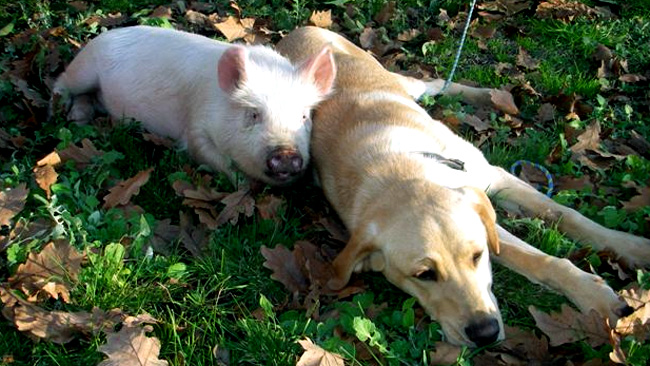
When comparing one animal to another, we are asking our fellow humans to consider the tortures we inflict on a certain species and to examine their justifications for it and whether those justifications would hold up if those same tortures were inflicted upon our beloved dogs. We point out that pigs have as much interest in living out their own lives as do dogs and that it's simply bizarre to exclude an animal such as a pig from the moral consideration we'd give to an animal such as a dog. We ask that instead of writing off this inconsistency to culture or tradition that people instead consider that the same reasons we would most viscerally protest putting a dog through the hell that we do animals raised for food are just as applicable to those animals we raise for food. Of course Nicolette Hahn Niman disagrees, which as it turns out is lucky for the beloved Great Dane she mentions in her article, but not so lucky for the animals she and her husband profit from as raise them and send them off to slaughter.
To learn more about speciesism, sentience and what we really owe non-human animals, please visit Animal Rights: The Abolitionist Approach.
Monday, June 21, 2010
On Speciesism and Commodification
"Speciesism is wrong because, like racism, sexism, and homophobia, it excludes sentient beings from full membership in the moral community based on an irrelevant characteristic. Race, sex, sexual orientation, and species are all irrelevant to the capacity to be harmed.
But the rejection of speciesism on this ground implies the rejection of discrimination based on race, sex, or sexual orientation. It is unacceptable to perpetuate the commodification of one group for the benefit of another. Commodification involves treating the other—whether a woman, person of color, gay or lesbian, or nonhuman—as an object, as something rather than as someone."
-- Prof. Gary L. Francione, "The State of the Movement" (2007-01-24)
Friday, June 18, 2010
Bad Reputations
 Rock icon Joan Jett has been a celebrity mouthpiece for PETA for years. She's also often misrepresented in the media and by animal advocacy groups as being vegan, even though she consistently shows up at public events wearing her trademark leather pants and other leather clothing. She set the record straight about her non-veganism recently in an article in the New York Observer:
"If not wearing leather would stop animals from getting eaten, then I'd stop wearing leather tomorrow," said Ms. Jett, who recently released a greatest-hits album and a new book and is played by Kristen Stewart in a new movie, The Runaways. "At least I can sit there and thank the dead cow for letting me wear its skin."The non-human animal enslaved and slaughtered and whose skin Jett continues to wear to maintain her rock 'n' roll image doesn't care whether his or her parts ended up in her body or on her body (or "its" parts, as Jett might prefer to say). It's not how we use non-humans that is significant; what's wrong is that we use them at all.
Add to all of this that PETA described her as handing out "vegetarian/vegan starter kits" for it in NYC a few months back. Whether PETA was using the terms 'vegetarian' and 'vegan' interchangeably (which is problematic in itself, albeit not surprising from PETA) or unapologetically non-vegan Joan Jett hit the pavement to promote that which she herself opts not to embrace, my head could very well implode trying to peel away the layers of muddled contradictions and moral confusion.
If Jett's inability to "get it" with regards to animal use isn't apparent in the previous quote, how about this one from PETA's GoVeg.com website, where she responds to a question concerning how she feels about people who wear fur?
I believe they are callous and self-involved. With such good-quality imitation fur available for making clothes, etc., there is no reason to torture animals. It’s the “out of sight, out of mind” syndrome. Put fur lovers’ legs in a steel trap for a few days, or whack ’em on the head with a club, and maybe they’ll get it.So eating animals is wrong and wearing their skin with the fur still left on it is worthy of having your leg put "in a steel trap", but wearing that skin is perfectly alright as long as you unhair it first? From Jett's first comment, I am guessing that she assumes that all leather comes from cows raised for human consumption and thus attempts to justify her use of it in that she figures that the cows are dead anyway. This is far from being a given, though.
What's somewhat ironic is that PETA, itself, has a blurb about leather on its site where it states the commonly known fact that leather can come from the skin of a wide variety of non-humans (e.g. cats, alligators, kangaroos, ostriches, and more -- some of them raised specifically for the human use of their skin). PETA points out that since leather is generally not labeled, there's often no way to tell whose skin you're wearing (as if it should matter whose skin it is, honestly). PETA also states on its site that the leather industry is the most economically important by-product of the meat industry, helping to prop it up financially. What PETA doesn't mention is that the skin of calves helps prop up the dairy industry even more so -- whether taken after they are slaughtered to become "veal", or taken from the fetal calves of spent pregnant dairy cows at the time of slaughter. Providing demand for a cow's skin ensures the continued profitability of the beef and dairy industries -- dots which Jett, unfortunately, fails to connect. What's most important to remember, though, is that condoning the occasional use of some parts of some non-human animals for human pleasure merely perpetuates the status quo -- that animals are things for us to use. Is that really the best way to advocate for them?
----------------------------------
For more information about PETA and the many dots it miserably fails to connect, itself...
Please check out Dan Cudahy's Unpopular Vegan Essays blog here.
Visit Animal Rights: The Abolitionist Approach to read Prof. Gary L. Francione's articles on how PETA kills animals and has been killing animals for a while, and on Ingrid Newkirk's defense of PETA's speciesist and sexist campaigns (and check out a few examples of the sexist campaigns here and here). Also read about how PETA gives awards to animal exploiters like KFC and works with them to make people feel better about continuing to consume animals.
Have a look at previous My Face Is on Fire posts to read about how some of my fellow abolitionists and I got fed up and wrote a letter rejecting those sexist tactics used by groups like PETA in the animal advocacy movement. Also read an example of how PETA profits from animal exploitation, how it misrepresents veganism while promoting the consumption of animal products and finally, how PETA's Bruce Friedrich has shamed vegans for asking waiters about ingredients on restaurant menus.
Tuesday, October 13, 2009
On Hope in Human Animals
I think that a lot can be gleaned from this video below within the context of how vegans should consider engaging non-vegans around them about speciesism. It shouldn't follow that in loathing another's behaviour that we somehow need to loathe the person herself, should it? It's also less than conducive to facilitating vegan education to treat non-vegans as 'untouchables' and to expect our fellow-vegans to do so, as well. I say this with the full understanding that it can be anything from saddening or maddening for vegans (particularly those who support abolitionist principles) to watch their loved ones fail to connect the dots--to fail to take the interests of nonhuman animals seriously. And I say it with the full understanding that most vegans struggle with this issue every single day of their lives and deal with the issue in such a wide variety of ways that we likely won't all see eye-to-eye on this.
I don't have a checklist of answers, myself, concerning how best to cope with a lack of success in getting loved ones to come to understand that it's wrong to exploit nonhuman animals. (Some respondents to my previous blog entry mentioned success in bringing family members around to veganism; I would love to have some of them chime in to share those experiences!) I do think that it's important to acknowledge that we'd be lying to ourselves in refusing to admit that not succeeding at vegan outreach with the people closest to us in our lives is harder on the head and heart than not succeeding when leafleting or staffing a booth, and that the emotional entanglement that's involved can often end up loading the issue or even conflating it with other matters driven by underlying or unrelated relationship dynamics. I'm no expert; I've just a hunch based on my own interactions.
I do know with certainty that you cannot and will not educate a single person about a single thing if you choose to cut her off. A few people who responded to my previous post stated that you can't choose your family, but that you can choose your friends and partners and that this can somehow guide our decisions whether or not to walk away from others who, even after we've tried, choose to continue exploiting animals. As an adoptee who is by no means incredibly close to those who legally qualify as my own kin, I'm not so sure that a decision concerning whether or not a vegan should accept or reject an individual for holding speciesist views should rest on blood ties or a traditional concept of what should count as familial ties. I've actually chosen my family over the years and continue to build it up with people who've proven themselves worthy of my hope and love. Would it not make more sense to be more patient with them?
In response to my expressing a fair amount of dismay on Twitter one day several weeks ago at not having convinced a vegetarian friend to go vegan, Prof. Francione responded saying that I had planted a seed. Call me naive or call me speciesist, even, but I think that in my own interaction with my loved ones that I'd like that to be my focus. Rather than write off an attempt and a loved one as a failure, I'd like to hope that I've managed to at least plant a seed.
Here's the video:
Sunday, October 11, 2009
Being an Abolitionist Vegan in an Omni World
This post is meant to ask questions rather than provide answers. It's meant to stimulate discussion rather than to divide. I write it with the sort of earnestness that comes from a) the exhaustion of feeling as if I've been pounding my head into a wall over these questions, b) wondering about the effectiveness of said pounding, and then c) feeling judged for not having accomplished anything in that pounding and for d) trying to find a way to be comfortable with that outcome rather than getting tied up in knots over not having been an effective agent. I write it not just for myself, but for my fellow vegan abolitionists who end up dealing with the reality of living in an overwhelmingly omni world. Take it or ditch it for what it is.
A common discussion topic for vegan abolitionists involves the necessity of creative nonviolent vegan education as the primary tool to bring about an end to the exploitation of nonhuman animals. It is generally agreed that (as Prof. Gary L. Francione points out)
[i]f we are going to make progress toward a greater acceptance of veganism, we must educate. And we must educate in a nonviolent, non-confrontational way that takes into account the social, religious, and “movement” realities. This does not mean that our use of animals is anything but a moral outrage; it means only that our efforts to educate about that moral outrage must take into account how the vast majority of humans see this issue.So who and how do we educate? For some, opportunities arise in everyday situations with strangers, while others set out to do more deliberate outreach work with the general public. I've written here back in August about the need to educate vegetarians about veganism (and you'll find numerous links to what others have said concerning education vegetarians in that older blog post, as well).
Many abolitionists, like Vincent J. Guihan from We Other Animals, agree that it goes beyond being a necessity and that educating others about veganism is actually a moral obligation for abolitionists: We owe animals more than to just not eat (or otherwise exploit) them ourselves:
We all have blood on our hands. I wish I could tell you that the feeling of shame that comes from that blood goes away. I've been vegan for a decade, and still, I can't tell you that.So we go about deciding where to start and who and how to educate, and the how needs to involve striking a balance between blunt honesty and not forgetting that those around us have spent their entire lives taught or told that it's a given that nonhumans exist for humans to do with what we will. As Prof. Francione points out:
Most people have been raised to think that it is “natural” or “normal” to eat animal products. They have grown up in homes where an important part of family life has involved sitting around a table and consuming animal parts. Their memories of a deceased and beloved grandparent or other relative are connected to some meat dish that the relative prepared for holidays. They have been raised in religious traditions that have taught them that nonhumans lack “souls” or otherwise are spiritually inferior to humans.This is a common-sense realization of what can be gleaned from taking a good hard look at those around us. Most of us who now eschew the consumption of animals held that mindset at some point, ourselves. Or, rather than holding a "mindset", I guess it should be said that we took things as givens without questioning them.
That being said and realizing that there are some who will just be incapable of or unwilling to listen to why the exploitation of nonhumans is as wrong as the exploitation of a human cousin or neighbour, where do we, as abolitionists, draw our own lines in the sand concerning who we choose to educate? Guihan himself states:
I'm not saying you have to tell everyone you meet everyday of your life to go vegan. I'm proposing that you tell a mother, a sister, a brother, a father, a friend or a stranger that nonhuman animals have a right not to be used as property.So where do we draw our boundaries where that's concerned? Do we raise the issue once or twice and then walk away from it? And what happens when an abolitionist vegan attempts to educate others about veganism--particularly loved ones--and that attempt fails?
I once had an abolitionist I respect terribly tell me that he'd no sooner get emotionally involved with a non-vegan--a speciesist--than he would get involved with a racist. This weighed upon me quite heavily, since it was voiced within the context of my having brought up my involvement with an omnivore I'd come to adore. I've had more than a few abolitionists echo this sentiment since then. On a plain and ordinary level, I've always found myself agreeing with others that racism=sexism=speciesism. However, the association made concerning this person for whom I'd come to care didn't sit well, especially where I felt myself being judged for having allowed myself to accept this person regardless of his speciesism. I'd felt I'd been deemed inconsistent--a bad abolitionist.
So why the disconnect? I felt like a hypocrite. But then I didn't. I have an omnivorous mother. I have an omnivorous sister and two omnivorous nephews. I've explained to them my reasons for going vegan and those reasons have bounced off of them. Should I feel shame for continuing to love them or continuing to associate with them? Is the onus somehow on me to keep pressing them to change, however uninterested they've seemed thus far? Where does one draw the line with regards to one's obligation to educate others about veganism? Particulary when it comes to your personal relationships? And what of the aftermath? What if you fail? Do you "tsk-tsk" and walk away? Or do you acknowledge that the overwhelming majority of humans--whether strangers or loved ones--don't view nonhuman animals as anything other than things to be used? Does compartmentalizing this make you a bad abolitionist? Does it make you a hypocrite? Does it make you a realist?
I envy those who end up embracing the abolitionist approach to animal rights in tandem with a partner. I envy those who've been successful educating their family members about veganism and in bringing them around to veganism. But what of those who don't? How do we come to terms with the reality that the overwhelming majority of people around us, even loved ones or potential loved ones, are not and may never become vegan? Do we need to absorb these as personal failures? Do we need to judge those others around us who are just living their lives the way over 95% of humans do, taking it as a given that nonhumans exist for our use? Do we need to adjust our own boundaries and standards to reflect abolitionist principles and to cut people out who don't come around? Should there be shame in loving speciesists? Should a non-vegan need to fear that I would eventually dismiss him for being a non-vegan?
I look forward to reading your thoughtful comments.
Wednesday, September 23, 2009
Who's Confused?
It seems that Bailey Norwood, Associate Professor of Agricultural Economics at Oklahoma State University, has taken it upon himself to shed some light on the question of whether we are, in fact, generally morally confused about nonhuman animals and of whether speciesism is at the root of this confusion. Hell, he may even have put an end to the ongoing debate over whether we should view nonhuman animals in terms of their use or do so in terms of their treatment. According to Norwood's thinking, both would miss the point altogether. He claims there's no moral confusion as long as we understand that we should think of nonhuman animals in terms of their purpose:
I treat pigs one way because their "purpose" is to provide me with food and I treat my dog differently because her "purpose" is to provide me with companionship. One may say that I am immoral, but one cannot say that I am in anyway confused. I know exactly what I am doing. People largely base their decisions on how to treat animals not based on a moral philosophy or animals' IQs, but the purpose of the animal.In all seriousness, though: Norwood wrote the above as part of a blog post reaction to Prof. Gary L. Francione's podcast commentary "An Up-Close and Personal Encounter with Moral Schizophrenia" of a few weeks ago, in which he'd described his encounter with some hunters who'd stopped to help a deer who had been struck by a car, and how this encounter illustrated the nonsensical manner in which we choose to assess one nonhuman animal species versus another. At least I can agree with one thing Norwood states and that is that I suppose one may indeed say that he's immoral. I mean, one can say or write anything on the internet, no? As for whether or not he's fit to assess whether or not he's confused, I think that I'll leave that up to readers to judge for themselves.
Thoughts?
Friday, August 28, 2009
Clarity and Consistency as Tools Against Speciesism
I read an excellent essay this afternoon by Angel Flinn, posted over on the (unfortunately mostly welfarist) Care2 forums. It's called "A Mouthful of Flesh", and in it, Flinn examines whether there is a meaningful ethical difference between eating a nonhuman animal such as a dog (or a cat, hamster or horse) and eating a nonhuman animal such as a pig (or a cow, chicken or deer). She writes:
Frankly, it's a little baffling trying to figure out what combination of factors puts certain animals off-limits to certain people. Rabbits are a case in point. We're horribly confused about rabbits – some of us shoot them, some of us pet them, some eat them and some enjoy watching dogs tear them apart, limb from limb. As a society, we don't seem to know what rabbits mean to us. Are they our pets, are they our prey… or are they, in fact, persons: individuals who exist for their own reasons?She considers how some claim that the difference lies in the fact that there are some nonhuman animals we welcome into our families--we insist that they matter more because we have come to "care about" or "love" them, and how that sort of language has now become what's more or less a creepy marketing tool for farmers pushing guilt-free "happy meat" (i.e. animals most humans customarily view as food and who are touted as having been raised under loving and cruelty-free conditions until they're slaughtered to be eaten). Flinn views this as yet another attempt by humans to justify "morally reprehensible" acts against nonhumans and she's right. It's the reactions immediately following her essay, however, that are most telling when it comes to illustrating the absolute moral confusion humans have concerning the use of nonhumans. I encourage fellow-vegans to read the piece and to go through the comments left in response to it and to even jump into the discussion itself. There is so much work to be done to fight speciesism.
Earlier today, though, it was another article online that got my attention and got me wondering about how thoroughly confused some humans are about nonhumans. In an opinion piece in USA Today yesterday called "Veterinarian Isn't Necessarily Synonymous with Vegetarian", veterinarian columnist and admitted welfarist (and Pollanite) Patty Khuly decided to explain why she feels that professionals who earn their money by bettering and saving the lives of some animals shouldn't be expected to not want to spend some of that profit on products that involve the suffering and slaughter of other animals. Khuly admits that "our human science convincingly demonstrates that animals do feel pain, fear and stress — presumably to the same degree we do" and that "animals are not so very different from us". She then takes issue with what she describes (and resents) as the following general implication:
The problem is that doing so brings us in uncomfortably close proximity to the suffering of animals we've pledged an oath to protect. So it is that when we buy the meat, milk and eggs like everyone else does, we get less of a moral pass when it comes to checkout time. We understand animals. So we should know better.To a certain extent, I agree with her that this is a non sequitur. After all, the fact that someone profits from enabling others' use of nonhuman animals in no way entails that those who are profiting are, in fact, motivated by anything other than profit (and we have seen this ad nauseum with prominent regulationist animal welfare organizations, for instance). Unfortunately, Khuly chooses to take it further to make an argument concerning herself and her fellow-veterinarians, that
[f]or some veterinarians, first-hand knowledge leads to veganism, vegetarianism, reduced animal protein consumption or a highly selective diet of home-grown or non-factory-farmed animal products. And while all such variations are geared toward an animal welfare position that's defined by how animals are used or how they're treated should they be used, not a one includes an insect-sweeping observance of animal life preservation wherever possible. We all impose limits … somewhere.Not a one, Patty? It becomes obvious that this was a lead-in to justify what follows as her description of her own lifestyle, in which she raises chickens and goats for personal consumption and "cherish[es] [her] leather" shoes. It's in her final paragraph, however, that she almost petulantly expresses what I think are the bonafide gist and raison d'être of her article:
In short, I'm not perfect. None of us should be. We're only human. Now, if only the naysayers could begin to accept that individual moral progress is far preferable to a slavish adherence to any one particular animal rights dogma … then perhaps veterinarians could catch a break every once in a while when the dinner bell rings.I can't help but find such animosity towards the very idea of animal rights a bit disturbing from a woman who just earlier in her article was insisting that "animals do feel pain, fear and stress — presumably to the same degree we do" and are "not so very different from us"--even worse, that she'd hold this much animosity after she'd insisted that those such as herself "who devote [their] careers to finding ways to diminish animal stress and alleviate their suffering are more keenly aware of it than most". What's not surprising, however, is that an animal exploitation industry funded group such as the Center for Consumer Freedom would have hopped on her pile of moral confusion to present it as some sort of evidence that it's not, in fact, hypocritical to supposedly "dedicate [one's] life to helping animals" while accepting one's place "in the food chain"--that caring and concern need not apply to what's on one's plate.
The only thing that seems clear from this entire ball of moral confusion is that there is an overwhelming need for those who do take the rights of nonhuman animals seriously to adopt veganism as a moral baseline and to address the use (and not merely the treatment) of animals by educating others about veganism. Clarity and consistency about this are the only things that are going to change people's mind in a significant enough way to end animal exploitation. Anything less is disengenuous.

