Showing posts with label veganism as the moral baseline. Show all posts

Monday, September 10, 2012

Hacking at Branches: On Petitioning Whole Foods

James McWilliams recently posted a petition on Change.org to persuade the Whole Foods supermarket chain to stop selling meat. More specifically, the petition is (was?) to convince the chain to shut down its meat counters. In his petition, McWilliams does offer up some sort of quasi-broader contextualization for its focus:

Forget (for the moment) dairy and eggs and all the animal-based products dependent on systematic suffering that you believe are integral to a robust stock price. We can deal with these items later.
This contextualization does little to change the fact that for a non-vegan supermarket chain that prides itself on its offering its customers so-called "happy" animal consumption options, singling out animal flesh as significant would just send a confusing message. Whole Foods' "articulated values" (as appealed to by McWilliams) are all about providing its customers with these purportedly "kinder" options. It's not -- and never really has been -- about offering consumers an alternative to using other sentient beings. Instead, Whole Foods profits off of its lulling consumers into thinking that there is such a thing as ethical animal exploitation: This is part of its raison d'ĂȘtre.

Nonetheless, McWilliams suggest the elimination of its meat sales to Whole Foods as a first step it should take. He cushions it by temporarily excusing the sales of other animal products until "later" and then throws this weird bit of flattery in:
As a loyal patron, vegan advocate, and historian of agriculture, I’m asking you to do what you have done so well since the 1980s: lead.
That left me earnestly baffled. I'll 'fess up and admit that I've been reading many of McWilliams' blog posts off and on over the past several months whenever I've had time to sit back and catch up on advocacy-related reading. At one point months ago, I would actually get excited reading some of his posts since they seemed to reflect the thoughts of someone who "got it" and who was bent on forwarding an unequivocal message that other animals deserve nothing short of our going vegan. How on earth would he come to see a company such as Whole Foods as "leading"?

The thing is, though, that even if McWilliams' petition had called on Whole Foods to stop selling all of the animal products it stocks on its shelves, whether meat, dairy, eggs, honey and the other ingredients that manifest themselves in the processed foods and non-edibles it carries, the petition would have been -- however possibly well-intentioned -- really wrongheaded and pointless. As Whole Foods' co-founder and co-CEO James Mackey pointed out in his official response to McWilliams:
Whole Foods Market has no plans to stop selling meat and poultry…or seafood, eggs and dairy items for that matter.

[...]

Our first stakeholder is our customer and the most of them purchase and eat meat.

[...]


At the most, about 10 percent of our customers are strict vegetarians and probably around three percent are strict vegans. To not offer a full array of food options is basically suggesting that we voluntarily commit business suicide.
None of this should come as any surprise, yet many animal advocates have reacted to Mackey's response with outrage. You would think that he had suddenly revealed something quite shocking that should leave him worthy of being deemed evil incarnate. The bottom line, however, is that Mackey is a businessman and that perpetuating the myth that some animal use can be more ethical than other types of animal use has been and is essential to Whole Foods' operations. Asking them to cut out selling a particular animal product when Whole Foods has been insisting to its customers that all of the products it sells come from animals who've been raised "happy" goes completely against how Whole Foods justifies including itself in the cycle of animal exploitation.

Focusing on the middle-man really makes no sense where animal advocacy is concerned. If Whole Foods stopped selling meat, its customers would just go elsewhere to purchase it. Why wouldn't they? Mackey knows this and it baffles me that McWilliams wouldn't see this, as well. Mackey was right in saying that McWilliams was ultimately asking Whole Foods to engage in "business suicide".

More so than this Whole Foods affair (which is just perplexing), McWilliams' recent promotion of Melanie Joy has left me a little saddened. Joy's work emphasizes the ethics and psychology of meat eating, highlighting so-called "carnism" as she calls it instead of acknowledging the actual issue of speciesism as a whole. She chooses to publicly pooh-pooh the delivering of a vegan message as being too extreme, insisting that talking about veganism is somehow counter-productive when trying to get people to take other animals seriously. McWilliams' endorsement of her work was a sad surprise. I had come to really enjoy his writing style and his writings themselves had seemed to indicate that he did indeed understand that teaching people to not use others animals was the first step in making a difference for those other animals.

In his more recent article for
Slate ("Vegan Feud"), McWilliams actually takes issue quite explicitly with the those who present veganism as a moral baseline for animal rights advocacy. McWilliams touts it as extremist. Instead, he champions HSUS, whose bread and butter (yep) is also wrapped around lulling consumers into thinking that there is indeed such a thing as a kinder, gentler and more ethical way to treat other animals as things. In his piece for Slate, McWilliams champions HSUS and then specifically singles out abolitionists and the work of Prof. Gary Francione as too, too demanding with their focus on teaching the public to take the rights and interests of other animals seriously by choosing not to participate in the use and exploitation of these other animals.

I won't weigh in on the Slate article at this time, since Francione has already done so and even extended an invitation to McWilliams to discuss all of this in a podcast via his Abolitionist Approach website. McWilliams has agreed to participate in the podcast and it should be falling into place sometime in October. I really do hope that the discussion they have brings McWilliams around to realizing that singling out those who provide consumers with what they want or asking them to stop providing in no way convinces those same consumers that they should stop viewing other sentient beings as things. The only way to fight speciesism is to get those who provide the demand that perpetuates the cycle of animal exploitation to understand that animals aren't ours to use. Limiting their options in terms of where they can obtain animal products certainly won't accomplish that.

Francione gets that. I get that. A lot of you get that and even Whole Foods' Mackey gets that. Hopefully, come October, James McWilliams will get it, too.

Wednesday, April 11, 2012

'Vegan' as a Qualifier

For the past few years, I've been sifting through articles and opinion pieces on the websites of various newspapers and magazines, trying to make sense of how it is that writers have come to so clumsily and conveniently bend--or altogether ignore--the actual definitions of words that have become buzz words. It's as if once a word associated with some sort of popular trend is known to draw a reader in, license is granted to co-opt that word, however its meaning ends up being misrepresented or mangled in the process. Whatever sells, even if that "whatever" gets watered down or redefined, right? Years ago when I'd first started exploring vegetarianism, it was made pretty clear to me that veganism was what the "serious animal rights people did". Veganism meant not just abstaining from eating other animals and their secretions, but also refraining from using them to make clothing or personal care products, for human entertainment and so on. These days, if I use the word "vegan" to describe myself, there's a small (albeit realistic) chance that I'll be asked if I'm doing a cleanse. Worse is when some well-meaning person will pipe up and say: "Oh, my son's girlfriend is a vegan... but she treats herself to turkey at Christmas and will eat fish if her body tells her she needs it." Indeed, it's hard to blame anyone for their confusion, given that with what's being written in mainstream media, folks are being bombarded with increasingly confusing messages daily.

Thanks to
people like Mark Bittman, the word "vegan" has even been downgraded to being used as a qualifier to mean something akin to "that moment you ate something plant-based". In opinion pieces like Mary Schwantes' in Suburban Journals yesterday ("Try 'semi-veganism' to eat healthier"), the term seems presented as meaning that someone, for health reasons, is eating a few more fruits or vegetables than usual. Now, I'm all for people eating more fruits and vegetables (or whole grains, nuts, seeds, legumes and other plant-based fare). The thing is, though, that when you start calling the slipping in of a few extra bites a day of plant-based food "semi-veganism", you really miss the point altogether of what veganism is about. You might as well call someone who goes an extra few hours between romps in bed "semi-celibate", for all the meaningfulness contained in distorting the term so.

Credentials as Credibility?


According to
Suburban Journals, Schwantes is a "retired professor of dietetics and nutrition", so it's no surprised that the piece misrepresents veganism as merely a diet and focuses on health as an incentive. What's bizarre, however, is how its author presents eating a single dish without animal products as if it were a vegan act in and of itself:

My point here is to make "semi-veganism" work for you. Once a week, let oatmeal burgers stand in for hamburgers, leave the meat out of your pasta sauce and add mushrooms, make a risotto the likes of which you've probably never had with pecans, mushrooms and fresh spinach or butternut squash — and you may just find yourself eating "better".
So if you indulge in Meatless Monday, you're kind of a vegan. Heck, according to Schwantes, if you have a weekly bowl of cereal (with soy milk, one assumes), you could even consider yourself a semi-vegan. It's that easy! I mean, using this logic, every single human on the planet could be considered a vegan while he or she sleeps.

Speaking of Authoritative Voices...

It's so easy, in fact, that an increasing number of people are self-identifying as "vegan" (which given articles like the aforementioned really doesn't bode well for nonhuman animals). Furthermore, many of these people self-identifying as vegan--whether or not they actually are vegan themselves--are offering themselves as authentic and experienced vegan voices and then sputtering into the pre-existing pile of confusion to just gum it all up further. Take for instance an article on "veganism" by Sharon Riley which appeared in Toronto's The Globe and Mail last week ("Why I'm a vegan [and why it's okay that you're not]"): The focus is again on diet alone, with Riley referring to "thoughtful veganism" as "the best approach to food". Where the plight of nonhuman animals is concerned, it's evident that her sole preoccupation is not that they're used, but of how they're used. She also makes it clear that the issue of animal use outside of what she chooses to put in her mouth is is definitely not an issue for her:
Just the other day, my 12-year-old cousin was confused as to why I was wearing socks made from wool from my mom’s sheep. “I thought you didn’t like things that come from animals?” she asked, flummoxed. I had made a tradeoff in my own mind: They are treated like pets, and relieved to be rid of their warm coats every summer. I eventually replied, “Everyone has to make their own decisions about what they think is right.”
In one fell swoop, Riley makes it clear that she's not opposed to the exploitation of nonhuman animals as long as she can convince herself that the animals we call "food" (or in this case "sock providers") are treated in a similar manner to those animals we call "pets". Self-identifying as someone who happily uses animal products, she also makes it clear that she's not vegan. It's also troubling that as she presents herself in this Globe and Mail piece as a vegan and thus attempts to speak with some sort of authoritative voice on behalf of others who are indeed vegan, that she doesn't view veganism as any sort of moral imperative and seems rather unconcerned about whether or not others choose to use animals and the degree to which they might.

And so it goes...

The thing is that if she did actually take the rights and interests of other animals seriously, it wouldn't be much of a leap for her to see it as the minimum standard of decency in terms of what humans owe other animals. It's evident that she does neither, however. In and of itself, this is sad. What's sadder, perhaps is that her views should be shared by a publication such as The Globe and Mail as representative of vegan views. It's sad, but given how widespread the misrepresentation and mangling of the word "vegan" has become, it's certainly no surprise.

Monday, August 08, 2011

(Not) Veganism in the Media

HSUS' Wayne Pacelle has been making the rounds recently to promote his book, The Bond: Our Kinship with Animals; Our Call to Defend Them. The articles I've been reading here and there about his various appearances have not offered up anything surprising; they've mostly reflected his continued commitment to ensuring that Americans feel more comfortable about using non-human animals. This recent piece in Michigan's Lansing State Journal, for instance, turned up more of the same. Strangely enough, the article starts off quoting Pacelle as saying that "we [...] need to be mindful and intentional in a society where our attitudes toward animals are conflicted and contradictory". Given the conflicted and contradictory messages HSUS has been disseminating over the years, Pacelle's plea for mindfulness and an associated thoughtful intentionality when it comes to how we think of non-human animals seemed ironic at best -- and disingenuous at worst.

The article's emphasis seems largely placed on Pacelle's great "passion" and charisma. I've no doubt that HSUS' president and CEO is still able to seem enthusiastic while engaging with ease in essentially churning out
the same old message he's been churning out for years now. Pacelle's become adept at reassuring people that HSUS is no "us" to the general public's "them" -- that everyone, regardless of actual concrete follow-through has some sort of good intention, and that this good intention is enough.

People of every background and experience have a passionate connection to animals and they want to do something to make the world better for them.
And just what sort of people share Pacelle's "passionate connection" to animals and want "to make the world better for them"? People like attendee Gita Mahabir, who insists that she's "not like a crazy animal person" but that she "just do[es]n't like to see things [sic] suffer". Basically, Pacelle's message is palatable to people who view those who take the rights of non-human animals seriously as nuts. In repeatedly dodging opportunities to talk to the public about going vegan, Pacelle also implicitly endorses this mindset.

How exactly does Pacelle manage to obtain and hang on to the attention -- and financial support -- of people like Mahabir? By making it clear to them that to walk shoulder-to-shoulder with almighty defender Pacelle, you need not worry yourself about being lumped in with the "crazy animal people" who choose not to use animals. Although he asserts that that eating is a moral act, his interpretation of its morality completely sidesteps exploring the notion that anyone should consider the bother of depriving themselves of the taste of animal flesh and secretions.
It doesn't mean you have to be a vegetarian but you have to be conscious and perhaps buy products from farmers who are raising animals humanely [sic].
According to the article, his book contains "50 ideas to help animals" with "many" actually involving cutting back on animal consumption. I wonder how many times Pacelle actually brings up not using animals as a possible way to "help" those locked into this cycle that inevitably ends in their slaughter? (I haven't read it, but would be happy to do so and to give it an earnest review if somebody wanted to send me a copy. A bonus: I own a good shredder!)

So hey, Wayne? Instead of suggesting to people that they "perhaps buy products from farmers who are raising animals humanely" and presenting it as the very least they can do, how about offering veganism as your so-called "prescription" for the immorality of what we're putting billions of non-human animals through every single year? Is it really so far-fetched to consider telling your HSUS donors that not using non-human animals altogether is even a viable option? Is it really so unfathomable to present not using non-human animals at all as the only truly "humane" option when it comes to whether or not we should treat animals like things and continue to breed them for slaughter? C'mon? Think about it.

Monday, May 16, 2011

The Roles We Assign


Two articles I stumbled across this morning had nothing to do with veganism, but everything to do with our moral confusion when it comes to how we perceive and use non-human animals:

About a Donkey

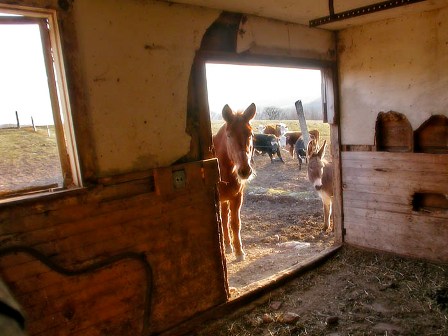
The first article ("Iraqi donkey finally in U.S.") is about a donkey, adopted as a mascot and named "Smoke" by retired Col. John Folsom's Marine unit stationed at a base in Iraq in 2008. When his unit left, the remaining Marines at the base continued to care for the donkey; once those Marines left, the Army soldiers at the base handed the donkey off to a local sheik who proceeded to neglect the former mascot. Folsom and some others found out and

a massive effort spanning continents and featuring the help of military officers, government officials, foreign journalists and many others [ensured, with t]he Society for the Prevention of Cruelty to Animals International rais[ing] money to cover the thousands of dollars it cost to transport Smoke to the United States.
And how did Folsom, his friends and family and "members of the local horse set" celebrate Smoke's arrival in the U.S.? Folsom's
friends Debbie and Alan Nash hosted the welcome-to-America party on their polo horse farm"[where t]hick New York strip steaks and pork ribs sizzled on the grill.
Folsom's efforts were not lost on assembled guests, who expressed their admiration of his beautiful gesture: “'It's wonderful they rescued this donkey,' said Carl Cox, who goes fox hunting with Debbie Nash and came to see the donkey".

After the rough life Smoke's had and what was surely the somewhat traumatic event of being transported halfway around the world, one would think that the rest of his days would involve some peace and quiet, but Folsom has other plans for the donkey:
He'll soon start his new job, providing comfort to veterans at Take Flight Farms. The Omaha nonprofit uses horses to provide equine therapy to military veterans struggling with post-traumatic stress disorder.

But first he has a mini publicity tour ahead of him. Several national television networks have expressed interest in featuring Smoke, so Folsom was planning to drive into Manhattan on Monday morning, 20-foot horse trailer in tow, so his celebrity donkey could make the interview rounds.

Once you peel apart the layers of animal use in the article, Smoke's rescue reeks more of a public relations event than of an action taken with the goal of providing a non-human animal with a decent life. Rather than permit the donkey to live out the rest of his life peacefully, it seems that he'll continue to exist on whatever terms set out for him by the humans who call him "property".

Horses

A Huffington Post blurb I read this morning involved what's apparently become a scandal concerning the television show "Top Chef Canada". The show, a non-vegan cooking competition of sorts, involves the use of any number of animal products on any given episode. Tonight's episode, however, will feature one of the show's contestants using horse meat, and this seems to have outraged people around the world. Bloggers have been a-blogging about it like mad and a "Boycott Top Chef -- Protect the Horses" page has even been set up on Facebook.

Why are people so outraged? Here's some insight from the comments left in response to the Huffington Post article:

"That's a fine animal which can benefit humans in so much better ways, Why don't people get that?" -- Jaeshik
"I do not believe in eating companion animals or recreation animals, but that notwithsta­nding much if not most US horsemeat is simply not safe for human consumptio­n." -- Marybeth Kuznick

"These horses aren't purpose bred for meat, there is no traceabili­ty in place and no regulation­s as to the mediciatio­n they are given. These are lesson horses, dressage, jumpers, ropers, trail riding, backyard, racing, carriage, used up mennonite, police, rodeo, RECREATION­AL HORSES. I will never purposely eat horsemeat, but if they
were actually raised like beef from the time a foal hits the ground, including ear tags, production records, traceabili­ty, etc and handled in a more humane way to slaughter then it would be more palatable. What RIGHT does the pleasure horse industry have to suddenly turn their horse into human food when they're done with them? What RIGHT do they have to be able to sell their horses as meat for human consumpion on an honour system?" -- LJ60
So on the one hand, some see horses as having a different "purpose"or as having a multitude of better uses for humans than that of being served up on a plate: They deserve to be a different kind of property. On the other hand, those who seem to view any non-human's flesh as fair game are mostly concerned with what they see as the danger of consuming an animal not raised from the ground up to end up on said plate. Many of the Huffington Post comments (and other comments I've seen online) in response to the story describe the inability to ascertain the types and amounts of medications administered to the horse throughout his life. This of course perpetuates the myth that the flesh of animals raised from "cradle to grave" for human consumption is free from potentially dangerous chemicals.

Unfortunately, the few who do seem to point out (and rightly so) that eating the flesh of a horse is no morally different than eating the flesh of a pig or cow seem to be the "expand your palate" types, suggesting that people loosen up and try it, along with other bits and secretions from any number of other non-human animals not usually viewed as "food" in the West.

(Me? I'm just waiting for a PETA press release proclaiming that horse consumption is somehow more markedly "inhumane" than other forms of animal consumption this week .)

Want to spread some more clarity and consistency in how we view non-human animals and how we choose whether or not to use them? If you're not vegan, go vegan; if you are, talk to others about going vegan today!

Tuesday, May 10, 2011

On Rejecting Animal Use

Recently, in some darkened little corner of the interwebs, I found myself accused of having possibly hurt someone's feelings. The little corner was a spot which concerns itself with the promotion of veganism, and the "someone" had posted that she had recently located a nice Amish family that raised chickens in a comfortable setting, and that she was now consuming eggs and feeling "better" about doing so. As plainly as I could, I pointed out to her a few of the more obvious things, including that 1) once Ma Chicken's productivity declines, she ends up part of that nice Amish family's Sunday dinner and that 2) providing demand for eggs from this family would merely serve to contribute to an increase in the number of chickens who end up taking that last walk to the chopping block behind the barn.

I also pointed out that regardless of how supposedly comfortably these chickens are raised, the bottom line is that they're bred into wretched lives of being treated like food-producing machines. I asked her if this was what she really thought of non-human animals -- that they're things existing solely for our pleasure and convenience. I hoped not. She didn't answer, but I got a "tsk" or two from a few welfarists who suggested I'd had no business passing judgment on her choices, insisting to me that "every little bit counts" and that she was somehow "vegan-minded" and "on the right path". Why did I not praise her, they asked, since she was at least sourcing her eggs from someone purportedly treating their chickens a bit more kindly? Who was I to judge her for the best possible choices she was making for herself?

How is comforting oneself over one's continued use of animals either "vegan-minded" or on the "right path", though?

"If They're Happy and I 'Know' it, Clap Your Hands!"

I shared this, primarily, to re-emphasize that foregoing animal flesh while otherwise consuming animal products is still engaging in animal exploitation. We're kidding ourselves if we think that there is a difference between chomping down on a chicken leg or having a couple of scrambled eggs (or a bowl of dairy ice cream, and so on). And for those who try to lull themselves into thinking otherwise while they claim to support animal rights, or they express concern with not directly contributing to just plain old harming other animals, the truth is that there's no getting around the fact that using animals means perpetuating what is essentially for them a life of enslavement involving various forms of torture. Furthermore, regardless of how horrible that world is for them, respecting their rights and interests involves not thinking of them as things which exist for us to use in the first place. These are just the facts, though, as uncomfortable as it may be for some to weigh them.

I Ain't Clapping

As a vegan and as an abolitionist animal rights advocate, I avoid participating in animal exploitation. I don't condone others' doing so and I sure as hell don't applaud it or encourage it.
If you tell me that you take the interests of non-human animals seriously but feel that you're doing "enough" by avoiding meat and sourcing your eggs from birds at the happy chicken farm down the street, I will tell you that consuming animal products other than meat is still animal exploitation, and that veganism should be the moral baseline for all who do claim to really take the interests of non-human animals seriously. I will say to you that you should go vegan, or at least take steps toward doing so. To hurt or shame you? No. To provide you with the facts so that you realize what your choices involve? Absolutely. After all, why should I lie when billions are dying every single year when they needn't?

If I refuse to acknowledge this or that form of animal exploitation as being more commendable than another, I am merely refusing to condone it and refusing to nod politely at any justifications given for it. I think we owe non-human animals -- as well as non-vegan animal advocates -- at least that much. Don't
you?

--------------------------------------------------

To find out more about why vegetarianism falls short of offering justice to non-human animals and denies them their personhood, please read the following essays:

- My ramble from March 2010: "Why I Will Not Advocate Vegetarianism"
- Bob Torres' "Why Vegetarianism Isn't Enough"
- Dan Cudahy's "What Is Wrong With Vegetarianism"

Also, have a listen to this podcast by Gary L. Francione:

- "Commentary #6: Aspects of the Vegetarian/Vegan Debate"

For some advice on how to proceed when talking to others about what we owe nonhuman animals, read this blog post by Vincent Guihan: "They believe harm is wrong, but how do we get them to act on that?"

Friday, September 24, 2010

Veganism in the News

I've been MIA for the past few weeks with a house-guest from out of the country. Expect some blog updates in the upcoming week on a variety of topics, including an update on what some other abolitionists have been up to recently. In the interim:

School Cafeterias More Vegan-Friendly

In a brief article in SUNY at Geneseo's paper The Lamron, self-described vegan student Eve Anderson described how her fears of a french fries diet while away at college were quashed by the variety of offerings at various locations on her campus for vegans. From raw fruits and vegetables to meat substitutes in ordinarily animal-based wraps and "peanut butter and apple" panini" to hot vegan soup, Anderson found herself pleasantly surprised at how easy it is to eat a well-balanced diet as a vegan on her campus this year. Anderson focuses on diet in her article, but given that her article deals specifically with the availability of animal product free food on her campus, it's not clear that Anderson has jumped on the "veganism by mouth" trend.

I think that articles like these are encouraging and I hope that vegans who read this blog and who are at college or university this year take some time to write to their own school papers about the ethics of consuming animals and of why veganism is the right choice and that you speak to your cafeteria managers or your student council representatives about increasing vegan options on campus so that everyone can get a chance to see that you don't need to use animals to eat delicious healthy food while at school. I also hope that vegans who read this blog and who are students take those opportunities, either in their student papers or while talking to their representatives to discuss how other animal products in items other than food can easily -- and should -- be avoided. Please take some time to talk to others about veganism.

-------------------------------------------------------------------

Just Another Food Choice?

Seattle Weekly's chief mocker of vegans and animal rights activists, Jason Sheehan, wrote a piece yesterday to purportedly highlight a so-called "intelligent debate" concerning the ethics of using animals for food he wishes to encourage (and apparently facilitate) in his "From the Gut" series. Sheehan recently wrote about a CNN interview with chef Tim Love, in which Love promotes meat-eating by giving five facetious reasons to not stop eating animal flesh. Among other things, Love called vegetarians and vegans "preachy" (adding, of course, that he was just "kidding" and insisting that "[s]ome of [his] best friends are vegetarian" -- and then going on to call vegetarians and vegans "holier-than-thou"). Love defends meat-eating, insisting that it "provides much-needed protein, iron and amino acids" (all available from plant-based sources, of course) and then making comments like:

If I want to eat meat, let me eat it in peace. Nobody is forcing you to be a vegetarian, so why are you trying to force us?
He also tells readers that meat tastes better than vegetables and that they'd "get a lot of funny looks if [they] tried roasting a pumpkin at a tailgate instead of a pig. Essentially, Love puts animal flesh on par with with any plant-based food, emphasizing the current status quo by which it's considered quite normal to eat the body parts of slaughtered sentient non-humans.

Seattle Weekly's Sheehan took off running with this (i.e. spotted the potential to further mock those who weigh the ethics of animal use more seriously) to provide an additional ten reasons people should not stop eating animals. He then provides two reader responses arguing for and against "vegetarianism" and presents them as reasonable and equally worthwhile to consider in their logic and validity. Sadly, the supposedly "pro-" animal opinion focuses on vegetarianism, stopping short of veganism. The reader, "Herbivore", first argues against eating animal flesh for environmental and human health reasons and then delves into animal suffering and factory farming, mentioning animal intelligence and then focusing on animal use that involves slaughter. Herbivore's arguing against the ethics of animal slaughter is followed-up with a list of "the vast array of vegetarian" options available for humans to eat, including "[b]ean burritos, mushroom pizza, pasta with pesto sauce" -- all dishes customarily made using dairy and with no mention made by Herbivore of animal-free versions of them.

So, the "pro-" animal argument in Sheehan's piece is, unfortunately, not really arguing against animal use, but just arguing for human benefits and against some forms of animal treatment. It's a shame that the "either/or" presented by Sheehan is firmly lodged in perpetuating speciesism either way you look at it. Given that so many large groups in the animal advocacy movement fail to promote actually not using non-human animals at all, it should be no surprised that "some" use of animals would be presented in mainstream media as an extreme stance.
Sheehan asks for further "intelligent" reader comments to this supposed debate, but the truth is that the debate is not about animal use, but about how far we should moderate animal use while continuing to engage in it. Arguing either side of it, of course, fails to take the interests and rights of non-human animals seriously and misses the point altogether that veganism should be the moral baseline. For more information on this, please visit Prof. Gary L. Francione's Animal Rights: The Abolitionist Approach website.

Saturday, April 17, 2010

On Doing (More Than) the Bare Minimum


I read an article earlier this morning by Stephanie Ernst (
"A Vegan But Not an Activist? Sure. An Animal Lover But Not a Vegan? Nope.") which I'd like to bring to people's attention. Ernst writes about how people too often assume that being vegan means that one is also active in animal rights advocacy. Ernst describes how some people who may be uncomfortable advocating for causes, whose time is already gobbled up advocating for other causes or whose lives are just too busy to take on any additional responsibilities, sometimes shrug off going vegan because they think that the burden of activism comes with the label. She adds to this:

If you truly oppose something, you seek to not participate in it. If you believe in an ideal such as nonviolence, you don’t actively, daily make choices that stand in direct contrast to that belief. It’s not a choice of (a) devote yourself completely to activism against the injustice or (b) be a participant in the injustice. If you love animals, you don’t kill animals. If you respect animals, you don’t torment animals, emotionally, mentally, or physically. If you believe in nonviolence, you don’t engage in violence. And choosing to eat animals and animal products is to participate in torment, to participate in violence.
I agree with her that conflating veganism with animal rights activism seems a fairly lame excuse to not go vegan (although she expresses this much more diplomatically). I also agree wholeheartedly that it's completely nonsensical to call yourself an animal lover and to not go vegan.

I'll also admit, though, that
in all of my years as a vegetarian and then a vegan, I have never had anyone say to me that he or she did not want to go vegan because he or she didn't have the time/interest/inclination to be an animal rights activist. People generally say to me that they don't want to go vegan because it's "too hard" in terms of willpower or convenience, or they say that they're not convinced that the health arguments for it are sound. Sometimes they tell me, occasionally apologetically, that they don't want to be labeled "extremist". These are pretty lame excuses, as well, but they're the ones I hear most often. They're also pretty straightforward to address -- if one is willing to go the extra step. But you can't really alter people's misconceptions of veganism or correct the misinformation they have if you don't actually talk to people about veganism, right? This doesn't just apply to excuses people give you for why they wouldn't or "couldn't" go vegan, but it also applies to occasions where your own (or a fellow vegan's) choice to be a vegan is questioned or criticized, or where any aspect of the ethics of animal exploitation are brought up at all (and we all know that in this society, animal exploitation -- as an acceptable norm -- comes up in conversation constantly).

Ernst mentions that sometimes educating others about veganism becomes a "byproduct of the process — the more you learn, the more you want to share that information with those you care about, for their sake as well as for the sake of the fellow animals". She adds, however, that
even if that’s not you, even if you never write a letter to the editor or directly rescue an animal or hold up a sign or organize a boycott or even talk in much detail about your choices to your friends and family, you can do the bare minimum — you can remove yourself from the cycle.
I appreciate the spirit in which she asserts this -- particularly within the context of arguing that someone's shrugging off veganism for fear of feeling obligated to become an animal rights activist is no excuse to not go vegan. I also do indeed believe that veganism should be the moral baseline and that removing oneself from the cycle of violence is the very least -- the "bare minimum" -- someone can do.

The truth is that you can advocate for animals in all kinds of ways that need not fill up every second of your free time and that need not induce anxiety at the idea of speaking in front of a crowd. The stereotypical behaviours people often associate with animal rights activism--e.g. circulating petitions, holding demonstrations, organizing boycotts, et al.--are not only far from the only forms of activism in which animal advocates participate, but in many cases, activities like the aforementioned concern themselves with single-issue campaigns which end up presenting one single type of animal treatment or use, or the treatment or use of just one particular species of animal as having more importance than others. You can actually start advocating for animals today by just talking to people about veganism conversationally. You'd talk to people about your favourite television show or about your favourite hobby--why does it have to be so taboo to talk to them about why you choose not to use nonhuman animals as things?

Don't we owe animals more than just the bare minimum? What about our friends and families, or those who may in fact be open to veganism were it not for this or that obstacle they've (perhaps unwittingly) set up for themselves thanks to years of speciesist indoctrination or just plain old misinformation? Don't we owe
them more than just shutting up and letting them continue to participate in this needless cycle of violence? There are some who think that vegans should just shut up and embrace the status quo: I reject this and hope that anyone who takes seriously the interests of animals to not be used as things will also reject this.

So although I agree with Ernst that it's illogical to refuse to go vegan because one equates veganism with animal rights activism, I'd like to say that in light of the fact that there are over 10 billion animals killed for food in North America alone every single year, that I really hope that those who do make this very important decision to take that step -- to do the bare minimum and go vegan -- also come around to realizing that we owe animals so much more. I really hope that those who go vegan realize that there is no shame in talking to others about veganism. If we don't talk to others about the immorality of the exploitation and use of nonhuman animals, who will?

Go vegan. If you are vegan, please talk to others about going vegan.

For thoughts on creative vegan education, tips and resources, please check out my posts on what other abolitionist vegans have been doing, check out the vegan blogs and podcasts I've listed off on the side, and visit the following links:


From Gary L. Francione's Animal Rights: The Abolitionist Approach

What YOU Can Do to Help Achieve Abolition!
Some Thoughts on Vegan Education
Vegan Education Made Easy -- Part I
Vegan Education Made Easy -- Part 2
Vegan Education Made Easy -- Part 3: An Abolitionist Pamphlet
Abolitionist Vegan Literature
Making a Vegan Education Kiosk
A Smart Idea about Community Education


From Dan Cudahy's Unpopular Vegan Essays:

Vegan Education: A Background (Part 1 of 2)
Vegan Education: An Incremental Abolitionist Approach (Part 2 of 2)
Just Being Vegan (a gem!)
Abolitionist Vegan Education: The Vehicle of Progress
In Praise of Vegan Food Blogs


From Vincent Guihan's WOARadio podcast:

How to Answer a Question About Veganism


To talk to other abolitionist vegans about what you can do to educate others about veganism, visit the Animal Emancipation discussion forum:

Animal Emancipation Discussion Forum