Tuesday, April 23, 2013

Vegan Challenges


No, this is not a piece about what a challenge it is to be vegan. Don't get me wrong: Although I think that shuffling ingredients out of your diet and rejecting various other forms of use is actually pretty easy for most of us and gets easier and easier as time passes, I do think that it can be a bit more complicated from some who are not used to thinking about their food or in cooking for themselves, in reading labels or thinking about processes, but it's certainly doable. It's doable if you have made an earnest decision to extricate yourself from the cycle of exploitation and have based this decision on solid reasons that focus on the ethics of animal use; it's doable if you have come to realize and to accept that it's wrong to use other sentient beings and to treat them as things existing merely for human pleasure.

Sure, it can take a bit of time before it becomes old hat and you will find yourself in occasional situations with others where you may find yourself feeling singled out and sometimes treated unkindly, but who ever said that doing something right is always required to be easy? The truth is that in so many ways, once you realize the impact your decision has on the lives of so many others, going vegan is a relief at worst and an absolute joy at best. I find it difficult to qualify something like that as being "hard".

Playing "Vegan"

Almost every other week, it seems, someone pops up on some sort of news website proclaiming that he or she is going to attempt to "go vegan" for a month. More often than not, it's actually written after the so-called experiment. Sometimes a few friends or coworkers or a spouse get in on the action, as well. These pieces are invariably limited to discussion of diet and reinforce the misconception that veganism is a diet. I blame some of that on Kathy Freston and Oprah and the whole vegan cleanse fad they triggered (and at which she-with-everything-at-her-fingertips failed miserably).

In almost all of these articles or commentaries, the reasons given for trying it out focus on health or environmental concerns. Often, the writer treats it as some sort of trial akin to running a three-legged race, expressing interest in just wanting to see how "hard" it must be to "be vegan". Although a few end up shining a bit of positive light on the deliciousness of plant-based food, more often than not these articles end up being long whiny gripes about how inconvenient--or even near-impossible--it is to find those plant-based foods. All too often, they focus on cravings and admissions of cheating to savour this or that absolutely irresistible animal-based dish or of how family members or friends were horribly inconvenienced by the participant's ill-researched month-long dietary trial.

For Instance...

Grist recently ran a piece by Elizabeth Kwak-Hefferan called "What I learned from a month of eating vegan". Kwak-Hefferan makes some valid points in her piece, mentioning that convenience foods (often containing some sort of of "hidden" animal ingredient or another ) "got a whole lot less convenient" mind you, she should have visited the health food section of her supermarket to sample any of the many, many vegan prepared convenience food options now readily available). She brings up that not all restaurants are vegan-friendly and that their options can be limited and that getting used to cooking at home can help. She also points out--and rightfully so--that vegan-friendly foods are not necessarily healthy foods.

There were a few other glimmers of positivity in her piece, including her assertions that vegan food can be absolutely tasty and that cravings pass:
People generally reacted to our experiment in one of two ways. One, “Oh YAY! Being vegan is the best!” or two, “I could never be vegan.” As a former member of camp two, I can honestly say: Yes, you totally can. Sure, there are roadblocks. But the food can be sublime. And while I missed some taboo items, I didn’t miss them as much as I expected.
That's just super, except for the fact that Kwak-Hefferan admits at the end of the piece that she's chosen to go back to eating animal products. Her piece is also littered with somewhat mildly negative comments, as well as comments which illustrate the lack of seriousness with which she viewed her experiment. For instance, she talks about "becoming the 'difficult' guest at dinner parties and evenings out" and mentions "the smell of non-vegan foods promiscuously wafting about" in non-vegan restaurants. She also dismisses promoting going vegan as easy:
I’m sure this gets easier with practice. But insisting that a paradigm shift in dietary habits isn’t hard is a real disservice to anyone who’s struggling to adjust to it.
As I mentioned at the beginning of this blog post, I certainly do understand that going vegan can very be a bit more challenging for some than for others, but I think that as someone who basically threw herself into a few weeks of suddenly and drastically changing her diet with no motivation other than to write an article for Grist that of course it would make sense that she'd find it overwhelming and that she would whinge about it a little.  

When Playing "Vegan" Fails

It should come as no surprise that a group of people uninterested in animal rights issues who would embark on a month-long diet for the sake of writing an article would walk wash their hands of it at all at the end of their trial period.
“The relevant issues for me are sustainability, nutrition, and the enjoyment of food,” Matt mused. “Although veganism has useful things to say about all of them, completely eradicating animal products seems an overreaction to a complex problem.” Laura agreed: “Eggs from your neighbor’s chicken seem far more animal-conscious and environmentally friendly than tofu made from vast fields of soybeans and processed who knows where.” [...] Matt and Laura dedicated themselves to finding local meats and cheeses. We all understand now that we can survive perfectly well without animal products — so why wouldn’t we consume less of them, and make sure the ones we do eat come from ethical sources?
So they've all become more "conscientious" exploiters. Instead of having weighed what is indeed a "complex problem" from the standpoint of other animals and asked themselves whether or not these other animals should even be used by us, they have instead chosen to greenwash their animal use a little and to embrace current exploitation trends (e.g. locavorism).  Considering that their starting point didn't really concern itself with animal rights and didn't really involved going "vegan", it's really no surprise.

Presto! Instant Seasoned Veteran!

Our non-vegan writer decides to use her failed one-month experimentation with what is essentially strict vegetarianism to offer up advice -- yes, advice! -- to others thinking about going vegan. Kwak-Hefferan advises people to not "do it all at once" -- which she purportedly attempted to do. It's apparently too difficult and wouldn't "allow for the occasional [animal based] indulgence (all the better if it’s a local, organic, and humane one". One gets the sense that she's saying that you should leave yourself enough time to continue to treat yourself to the flesh and secretions of the exploited as you initiate your plan to uh, stop exploiting them. Now, I'll be the first to admit that I spent a long stretch as a vegetarian before I heard a clear message about animal use that addressed all forms of exploitation. I'd been shuffling out animal products for years, but it took hearing a few of the old Vegan Freak Radio podcasts and reading some of Gary Francione's essays on his Abolitionist Approach site before I then quickly made a permanent change. I certainly didn't continue to "treat" myself to any products of the exploitation I decided to reject. But others over the years have told me that hearing a similar clear message about what we owe other animals did indeed leave them going from ordinary ol' omni to vegan almost immediately.

Worse, though is how whatserface goes off on a completely confused ramble that just serves to further misrepresent veganism. Not only does Kwak-Hefferan announce that she's not going to go vegan herself, but she insists that she's going to "go more vegan than [she] was before". She also insists that the "all-or-nothing thinking" behind asking people to go vegan, you will get "nothing".
During the course of this experiment, I heard from and spoke with many more people who are “mostly vegan” (i.e., cop to eating cheese once in a while, or eat vegan at home but not necessarily with friends) than who are “really vegan.”
Duh. Given that over 98% of the population isn't vegan, of course she would have heard from more non-vegans. Somehow, though, she seems to think this reflects that a) you can be vegan and eat animal products, and/or that b) very few vegans don't give in to temptation or convenience and "cheat". She seems to use this to prop up her argument that asking people to go "really vegan" (i.e. what you and I know as plain old vegan) just won't work. So in the end, her "vegan challenge" to her readers is this:
Be more vegan than you are. Even if you don’t want to take me up on the month-long experiment, maybe you can eat a vegan dinner three times a week. Or do like New York Times food writer Mark Bittman and be vegan until 6 p.m. every day. Or hell, keep eating meat, but make it ethical meat. Whatever you’re doing, try doing it a little better. Who knows where it’ll lead you?
Sound advice from a woman with absolutely no expressed interest in animal rights issues and who's only ever dabbled temporarily with plant-based eating? Yeah, right. Follow it and I can assure that there's at least one place it probably won't lead you -- to actually going vegan. (I keep rolling my eyes involuntarily at her article's conclusion -- "keep eating meat, but make it ethical meat"? Yeah, keep beating toddlers, but make it ethical beating. Sigh.)

Doing it Right

I used to be horribly cynical about all 30-day vegan programs. I blame the aforementioned Oprah/Kathy Freston vegan cleanse pairing for it, along with all of these articles in the media like the one referenced above. I was also always concerned about the fact that anyone talking about "going vegan" for 30 days was almost always talking about food and doing it as a trial of sorts with a fixed end date.

The thing is that there are indeed some folks who have been taking the time to put together well-organized programs for those who are curious about veganism or who are genuinely interested in going vegan. Take the Peace Advocacy Network's program, for instance. Started in 2011 in Philadelphia, it's since expanded so that in 2013, similar PAN Vegan Pledge programs are being held in 9-10 different locations around the US. The programs aren't set up as one-off experiments or solely focused on food, but are introductory programs offering things like cooking classes and educational speakers addressing topics ranging from nutrition to the very ethics of animal use. Pledges are given care packages, shopping tips and hooked up with supportive mentors with whom they can touch base with any questions they may have. The programs are free for participants and PAN uses donations to cover the roughly $15 per participant cost (for rental-space, social events and so on) as well as product donations for the care packages given to pledges. The feedback from the pledges in these programs has been stellar and many have stuck it through and continued on as vegans. Some have even returned to volunteer as mentors the following year!

The Vegan Society in the UK has a more basic mentoring program set up, partnering up the curious with experienced vegans and providing educational materials. (I say "mentoring" when the truth is that having a mentor is optional for those who make a 30-day pledge, which seems unfortunate since I think that having a good vegan sidekick or sounding board for someone making the initial transition is invaluable.)

It's a true shame, though, that instead of embarking upon an unresearched and half-assed month-long plant-based eating experiment that someone like Kwak-Hefferan didn't seek out a group like PAN that is legitimately dedicated to sending people off along the path towards veganism. It's true that one's intentions before embarking on any such program will ultimately determine the outcome, but at least Kwak-Hefferan would have been exposed to people who were rightfully motivated and maybe their authentic experience could have been presented in the resulting article and at least Kwak-Hefferan could have actually learned a little about what veganism actually is before taking it upon herself to write about it for the public.

Wednesday, April 17, 2013

Humdrum Tantrums

It's telling when the best thing a writer for an online meat industry magazine can muster up for a piece is one big fallacious anti-vegan tirade. An unspectacular example of this can be found in an editorial published yesterday on The Pork Network, a website which features the cleverly named Pork Magazine. In "The ultimate vegan con", Dan Murphy (described as a "veteran food-industry journalist") attempts to undermine veganism by juggling strawmen and red herrings. You can almost sense his glee or imagine him doing little "gotcha" jigs as you read through his piece.

His article was triggered by his having read something on what he calls a "pro-veggie website". A reporter had apparently asked for input for a piece on the pros and cons of veganism and had then supposedly ignored any of the pro-vegan input, instead choosing to list off cons that are the usual bunk disseminated about veganism. Someone on the "pro-veggie website" wrote that the cons raised as issues had already been refuted and this, I guess, outraged Dan Murphy.
Well, I guess that settles it.

But I have a some questions for vegans to which they really ought to respond, if only to themselves, because far from being the perfect lifestyle and the ultimate diet they convince themselves it is, veganism is fraught with contradictions, misconceptions and a wholesale refusal to engage with what those of us not living in Fantasyland like to call “reality.”
Murphy does a little play on words sort of thing to present what he views as inherent contradictions (i.e. the "cons") and inconsistencies in veganism that he feels somehow undermine its validity overall.

History

He sort of starts off with a loose appeal to tradition with the accusation that "human experience over so many millenia" means nothing to vegans since we apparently don't show enough recognition for "the cultural, spiritual and culinary traditions of the Natives who populated this hemisphere for upwards of 20,000 years before Europeans showed up" by acknowledging or endorsing the whole notion of its being possible for people to treat the animals they choose to kill with "respect and reverence" as they track them down and slaughter them. See, according to Murphy, if I don't buy into that, then I am writing off the wisdom of "generations of elders from [...] hundreds of tribes". It makes me a cultural elitist and racist. Do we accept that it was possible for people to kill with so-called respect and reverence   
"Or do we label them as ignorant savages? Bloodthirsty carnivores? Misguided primitives who just didn’t know enough, or possess enough modern technology to subsist on soy protein, salads and processed concoctions manufactured to resemble meat, dairy and poultry foods?"
Where to start with this false dichotomy? Rather, where to start with what is just a big tangled mess of completing unrelated things? What on earth does what people did hundreds of years ago--people who in Murphy's own words did not "possess enough modern technology" -- have to do with whether or not it is the right thing to do here and now to be vegan, in this age and with our current technology? And how is it that vegans' not showing veneration for hunting and killing--however they are qualified--is tantamount to our considering people "ignorant savages" or "bloodthirsty" or "has-beens whose time has passed"? How does any of this show contradictions or downsides to veganism? Right. It doesn't.

Land Use

Is it really possible that a veteran food-industry journalist could be completely clueless about agriculture? Apparently so. Murphy suggests, somewhat melodramatically, that a vegan population just couldn't be sustained, implying that there would not be enough farmers to grow plant-based foods for everyone: 
Without recruiting literally millions of newcomers to agriculture, it’s difficult to envision the wholesale emergence of thousands of the small-scale, labor-intensive farms needed to grow all the fruits, vegetables, beans and grains on which vegans insist we all should live. Or is it acceptable to maintain the input-heavy, capital-intensive agricultural system currently in place, only somehow convince existing ranchers, livestock producers, dairy farmers, even farmsteads with a small flock of chickens to simply give it all up and somehow, some way switch over the growing the crops you believe could replace their lost income? Is that really plausible?
So basically, if all of a sudden one day the United States went vegan, too many people would need to get into farming for all to be fed if small-scale farming was done. If industrial-scale farming was maintained, then it would be unrealistic to ask those who raise animals for slaughter or for their secretions to switch to growing plants, since they wouldn't be able to earn a living. The thing is that almost 80% of agricultural land in the US is actually used to raise animals for food and to grow crops to feed them. About 80% of all corn in the US is used to feed farmed animals in the US or overseas, as is 22% of all wheat. Around 30 million tonnes of soybeans grown in the use are used to feed farmed animals. (Check it out here.) Surely it wouldn't be such a massive effort to use some of the croplands used to feed farmed animals to instead grow food for humans? As for those who raise animals for human consumption not being able to earn a living if they were asked to instead grow plants? In keeping with the sort of scenario implied by Murphy, the lack of demand for animal flesh and secretions would pretty much rule out any profitability in continuing to raise them for human use. So what's his point, you may ask? I really dunno.

As for Murphy's droning on about "the extensive use of tropical oils, spices, nuts and other food ingredients commonly incorporated in the manufacture of all those 'super-healthful' vegan foods" and then bringing up the environmental destruction caused by growing cocoa, palm and sugar cane, you would think that he was suggesting that no non-vegan has ever consumed tropical oils, spices, nuts, cocoa, palm oil and sugar. He must not watch a lot of non-vegan cooking shows and I'm guessing that he's never purchased groceries for himself,  nor cooked from scratch. I can't possibly find any other explanation for why someone would think that vegans somehow have a monopoly on consuming these goods. I certainly wouldn't expect that sort of uninformed thinking--these types of blatantly misleading and dishonest claims--from a veteran food-industry journalist. Would you?

Pricing

Murphy tries a little clumsily to perpetuate that old familiar myth that eating vegan is too expensive. You know the one. Wagging his finger with great fervour, he does his best to convince his readers, vegan or otherwise, that expecting everyone to go vegan discriminates against the less wealthy in that it would leave them hungry. Says Murphy:
Most organic, vegan and similar specialty foods available at retail are already two, sometimes three times as costly as comparable products not carrying those label claims.
He continues, somewhat nastily:
[A]re you okay with knowing that a lot of the dietary choices you want everyone else to make are out of many people’s price range? If not, doesn’t your holier-than-thou stance on food choices reek of hypocrisy? Can you answer that question honestly, vegans?
Sigh. There is nothing about avoiding animal products that necessitates eating organic plant-based foods. Or specialty foods. Apples are vegan. Rice is vegan. Rolled oats are vegan. Black beans are vegan. Just because they're being consumed by a vegan doesn't suddenly double or triple their price. I always shake my head at claims like these, remember how as a college student living on next to nothing, it was switching to basic, plant-based foods and teaching myself to cook from scratch that kept me from going hungry.

Sure, if you're on a limited budget and are going to try to live off of Amy's frozen entrees, Earth Balance puffs, Beyond Meat or Tofurky frozen pizza, you're going to run out of money. They're convenience foods, though. You don't need them. Save the $3-4 you'd spend on an Amy's Bean & Rice Burrito and instead make four burritos from scratch for the same price. As for shmancy meat substitutes, homemade seitan is cheap and easy to make if you want to eat something like that. Popcorn sprinkled with salt and nooch makes a good snack and pizza is super-easy and inexpensive to make at home. My point is that (as most of us who are vegan already know), you don't to buy expensive processed foods to go vegan. Murphy's shaming is all for naught.

Pets

The rest of Murphy's piece just gets more shamelessly vitriolic. He brings up cats and dogs and insists that nobody could possibly deny them what they're meant to eat. He asks: "So is it okay to deny them the food their bodies are best suited to handle?" and then asserts that vegans feed their companion animals vegan food to "feel superior" and that it's about our wanting "domination" over them. He likens our relationships with our furry family members to "a master-slave relationship". That's just silly at best and a really cheap shot at worst. Vegans who rescue other animals do so to offer those other animals a chance at a better life in a safe home. We care for them as well as we can, using our knowledge and resources while following our consciences.

Domestication has left us with a sad mess and with millions of animals abandoned into shelters and killed each and every year, it's up to us to do what we can to provide shelter for these refugees and to care for them the best we can. Have a listen to Gary Francione's Abolitionist Approach podcast Commentary #2: "Pets" to hear more. As for whether or not feeding cats vegan food undermines the validity of veganism, I think that it's a an extraordinarily complex issue and that it's not one treated likely by any single vegan I've known who shares his or her home with feline friends. Murphy would have us think that if we don't feed the dogs and cats in our lives the flesh of other animals that we're sacrificing their happiness for the sake of our moral posturing, and that our working towards a vegan world would also eventually deprive our animal friends of food to eat and that this is somehow the ultimate "gotcha" to throw on our laps to prove that veganism is, in fact, a bad thing. It's essentially a bundle of guilt trips, when the truth is that most of us do the best we can to conscientiously care for our loved ones, whatever choices we make for them.

Dogs are omnivores and their bodies are "best suited" to handle a variety of foods and that, as it turns out, they do really well on vegan fare. I usually avoid weighing in on the whole question of feeding vegan food to cats (who, unlike Anthony Bourdain, are obligate carnivores). For every story I hear from a vegan friend whose cat is doing well on vegan cat food, I hear one from another about a cat's having become gravely ill. I have tried in the past to feed vegan food to my cats and actually did so on the advice of a vet because one of the cats had developed severe food allergies. None of my gang at the time would eat it and so that was the unfortunate end to the experiment. More personal anecdotes from a few vegans whom I trust have left me wary of attempting to experiment any further for now. I do advise anyone who does so, however, to first speak to your cat's veterinarian about it and to learn how to monitor your cat's urine's pH levels to prevent urinary tract issues. (For more on the vegan/non-vegan cat topic, listen to Gary Francione's Abolitionist Approach podcast Commentary #4: Non-Vegan Cats.)

As for the striving for a vegan world's leaving obligate carnivores without food to eat? It's a scenario that I'll park on a shelf alongside that old familiar "if-you-were-stuck-on-a-deserted-island-would-you-eat-another-animal" scenario often brought up smugly to attempt to trip up vegans. I mean: Oh boy! I'd better stop trying to convince others to go vegan because when the entire world does, I'll be responsible for starving all of the world's cats. Seriously? The thing is that as an abolitionist vegan, I don't wish to perpetuate the institution of "pet" ownership and in an ideal world where everyone went vegan, I would also hope to see the end of the our deliberate breeding of cats and dogs for the pleasure of humans who want to own them. In the interim though, those who are here need our help, and we--vegans and non-vegans alike--should do whatever we can to foster and to adopt and to encourage others to do so.

Dan Murphy calls pet ownership the "insurmountable 'con'" for vegans, when domestication is the result of the generations' worth of speciesism against which today's abolitionist vegans are currently fighting. The problem would exist with or without vegans in the world, and I would like to think that those of us who are going out and educating others about veganism are also educating them about the need to help those cats and dogs (or other animals) who've been abandoned into shelters, or who've been left to fend for themselves on the street. The issue is complex, but for Murphy to paint it as somehow undermining veganism shows a pettiness and a complete lack of understanding of what the issues at hand really are. The "veteran food-industry journalist" should do himself and his readers a favour and spend less time ranting and more time reading. But that's just my two bits, for whatever it's worth.

Sunday, April 14, 2013

Hope Is an Obstacle

It was almost five years ago that I first picked up a copy of Thich Nhat Hanh's Peace Is Every Step. I remember loving the book then and I pick it from time to time now to leaf through it, re-reading passages I'd marked off lightly in pencil. I've been a margin-scribbler since I first learned to read closely. It was in that post, though, that I'd highlighted a passage which had resonated particularly strongly with me.
Hope is important, because it can make the present moment less difficult to bear. If we believe that tomorrow will be better, we can bear a hardship today. But that is the most that hope can do for us - to make some hardship lighter. When I think deeply about the nature of hope, I see something tragic. Since we cling to our hope in the future, we do not focus our energies and capabilities on the present moment. We use hope to believe something better will happen in the future, that we will arrive at peace, or the Kingdom of God. Hope becomes a kind of obstacle. If you can refrain from hoping, you can bring yourself entirely into the present moment and discover the joy that is already here.

[...]

Western civilization places so much emphasis on the idea of hope that we sacrifice the present moment. Hope is for the future. It cannot help us discover joy, peace, or enlightenment in the present moment. Many religions are based on the notion of hope, and this teaching about refraining from hope may create a strong reaction. But the shock can bring about something important. I do not mean that you should not have hope, but that hope is not enough. Hope can create an obstacle for you, and if you dwell in the energy of hope, you will not bring yourself back entirely into the present moment. If you re-channel those energies into being aware of what is going on in the present moment, you will be able to make a breakthrough and discover joy and peace right in the present moment, inside of yourself and all around you.
I've spent a lot of time revisiting that passage over the years, mostly when it's been most useful -- sometimes necessary -- for me to do so. Sticking close to its words, I understand and appreciate the intended message, in and of itself. However, I do see hope as forming an obstacle in so many other ways beyond its leading to one's overlooking being in the moment and recognizing the joy and possibilities right at our feet.

I wonder if it goes back to when I was a kid. I remember one year getting my heart set on having an Atari game console. My best friend Julie and her brothers had one and I was always over at their house playing with it. It made my hand-held Blip seem primitive and I had become a Pac Man addict. "Ask Santa and we'll see what happens." So I crossed my fingers and waited. I hoped. Good things come to those who wait, and all that jazz, right? I was convinced that if I kept up with my routine and stayed out of trouble that Santa would deliver. I could have tried to save my allowance. I could have tried to find ways to drum up a few extra dollars, but instead I balanced out the desire I had with the sort of pleasant and soothing feeling that comes from imagining that somewhere off in the distance, this thing that brought me happiness would eventually fall into my lap. I went on with my routine and didn't think to focus on other goals -- little bursts of happiness, they may have provided -- but just waited for the Atari. And yes, five months later Santa delivered. But then again, Santa always managed to somehow deliver.

As an adult, I've found myself going through dips, some more steep than others. Life's road is pothole-filled, but every once in a while you hit one that feels like a sinkhole. You catch a glimmer of something and haul yourself out and head towards what you spied. Sometimes you move towards it as much as you can and imagine what it will be like when you reach it, weaving your anticipation into future possibilities and as you do so, your road feels a little smoother. At least you don't notice the usual bumps as much as you would have before. They seem almost irrelevant, your eye fixed on that source of happiness up ahead that you've managed to let yourself think would be attainable. You trust in it. It's human nature to want to trust in something good. Then you find you've done as much as you possibly can to reach it. Closing the distance is left in the hands of others and, as far as you've been able to suss out, you've no influence on its being closed, you wait. You hope. By this point, your obtaining the goal has become such a source of comfort. You just know that the sinkholes are far behind you and that soon all will be right. You're so set on it that the possibility of that last gap's not being closed isn't even a consideration. You've already woven attaining it into your reality and so you sit back in a sort of pleasant and positive haze and wait. And wait.

The problem arises when in sitting back and continuing to weave your anticipation into an imagined reality, you become oblivious to the fact that the gap's not, in fact, being closed. In the back of your head, this little voice reassures you that you've done everything you could have done -- that you've done everything right edging closer and closer to it -- so that it's just a matter of everything else falling into place. But it's in this sense that hope becomes your biggest obstacle. It distracts you from considering the possibility that the gap's there for good and that it's time to retrace your steps, to ease yourself back to a more productive place. To look for other glimmers in the dark and to deal with the little bumps you've ignored while striving to reach your goal. Hope may make us feel better, but past a certain point, it can become blinding, paralyzing.

When you finally do clue in that the gap is permanent, you're left with the double-whammy of realizing that your goal is lost and that your hope was all for naught, that it obstructed your visions and muddled your senses. In hoping, you let yourself get caught up in a rush that left you not bothering to leave markers along the way. You find yourself lost and unprepared to find a way to retrace your steps, the path you followed suddenly unfamiliar to you. And hope? It's discarded as a deceit. I think that in some ways Thich Nhat Hanh is more charitable concerning it. Me? Not so much. Best to keep your eyes on the road while moving forward, to leave markers, to second-guess and to be prepared. Hope is a distraction. Hope is indeed an obstacle.

But then you find your feet and start over, aware.


Friday, April 12, 2013

Eli


On a mild Saturday afternoon a week and a half ago, I hopped into a cab to go meet Eli. I was actually a little nervous. I had called the shelter after first spying him on its website. They had told me that they update the site almost immediately if someone is adopted, and so I found myself glancing at his photo and profile information every single day for almost two weeks, wondering about him and half-fearing that his photo would eventually disappear. He had been there since September -- six long months left unwanted.

I was still grieving the recent loss of my sidekick Zeus. My work schedule since my return from a short stint in the US had become somewhat hectic. Post-vacation pocket change was also scarce with Zeus' vet bill, jumbled numbers on a piece of paper that served as a reminder to me of his final day. When I finally mentioned Eli to friends, they asked "Why are you waiting?" and I cited time and expense, but I was also just too sad to go to the shelter.

I hunkered down with 16-year-old Sammy, spending most of my free time at home with him. When Zeus died halfway through my trip to Virginia, Sammy had been left alone for the first time in the thirteen or so years he's lived with me. During the second half of my trip, thinking of him mostly by himself had left me incredibly anxious to return home. I had tried to secure visits from a friend to provide him with some additional company, but in the end my cat-sitter volunteered to stay with him a few extra hours each day for a tiny increase in her fee, sometimes bringing her husband along with her to give Sammy some extra attention. 
Hiding-beneath-the-futon-cat comes up for air!
During my first week back, each and every time I walked into my apartment after venturing out to go to work or to run an errand I was met with frantic meows.They were invariably followed by the loudest of purrs when I held Sammy to reassure him. I joked to a coworker that Sammy had developed a case of separation anxiety. "You're projecting," she replied. "Cats do fine by themselves." But back when I'd rescued him from a neglectful neighbour, Sammy had entered a two-human, four-cat home and he had always had company of some sort, whether human or feline.

I've written before about the importance of adopting other animals. Up to four million dogs and cats in US shelters alone are killed each and every year, most of them perfectly healthy and suffering from no affliction other than their simply being unwanted. Many are shrugged off as inconveniences, whether in terms of veterinary expenses or (very, very often easily resolvable) behavioural issues. Sometimes some of them are abandoned just because their people found other things with which they preferred to occupy their time. It's strange that it had not even occurred to me up until that point to fear that Eli's photo may have gone down for reasons other than adoption. When that thought did suddenly pop into my head I felt panic, but a local friend reassured me that the shelter was not over-crowded and was not a kill shelter. Nonetheless, I realized that every single day I had spent pining had been a day where someone -- someone like Zeus or Sammy -- had been left sitting in a room or in a cage... waiting. Worse was the thought that this waiting might have prevented someone else from being taken in by the shelter.

"He's probably so lonely," my mother told me one evening, trying to recall which of the six cats she's met over the years had been Sammy. I agreed and realized that my pining over Zeus was doing no one any good. The next morning, I awoke to find a bunch of posts on my Facebook wall, triggered by a friend who had suggested making donations through the PayPal button on my blog to scrounge up a donation to the shelter in Zeus' memory that would cover an adoption fee. Within an hour, another friend 'fessed up that she had, in fact, already made a donation to the shelter in Zeus' memory to cover the fee for a kitten or two adult cats. A few days later, I received a card in the mail from the SPCA to confirm it and to invite me to stop in. So on my first available day, I did. 
A first meeting.
On Saturday, March 30, I folded a soft towel into a carrier, grabbed my bag and called that cab. My first words to the receptionist in the shelter's front room were: "Hi. I've come to meet Eli. I mean, I'd like to apply to adopt..." A volunteer was hailed and she brought me to a small room where Eli was housed with a moody tabby called Kringle. Both were long-time shelter residents, I was told. Eli had been repeatedly overlooked because he was shy and standoffish; Kringle, on the other hand, had come in a mess as a stray with a bad eye infection, months later still receiving treatment for his eyes.

With gentle nudges and a tin of food, the volunteer managed to coax Eli down from a high perch as she told me his story. Once he'd settled down on a cushion beside me and had let me pet him for a while, she suggested leaving us alone and did so for well over a half hour. My back to the door, but aware of passersby sometimes stopping at the window, I talked to Eli about Sammy and about Zeus and told him that he his life was going to get a little interesting soon, and he eventually began to purr and to lean into my hand. Eli had been rescued from a neglectful hoarding situation where he and his sister had been kept in a basement along with up to 30 other animals, none spayed or neutered. The volunteer told me that he'd gone into foster care upon arrival and that they had figured he'd had little interaction with humans, since although he was quite comfortable with other cats and dogs, people made him nervous. And he was nervous, flinching each time he heard doors slamming or the loud voices of shelter visitors and volunteers passing through the hallway just outside the door.
Making himself comfortable.
Someone stopped at the window behind me. "Oooh! Look at the pretty white cat! You should get him, Elaine! He looks so friendly!" I didn't turn around, but suddenly found myself shifting to try to block Eli from view. When they'd moved on, I stood up quickly and glanced out the window, hoping to catch a volunteer's attention. I was worried that someone might actually fill out an application for him before I had the chance. He walked over to me and rubbed his head against my leg and I sat back down to pet him, Eli leaning into me now. A couple who'd been walking down the hallway paused and so I heard yet another woman's voice exclaiming how attractive Eli was. It seems that my having won Eli over while sitting there and petting him was garnering him some extra attention. I heard her ask her friend if he thought I worked there. They let themselves into the room and at that moment I stood up, grabbed my bag and carrier, smiled and told them that Eli was coming home with me.

I didn't want to leave him with strangers, but headed straight to the reception desk to tell the volunteer who'd brought me to him that someone was in there looking at him and that I wanted to finalize his adoption. It was obvious to her that I had been completely hooked. She smiled and said "First come, first served" and handed me a sheet. "We wouldn't have let anyone do that while you were in there," she added. Another volunteer came out and was told that I was taking him. She responded with a wide grain and a "Yay! He's finally found a home! He's been here so long!"

Most of his first day home was spent hiding beneath the futon in my spare room. After almost six hours (by which point, I had begun to get a bit worried), he came out and looked around, located the litter box in the corner and used it and then proceeded to gobble down a huge amount of food. We played for around an hour and then he amscrayed back beneath the futon. He stayed there most of the following day, but resurfaced out again in the evening and this time we played for a few hours and he allowed me to brush his fluffy white fur, purring loudly. He and Sammy sniffed at each other from either side of the door, intrigued.
"That cat's probably feral. Wouldn't you rather get a people-friendly cat? It sounds as if he'll be a lot of work."
"Shouldn't you get a kitten? Sammy is probably too old to adjust to a new cat."
"You should keep them separated for at least a week. They're older and you'll end up with both spraying everywhere."
"That cat is going to maul your old guy."
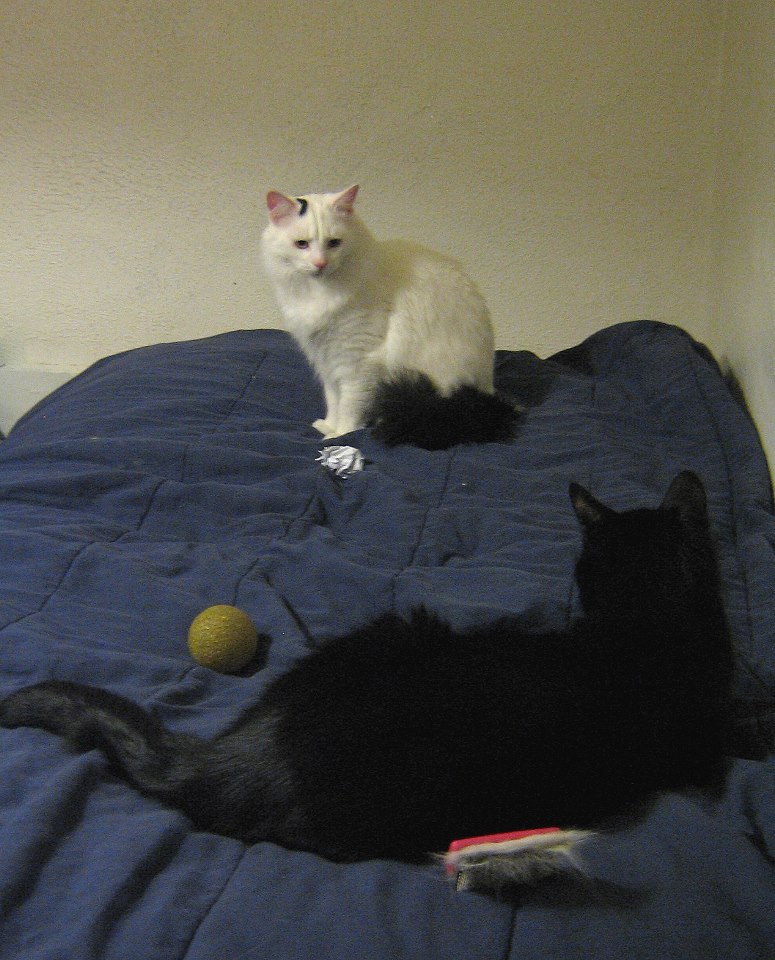
Within less than 48 hours, Sammy and Eli met. They sniffed each other's noses, Eli licked Sammy's cheek. They sat and observed each other calmly for several minutes and then they each seemed to shrug. Sammy headed over to a bowl to have a snack and Eli resumed batting around a wad paper. Within less than 72 hours, Eli had the run of the apartment and a little later that night both curled up with me on the bed to sleep. Less than two weeks later, I often come home from work to find them curled up alongside each other, heads or paws touching. Each has taken turns trying to entice the other to play. Although still skittish in some rooms, Eli is openly affectionate with us both and has been gradually making himself more and more at home, claiming various spots and sunbeams.


A little less than two weeks ago, my family -- Sammy's family -- got a little bigger. It's been less than three weeks and already it's hard to imagine what our home would be like not sharing it with Eli. If you have room in your own hearts and homes, won't you consider stopping by your local shelter this week to adopt one of the many cats and dogs waiting to be welcomed into your lives? If you simply cannot commit to an adoption at this time, consider fostering someone in need. At the very least, sign up to volunteer to lend a hand and to interact with your local shelter's many residents. Lives depend on it. They really, really do.

Friday, March 29, 2013

What's Extreme


That NPR Commentary by Barbara J. King


Anthropologist Barbara J. King is surprised. She wrote a short commentary for NPR yesterday about veganism ("Want to help animals? No vegan extremism is required"), weighing in on where to draw the line to qualify a vegan as an extremist. I mean, it's a really short commentary and variations on the word "extreme" show up a good half-dozen times to punctuate it. Her blurb begins by focusing on another NPR commentary written a few weeks ago, this one by Eliza Barclay and about a recently-published book called Veganissimo A to Z: A Comprehensive Guide to Identifying and Avoiding Ingredients of Animal Origin in Everyday Products.

Veganissimo as (Possible) Straw Man

Barclay's commentary ("Is your medicine vegan? Probably not") revolved mostly around how some vegans -- including one of the book's co-authors -- will actually risk their own lives by refusing to consume non-vegan medicines they need to survive. According to the book's press release, a copy of which I received (and promptly forgot about) back in early December, veganissimo is purportedly "a new word to describe someone who is as vegan as possible". According to the release, the book is mostly descriptive in that it provides the information about the prevalence and occurrence of animal ingredients in stuff (i.e. not just pharmaceuticals, but in food and other consumable products) for people to do with it what they will. Either Barclay decided to hyper-focus on the pharmaceuticals aspect of it, or perhaps the press release is vague on the book's actual slant and on its perhaps being prescriptive and persuasive. (I suspect the former, but have contacted the publisher and should be obtaining a review copy shortly to see for myself and to share the outcome with My Face Is on Fire readers. And don't get me started on this whole "new word for a variety of veganism" thing. I think I've made my position on that clear enough in the past.)

"There's No Such Thing as a Vegan"

So back to Barbara J. King's piece: She starts off talking about how "animal [people]" sometimes decide to alter their lifestyle choices to exclude different types of animal exploitation, sometimes doing so progressively until they reach a point where they decide to reject to consciously participate in animal exploitation altogether. She writes:
Now you're thinking about taking the next step: going vegan. You're ready to give up dairy and eggs. But something worries you. Can you ever be vegan enough?
Right there -- that. Every vegan has heard the lame argument brought up again and again by non-vegans -- or worse, by "former" vegans -- that there's really no such thing as veganism, since you simply cannot avoid all animal products: they're everywhere. This gets brought up -- often smugly -- as if to convey that deliberately choosing to go ahead and consume some animal products is morally OK, since you're going to end up using other animals on some level or another anyway. What's funny is that this is completely lost on King (who may very well not be vegan -- anyone know?), who tweeted her surprise several hours ago today that what she describes as her "pro-vegan" commentary is experiencing some "vegan backlash".

Matt Ball and His Unvegan Outreach

Of course, I had to take a peek at the particular blog post response to her piece which she cited as "vegan backlash". Albeit roughly written, some valid points are made in the post referenced on Of Course, Vegan. Veganism isn't extreme and it does a disservice to vegans and to non-vegans, who are more than ready to hear a clear vegan message, to blather on about where vegans should draw the line in terms of those areas where animal ingredients aren't, in fact, easily avoidable. The writer of Of Course, Vegan begins by showing a complete lack of understanding of Matt Ball's position on what it means to be an "extreme" vegan by describing him as having been "coerced" by King into "talking as if taking animal products is something that vegans should do". Anyone involved in serious vegan advocacy knows that Ball and his misnamed Vegan Outreach outfit certainly do not need to be coerced into loudly proclaiming that vegans should consume non-vegan things and engage in non-vegan animal advocacy. Ball repeatedly shames vegans who choose to avoid easily avoidable animal products in their food, accusing them of making veganism seem "too hard", and Vegan Outreach has become pretty publicly outspoken about vegan advocacy's asking too much of non-vegans. (Thankfully, Of Course, Vegan's writer did manage to see through Ball's illogical rubbish and commented on it.)

So King goes straight to Matt Ball (who shames vegans as being too extreme for 1) not consuming honey, 2) asking servers about ingredients in dishes on restaurant menus or for 3) being unequivocal in promoting veganism). In doing so, she ends up just regurgitating -- or at least perpetuating -- that same old "veganism is too hard" whine that's usually spewed out alongside the "veganism is extreme" whine of the many who want their occasional piece of cheese and to not have it pointed out that they didn't need it and that it wasn't theirs to take. She gives Ball a platform to do more of his usual shaming by quoting him repeatedly. For instance:
What we personally consume (especially at the margins) is almost irrelevant compared to what we can accomplish with thoughtful, honest advocacy for the animals. For example, influencing just one person to stop eating chickens and eggs — or even simply cutting back! — has an almost infinitely larger impact than if I avoid yet another obscure, miniscule animal product.
What my choosing to personally consume has to do with influencing "just one person to stop eating chickens and eggs", I have no idea. Ball seems to be saying that we need to stop being vegan to somehow accomplish more for other animals. This makes no sense whatsoever. None. King described her commentary on Twitter as being "pro-vegan", but it's not -- unless you consider "vegan" to involve occasionally indulging in a bowl of soup made with animal fat broth, stealing honey from bees and applauding others for shuffling a few animal products out of their diet while they continue to otherwise exploit other animals. King doesn't seem to get this, but in relying on Matt Ball as some sort of reasonable expert vegan voice, she pretty much set herself up to not "get it".

The Lo-Down on Basic Self-Preservation

Whether this book that triggered King's commentary actually encourages vegans to avoid taking life-saving medication is sort of beside the point. I mean, vegans encouraging other vegans to risk their lives is of course a form of inexcusable reckless shaming. If the book does indeed engage in that (and I'll find out when I get my review copy), its writers are crackpots. That line of argument is the same sort of absurd bunk that leads some to insist that if vegans really wanted to avoid exploiting other animals they shouldn't even eat plants, since growing plants involves displacing and killing other animals.

The bottom line is that there are medications we sometimes need to take which are derived from other animals, or that have at one point been tested on other animals -- medications for which there are no animal-free or animal-tested alternatives. Taking these to be healthy and to stay alive is certainly excusable. But doing so in no way adds weight to the argument (perpetuated by groups like Vegan Outreach) that there are times we should shrug off consuming or exploiting when it is possible for us to avoid doing so. Using Veganissimo as a lead in to bring in Matt Ball's slippery-sloped take on what should be considered "extreme" was confusing, wrongheaded and unfortunate.

The Lo-Down on Speciesism

What dragging Matt Ball into her commentary seems to have accomplished is to conflate a sort of viewpoint that is extreme (i.e. vegans might as well all become breatharians since the mere act of living seems to involve animal exploitation) with Matt Ball's twisted idea that actually earnestly rejecting animal exploitation and following through accordingly and authentically in our daily lives is also extreme. Ball seems to think that we should all throw in the towel and discard holding veganism as a moral baseline in our advocacy, since even though vegan education worked to persuade some of us to stop exploiting other animals, it somehow can't possibly be expected to make a difference in the rest of the world.

Someone like Ball considers it a victory for other animals if we can all just persuade a friend or family member to skip eating meat for one or two meals out of their average week. Actually addressing the underlying issue -- i.e. the prevalent speciesism in this world -- seems unthinkable to him. But the thing is that we're not going to shift the general population's mindset without striking at the root of the problem. We're not going to permanently change their hearts and minds about treating those sentient beings as things by giving someone a high-five if she shuffles out this or that form of animal use while otherwise continuing to use other animals. We're certainly not going to convey that we in any way take the rights of other animals seriously if we giggle and shrug, then gobble up a non-vegan dish with gusto alongside them.

If Matt Ball believes that punching toddlers is wrong, would he suggest to us that we should give a parent a big old hug for agreeing to not punch their toddler one day a week? Would he expect us to  call it a victory for toddlers? Would he not agree that what we would need to do is convince those abusive parents that punching toddlers is wrong in and of itself since toddlers shouldn't be punched at all? So why settle for less with other animals and ignore that it's the underlying speciesism guiding non-vegans' behaviour that needs to be addressed in our advocacy?

So if Barbara J. King is surprised that there would be any sort of "backlash" to her article, maybe she needs to re-examine her understanding of what it means to be vegan. At the very least, she should have done her research before weaving Matt Ball's shaming of ordinary old vegans into her commentary and using a straw man to launch into what she claims is a pro-vegan piece. Far from being pro-vegan, it's just more of the same speciesist fodder from the overwhelmingly and sadly speciesist mainstream media.

Vegan Eats in Washington, DC

I've spent a surprisingly large amount of time in the DC area in the last two months: a total of around 25 days. I hadn't realized just how many days had actually added up until just a few minutes ago. My first visit there in January was my first ever to the area and my introduction to it was both gentle and thrilling. There will be gratuitous tourist shots in blog posts in the coming weeks. Over the next few days, however, I hope to stay more focused and share with you the crazy variety of beautiful and scrumptious food I got to enjoy during my stay in North Virginia (NoVA to many locals) and frequent visits into the towns and cities nearby. Although conservative with my borrowed camera during my first stint there, I hauled it out more often earlier this month to snap photos, sometimes to the quiet sighs of my hungry host, who sat waiting patiently.

Devouring the pizza with his blue peepers.
DC has some pretty vegan-friendly places to eat. One experience which was new to me was having the opportunity presented to eat vegan pizza at a number of different regular pizzerias, where they will happily top your pie with Daiya. (At least one place will apparently sprinkle on Daiya if you bring it in yourself, which is sort of silly, particularly if they charge you the same as they would charge for a pie covered in dairy cheese.) Pete's New Haven Apizza (aka Pete's Apizza) was a spot which Gary had wanted to try out, so after a day spent Smithsonian museum hopping, we drove over to its Columbia Heights location and ordered "The Green" -- artichoke hearts, sauteed spinach, oven-dried tomatoes and kalamata olives on a thin crusted pie with delicious rich and tangy oregano-scented sauce and a generous pile of mozza Daiya. It was a little pricey, but quite yummy and a treat for me, since "cheesy" vegan pizza back home in nowheresville Canada is solely concocted in my own kitchen.
A closer look.
For dessert, we drove over to Sticky Fingers on a quest for Cake-in-a-Cup or cheesecake, but were disappointed to find the display case mostly filled up with cookies and a few cupcakes. We watched a customer order what seemed to be the last sticky bun and then Gary piped up and asked if there were more. Lo and behold, a tray was brought out and we indulged. They were enormous and wonderful. I do really like this spot for sweets (don't get me started on their over-priced and bland "regular food" menu), but it doesn't compare to to the bliss that was visiting Vegan Treats in Bethlehem, PA, whose cheesecake nearly made me cry from happiness a few years ago. (No surprise that their products are even shipped in from PA to a few vegan-friendly restaurants in DC and NoVA.) Sticky Fingers is a hopping little spot with a lot of character, though; I'd gladly visit it again for a sweet treat.


There are two things that are certain when you're visiting the DC area. One is that it has the highest number of Ethiopian restaurants per capita in North America. The other is that those Ethiopian restaurants will offer up a fair number of vegan-friendly dishes. I visited one spot in NoVA during my first visit -- I can't find the photos and don't remember the name of the place. It was diner-like and Gary claimed that the food was so-so and super, super greasy. It was still sort of neat to me, since I'd never had Ethiopian food before. This last visit, though, we went to Ethiopic, a new-ish place with a relaxed atmosphere, enjoyable music, stellar service and decent prices. It got Gary's nod of approval for its fare, which was truly delicious.

Waiting patiently for the food itself this time.
There were two vegetarian sampler platters on the menu and both were priced reasonably. We chose the one with the most options. In the photo below, from the bottom left going counter-clockwise are dinich wot (a mild curried potato dish), shimbra asa wot (spicy chickpea dumpling stew), tikile gomen (a mild potato, cabbage and carrot dish), miser wot (spicy split lentils), kik aletcha (mild yellow split peas), fosalia (Gary's favourite, caramelized green beans, onions and carrots mixed with jalapeno peppers) and gomen (mild simmered collard greens). In the center was a spicy tomato salad, which provided a nice change in texture. The basket of injera, as is the norm in these places, was bottomless.
Way too much food for two hungry vegans to finish off in one sitting.

I can't write a post about eating vegan in DC without bringing up one of the few actual vegan restaurants I got to check out on my trips. Everlasting Life was my intro to vegan "soul food". During my visit in January, I got to try their "ribs" and fried "chicken" and a variety of their salads. A few weeks ago, we went in looking to indulge in their brunch offerings. It was late in the day and since I'm not generally a fan of pancakes or waffles, I loaded up on their sausages, mac and "cheese", roasted potatoes and garlicky kale. Gary, with obviously much more brunchy inclinations, switched out the kale for tofu scramble. The sausages -- some sort of tasty homemade seitan -- were incredible, as all meat subs I've tried at Everlasting Life have been. The mac and cheese of which I've heard so much really hit the "comfort food" spot, and as an unapologetic kale addict I was left pretty damn happy munching away on my greens.

Good eats.
Everlasting Life's an interesting spot. You walk in and through the dining area and all the way down a small corridor to the back where you pick hot and/or cold dishes available to build up a personalized plate on a tray, sort of cafeteria-style. They have specific main hot entrees each day of the week. It's a small room and when busy, it can get a little clogged and confusing in there -- something I experienced back in January after an afternoon getting jostled at . You then head back out to pay with the option of purchasing a bottled beverage or freshly-made juice. On both my visits, I've gotten the Roots Tonic, a drink made of carrots, beets and ginger that's left me determined to buy a good juicer.

To the food fetching area.
The juice bar.
Slowly-sipped gingery goodness.
I'm missing a few odds and ends and completely omitting a visit to a DC Busboys and Poets location during my January visit. There I had the best vegan nachos I've eaten since my visit to Saturn Cafe in Berkeley, CA last year (which I don't think I ended up reviewing, either). Maybe a post on vegan nachos -- and homage to them! -- is in order in the near future? At the very least, over the next few days, I'll be sharing photos from visits to other restaurants in the area outside DC itself and writing more about the vegan-friendliness of urban area.

Wednesday, March 20, 2013

Missed Goodbyes


I've written about Zeus several times before, most recently when serious issues arose with his health a few years back. He's the beautiful boy in my arms in the profile photo for this blog. When I first met him almost thirteen years ago, he was one of two runt kittens fostered by friends of a good friend. Their mother had apparently been found pregnant and starving in an apartment whose tenants had left. Zeus and his sister Sophie were born shortly after they were taken in by the shelter and once I met them, tiny balls of furry energy that they were, I knew we would end up sharing each other's lives for a spell.


Zeus eventually developed the same asthma that led to his sister's death in August of last year. As with Sophie, quality of life became a constant concern. The neighbourhood pharmacist knew them both by name. They were his first ever feline "customers" with their prescriptions for the inhaled corticosteroids and bronchodilators they both eventually needed to breathe. Both Zeus and Sophie's asthma seemed triggered by food allergies, but as time wore on, other triggers factored in. My home became scent-free years ago. The search for the perfect dust- and scent-free litter left me constantly exploring new products. Different foods where shuffled in or out whenever symptoms worsened. I learned to sleep lightly, sensitive to the sound of wheezing that meant someone needed urgent help; I learned to deal with the constant anxious gnawing of the fear that such an attack might occur if I was at work, at the store or elsewhere.

That same anxious gnawing left me hesitant a few weeks ago when I planned a return trip to the DC area to spend time with a human love. For the first time in my life, I hired a cat-sitter, hoping that in tandem with visits from a friend, someone would be around as much as possible to keep an eye on my feline loves and to ensure that Zeus' medications were administered regularly to mitigate any possible issues.
 
Eight days into my trip, a worried cat-mom's worst nightmare occurred. A friend just happened to drop by on a Friday afternoon and found Zeus in respiratory distress. She rushed him to his vet's where the clinic promptly took him in and then refused to deal with her since she wasn't listed with them as a contact. I'd forgotten to have her added. Worse was that I was stranded at my host's landline-free apartment, my Luddite self without a cell phone. My friend messaged me on Facebook to urge me to find a way to call the vet immediately and after a few frantic emails to my American host (who was at work), phone access was obtained and I was patched through and told that his condition was quite bad and that his prognosis with treatment was incredibly poor.

Zeus had suffered a pleural effusion. Fluid had filled up his chest cavity and by the time my friend found him that afternoon, he was already in seriously bad shape. It was unrelated to the asthma and the vet assured me that its onset is almost always sudden and an emergency, its symptoms manifesting similarly to those of asthma."You wouldn't have been able to have done anything differently had you been there," the vet reassured me. Worse, I would have been at work that afternoon and would not have found him until hours later. The staff at SouthPaw did all they reasonably could and I'm grateful that they were able and willing to look after him when he was brought in.


Zeus' suffering was brought to an end shortly after I called, my friend returning to be with him during his last moments. My heart broke from hundreds of miles away, my arms unable to hold him, to comfort him, to whisper to him how dearly I loved him and to tell him how sorry I was that I'd left. Since kitten-hood, Zeus had always expressed a preference for climbing up to my left shoulder, pressing his head against my neck as I held him to my heart. So many evenings when I've sat here at my desk typing, it's been one-handed with Zeus' warmth against me, listening to his reassuring purrs as he snuggled in more closely. Even now, I remember precisely how it felt to hold him. Sammy and I both miss him, each of us wondering where he is -- where he went.

Monday, March 04, 2013

Hey Lardass?


A few weeks ago, I had someone misinterpret something I had written in a vegan group email exchange. (Yes, I know: OMG! Something was misunderstood on the internet!) I'd cracked a pathetic joke about your average non-vegan man probably relatively packing away more animal products than your average non-vegan Hollywood starlet (i.e. strictly by virtue of their relative overall food consumption). I'm only ever accidentally funny, so it didn't surprise me that the attempt at lightheartedness fell flat. What did surprise me, however, was when someone took off on a tangent, pointing out to me that veganism and weight are unrelated (I had not suggested otherwise -- we'd been discussing two non-vegans). This somehow led to someone else's mentioning overweight vegan friends in a manner that conveyed that he was assuming the previous person's response had indeed been to my perhaps having suggested that non-vegans weigh more than vegans.

The funny thing about that is that I'm usually the first person who will pipe up to object when vegans sometimes lapse into diatribes about the supposed chronic obesity of those who consume animal products, or worse, who insist that going vegan will invariably lead to a 20-50 lb weight-loss. Not only have years gabbing it up online with other vegans shown me that this is in no way "invariable", but I can speak from experience about it. You see, I'm one of those vegans who didn't lose 10-50 lbs upon going vegan. Nope, I am one of those people who went vegan and actually gained weight. After years mired in my vegetarianism, though, I hadn't gone vegan for health reasons. Some friends and family members assumed as much, since my going vegan coincided with the death of my father following his short battle with cancer. And although at the time I certainly wasn't skinny, I most certainly hadn't gone vegan to lose weight. I'd gone vegan for ethical reasons, because a clear vegan message had left me unable to do anything but permanently connect the dots and make immediate (and permanent) changes to my overall life habits. Wandering into my late thirties may have been a contributing factor. An official "bum thyroid" diagnosis just a few years earlier may not have helped. Starting an office job where I sometimes work 10+ hours a day glued to my desk? Sure. The bottom line is that veganism was no panacea for the weight I ended up gaining.

I was left with it, internalizing comments and advice from friends, coworkers, family and romantic interests who made it a point to let me know that the weight gain had been noticed or that the weight gain was deemed unattractive. Eat less, exercise more. That's what the first person I dated after a lengthy years-long relationship's break-up advised on our first (and last) date. So I ate less. I counted calories for the first time in my life, shuffled a lot more raw fruits and vegetables into my diet and would juice for several days a month. I counted calories to the point of spending most of my day tracking every single thing going into my mouth. We're talking hours of plugging ingredients into online databases, or of crunching numbers factoring in the nutritional information on the backs of cans of food. Hell, I spent so much time crunching numbers that I had little time to eat -- or even exercise! Further disincentive to eating came from knowing I'd eventually have to spend an hour documenting a salad it might have taken me a mere 20 minutes to make and eat. I bought a bike and used it daily. I actually lost a lot of the weight... and when I went back to eating ordinary vegan meals, a lot of it just came right back. Life went on. The raw fruits and vegetables were reincorporated into my diet, albeit to a lesser extent during the long cold off-season months when a small head of romaine lettuce can cost as much as $4 at one of the local supermarkets. I kept bicycling. I kept working, blogging, dating -- basically living and loving, but no longer counting calories. I still found myself -- still find myself -- perpetually aware of my shell, even more so than I do of my perpetually over-thinking, introverted and existentialist inner-self. And although I no longer count calories, I still watch what I eat every single day, as if each and every item I put on my plate could possibly amplify that miserable hyper-awareness I've developed of my shell.

It was a strange experience to have found myself dealing with what became an almost painfully raw self-consciousness about my body -- whether of how I moved or how much space I occupied, and of how others around me observed me and judged me at the time. I'd grown up with a family member with body dysmorphic disorders and had a roommate in college who'd suffered from anorexia. As a child, I'd always felt awkwardness watching my mother pick at her food during bikini season and over having anyone and everyone constantly fawning over my older sister's "petiteness" at 93-95 lbs up into her teenage years, and in college I'd watched my roommate leave behind her a trail of broken-hearted college boys. I always felt that I was an observer and that I somehow managed to keep my emotional distance relatively unscathed. Let's face it, though: We live in a society which, if we cannot admit glorifies thinness, we can at least admit vilifies not-thinness and does so particularly with girls and women. I've watched my sister refuse to eat, heard my college roommate regurgitating her meals, have listened to my size 2 coworker verbalize the loathing she has for her rear (which she refers to as "Lardass", her purported "dating nemesis").

One of my own last relationships was with someone who constantly criticized how much I ate at the table, not because I ate too much around him (I didn't -- I was uncomfortable eating anything at all around him), but because he felt I should eat a lot less to bring my weight down to something comparable to that of his lifelong-thin marathon runner ex-wife's. He used the word "fat" as a weapon in arguments, but then it's hard not to think of the word as a weapon when it's used by anyone who isn't. And as someone who's well aware that she would still not be described as "thin" if she lost 20 lbs, hearing the word tossed around by loved ones -- family, friends, lovers -- invariably leaves me feeling as if that weapon is pointed directly at me. I've been in relationships with other men who've either referred to themselves with disgust as "fat" and who've fingered other women in public as such with equal amounts of disgust. It's no unless unnerving to see that weapon pointed at another.

This same body size fixation seems to permeate vegan circles but with a twist, since it's almost always tied to criticism of non-vegans. Even now, after years of observing it, it still sometimes astonishes me to see or hear the derision with which some vegans rant about omnivorism (non-veganism, really) and obesity, as if the two are inextricably linked. Aside from the ridiculousness of vilifying non-vegans when most of us who are vegan now once-upon-a-time weren't, and when most of us have loved ones who are non-vegan, it's jarring to hear people who concern themselves with others speciesism linking speciesism with a sort of discrimination which, more often than not, is wrapped in sexism or misogyny. It's also ridiculous since far from all vegans are thin and, as I've both seen and experienced, veganism is in no way guaranteed to lead to weight-loss. Less saturated fat? Possibly? Less bad cholesterol? Sure? But less calories? A more efficient metabolism? Nope. It's not in and of itself a 100% guaranteed panacea.

Aside from being off-the-mark in terms of the assumptions it carries with it, this vilification by some vegans of the overweight thus leads to a shaming of overweight vegans. Whether or not that shaming is inadvertent is irrelevant. Isn't it enough that vegans walk around expected by non-vegans to be exemplars in terms of having super-powered immune systems (e.g. if you get the sniffles, it's because you don't eat steak). Do we now need to drag body image into the equation when thinness is no more the vegan default than being overweight is for non-vegan omnis? What vegans should have in common is a rejection of animal exploitation. What abolitionist vegans should have in common is the rejection of speciesism and of other forms of discrimination. What sort of sense of community are we fostering as vegans when we perpetuate the wrongheaded belief that eating animal products = being fat, while not eating animal products = being thin? Also, what sort of message are we sending to young girls who choosing to reject speciesism and who find themselves teetering on the edges of a vegan community that tosses at them the same old body loathing messages they're already hearing from society? What are we reinforcing? Think about it.